
Per amor di lei
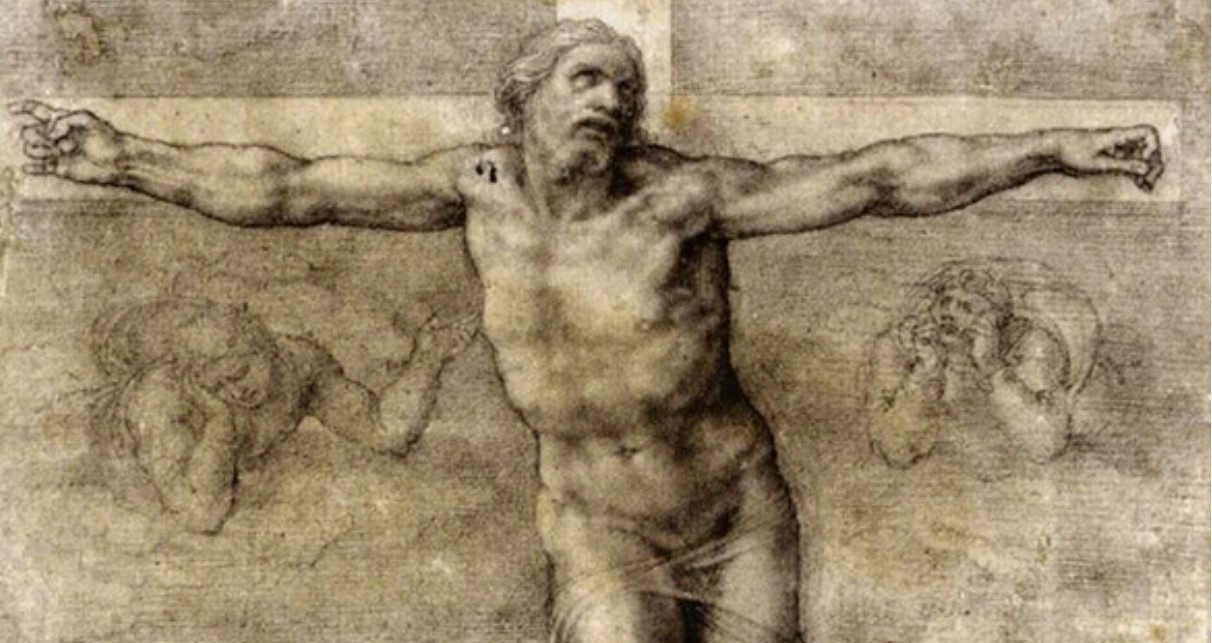
“Fece anco per amor di lei un disegno d’un Giesù Christo in croce, non in sembianza di morto, come communemente s’usa, ma in atto di vivo, col volto levato al padre, et par che dica: “Heli heli”; dove si vede quel corpo non come morto abandonato cascare, ma come vivo, per l’acerbo supplizio risentirsi e scontorcersi”, scrisse il Condivi narrando la vita mia nel 1553.
La descrizione del Cristo vivo in Croce, corrisponde al disegno custodito al British Museum di Londra.
egalai con grande piacere quel foglio alla mia carissima amica Vittoria Colonna, raffinata poetessa e donna Rdi grande cultura tanto che papa Paolo III Farnese teneva in grande considerazione i suoi pensieri.
“Amò grandemente la Marchesana di Pescara, del cui divino spirito era inamorato, essendo all’incontro da lei amato svisceratamente; della quale ancor tiene molte lettere, d’onesto e dolcissimo amore ripiene, e quali di tal petto uscir solevano, avendo egli altresì scritto a lei più e più sonetti, pieni d’ingegno e dolce desiderio”.
Purtroppo di quelle molte lettere poche sono sopravvissute fino ai vostri giorni e non è da escludere che fui io stesso a darle alle fiamme prima di passare a miglior vita.
Ero attratto dal suo intelletto e non sapevo e nemmeno volevo resistere al suo carisma così seduttivo.
Vi posso dire che anche lei però ricambiava quel sentimento così forte e nutriva nei miei confronti stima e un’amore incondizionati. Sempre il Condivi narra che Vittoria Colonna più volte partì da Viterbo o da altri luoghi dove si trovava nel periodo estivo per venire a trovarmi a Roma.
Quando ricevette il disegno con il Crocifisso vivo in croce rimase estasiata da quel mio lavoro e volle ringraziarmi scrivendo parole struggenti:
“Unico maestro Michelagnelo et mio singularissimo amico. Ho hauta la vostra et visto il crucifixo, il qual certamente ha crucifixe nella memoria mia quale altri picture viddi mai, nè se pò veder più ben fatta, più viva et più finita imagine et certo io non potrei mai explicar quanto sottilmente et mirabilmente è fatta, per il che ho risoluta de non volerlo di man d’altri, et però chiaritemi, se questo è d’altri, patientia. Se è vostro, io in ogni modo vel torrei, ma in caso che non sia vostro et vogliate farlo fare a quel vostro, ci parlaremo prima, perché cognoscendo io la dificultà che ce è di imitarlo, più presto mi resolvo che colui faccia un’altra cosa che questa; ma se è il vostro questo, habbiate patientia che non son per tornarlo più. Io l’ho ben visto al lume et col vetro et col specchio, et non viddi mai la più finita cosa.
Son al comandamento vostro,
La Marchesa di Pescara
Il ‘vostro’ citato nella lettera non è altro che Marcello Venusti al quale la Colonna riconosce un’ottima mano tanto da renderle difficile comprendere se un’opera possa essere mia o sua.
Rileggete la parte finale della lettera nella quale Vittoria scrisse che se il Crocifisso fosse di mano mia, non sarebbe intenzionata a restituirmelo.
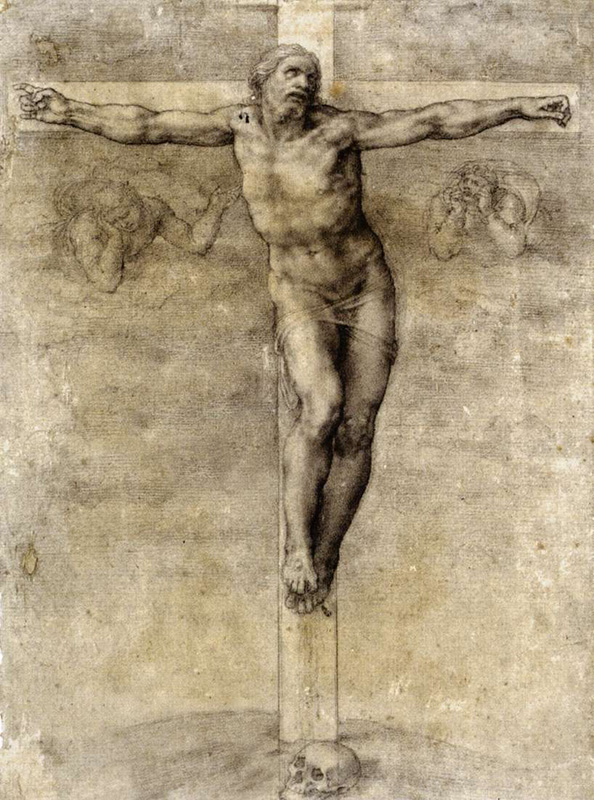
Molto si è discusso e dibattuto sul Crocifisso descritto nella lettera in questione e si continua a dibattere se sia proprio quello del foglio del British Museum, una scultura oppure una pittura avente lo stesso soggetto.
Il Condivi rimane vago sulla natura dell’oggetto mentre sembra essere più specifico il Vasari, a patto che si tratti dello stesso lavoro tirato in ballo: “E le disegnò Michelagnolo… un Cristo confitto in croce, che alzato la testa, raccomanda lo spirito al Padre: cosa divina”.
Quel Cristo vivo in Croce che tanto fece scalpore, come scrisse il Condivi lo disegnai per amor di lei. Con lo sguardo rivolto verso l’alto sembra stia interpellando il padre chiedendogli “Elì Elì Memà Sabactani”, Dio mio, Dio mio perché mi hai abbandonato.
Quel mio lavoro in poco tempo divenne molto noto in tutta Europa. sua conoscenza s’era diffusa attraverso incisioni e riproduzioni ma, papa Paolo IV Carafa, lo considerò veicolo della divulgazione luterana in Italia. Insomma, ai suoi occhi era un Cristo eretico. Follia.
Nell’agosto del 1556, papa Paolo IV Carafa, con una specifica bolla, proibì categoricamente la rappresentazione del Cristo vivo in croce e il mio disegno così come le sue copie, divennero fuorilegge.
Per il momento il sempre vostro Michelangelo Buonarroti vi saluta dandovi appuntamento ai prossimi post e sui social.
For her sake
“He also made for her a drawing of a Jesus Christ on the cross, not in the guise of a dead man, as is commonly done, but in the act of a living man, with his face raised to his father, and he seems to say: “Heli heli”; where that body is seen not as if abandoned dead falling, but as if alive, resentful and contorted by the bitter torture”, wrote Condivi narrating my life in 1553.
The description of the living Christ on the cross corresponds to the drawing kept at the British Museum in London. I gave that sheet with great pleasure to my dear friend Vittoria Colonna, a refined poet and a woman of great culture, so much so that Pope Paul III Farnese held her thoughts in high regard.
“He greatly loved the Marchesana of Pescara, with whose divine spirit he was in love, being in turn loved by her passionately; of which he still has many letters, filled with honest and sweetest love, and which used to come from that breast, having also written to her many and many sonnets, full of wit and sweet desire”. Unfortunately, of those many letters, few have survived to your days and it cannot be excluded that I myself set them on fire before passing away.
I was attracted by her intellect and did not know and did not even want to resist her very seductive charisma.
I can tell you that she also reciprocated that strong feeling and had unconditional esteem and love for me. Condivi also tells that Vittoria Colonna left Viterbo or other places where she was during the summer period several times to come and visit me in Rome.
When she received the drawing with the living Crucifix on the cross, she was ecstatic about my work and wanted to thank me by writing heartbreaking words:
“The only master Michelangelo and my most singular friend. I have yours and seen the crucifix, which certainly has crucified in my memory what other picture I have ever seen, nor can one see a more well done, more alive and more finished image and certainly I could never explain how subtly and wonderfully it is made, for which I have resolved not to want it from the hands of others, and therefore explain to me, if this is from others, patience. If it is yours, I would take it from you in any case, but in case it is not yours and you want to have it done by your own, we will speak first, because knowing the difficulty there is in imitating it, I resolve more quickly that he do something other than this; but if this is yours, have patience because I am not going to return it again. I have seen it well in the light and with the glass and with the mirror, and I have never seen a more finished thing.
I am at your command,
The Marchioness of Pescara
The ‘your’ mentioned in the letter is none other than Marcello Venusti, to whom Colonna recognizes an excellent hand, so much so that it is difficult for her to understand whether a work could be mine or his.
Reread the final part of the letter in which Vittoria writes that if the Crucifix is by my hand, she will not be willing to return it to me.
Much has been discussed about the Crucifix described in the letter in question and there has been, and continues to be, debate as to whether it is the one on the British Museum sheet, a sculpture or a painting with the same subject.
Condivi remains vague on the nature of the object in question, while Vasari seems to be more specific, provided that it is the same work mentioned: “And Michelangelo drew them… a Christ nailed to the cross, who, raising his head, commends his spirit to the Father: a divine thing”.
That living Christ on the Cross that caused such a stir, as Condivi wrote, I drew it for love of her. With his gaze turned upwards he seems to be questioning his father, asking him “Elì Elì Memà Sabactani”, My God, my God why have you abandoned me.
That work of mine quickly became very well known throughout Europe. Knowledge of it had spread through engravings and reproductions but Pope Paul IV Carafa considered it a vehicle for Lutheran dissemination in Italy. In short, in his eyes it was a heretical Christ. Madness.
In August 1556, Pope Paul IV Carafa, with a specific papal bull, categorically prohibited the representation of the living Christ on the cross and my drawing, as well as its copies, became illegal.
For the moment, yours truly Michelangelo Buonarroti bids you farewell, making an appointment for the next posts and on social media.

Sostienici – Support Us
Se questo blog ti piace e ti appassiona, puoi aiutarci a farlo crescere sempre più sostenendoci in modo concreto condividendo i post, seguendo le pagine social e con un contributo che ci aiuta ad andare avanti con il nostro lavoro di divulgazione. . ENGLISH: If you like and are passionate about this blog, you can help us make it grow more and more by supporting us in a concrete way by sharing posts, following social pages and with a contribution that helps us to move forward with our dissemination work.
10,00 €
Condividi:


Questo sono io





sostienici

Sostienici – Support Us
Se questo blog ti piace e ti appassiona, puoi aiutarci a farlo crescere sempre più sostenendoci in modo concreto condividendo i post, seguendo le pagine social e con un contributo che ci aiuta ad andare avanti con il nostro lavoro di divulgazione. . ENGLISH: If you like and are passionate about this blog, you can help us make it grow more and more by supporting us in a concrete way by sharing posts, following social pages and with a contribution that helps us to move forward with our dissemination work.
€10,00


