

Cappella Brancacci: il punto della situazione sul restauro
Inizia nella Cappella Brancacci la seconda fase del restauro.
Proseguono le operazioni di monitoraggio, studio e restauro conservativo nella preziosa cappella affrescata da Masolino, Masaccio e Lippi della chiesa del Carmine, facente parte dei Musei Civici fiorentini e di proprietà del Fondo Edifici di Culto del Ministero dell’Interno.
Nel cantiere aperto al pubblico quattro giorni a settimana, sono stati effettuati ulteriori approfondimenti diagnostici per individuare le tecniche esecutive, i materiali adoperati e per analizzare le cause di degrado con lo scopo di migliorare le condizioni di conservazione della Cappella Brancacci.

I lavori si protrarranno fino al termine del 2023 grazie al fondamentale supporto economico della fondazione Friends of Florence e la Jay Pritzker Fund che hanno appena stipulato un nuovo protocollo con l’amministrazione comunale, contenuto in una delibera approvata dalla Giunta su proposta della vicesindaca e assessora alla Cultura Alessia Bettini, per finanziare le operazioni.
“Sulla Cappella Brancacci al Carmine continueranno a lavorare esperti restauratori, diagnosti, storici dell’arte e ricercatori. Il progetto di ricerca, nato su iniziativa della Soprintendenza e del Comune di Firenze, è stato possibile grazie al sostegno di Friends of Florence, che colgo l’occasione di ringraziare. Gli esiti della prima fase conclusasi a giugno hanno incoraggiato a proseguire rinnovando gli impegni reciproci. Inizia la seconda fase di ricerche e indagini: un’occasione imperdibile. Salire sui ponteggi della cappella, permette una visione ravvicinata dei mirabili affreschi che hanno segnato un passaggio fondamentale dell’arte visiva del Quattrocento: a tu per tu con l’adorato Masaccio, ma anche a tu per tu con la Firenze del Quattrocento, qui ritratta, con l’opera di Masolino e poi con il completamento di Filippino Lippi. Se tanto è stato scritto sulla Cappella Brancacci, nuovi strumenti si offrono per approfondire le conoscenze sulle tecniche, la composizione dei colori, sui pentimenti e gli elementi perduti fino a monitorare lo stato di salute degli affreschi. Ed è quello che ci aspettiamo.”
– Afferma la Soprintendente Antonella Ranaldi –

Cappella Brancacci: i lavori della prima fase
L’ultimo restauro della Brancacci, prima di quello attualmente in corso, risaliva agli anni Ottanta del Novecento.
Nel novembre 2020 la cappella è stata sottoposta a un primo monitoraggio che mise in luce alcune criticità dal punto di vista della conservazione e la necessità di stabilizzare alcuni potenziali fenomeni di deterioramento presenti sui dipinti murali di Masolino, Masaccio e Filippino Lippi quali i distacchi dell’intonaco, localizzate perdite di coesione e depositi superficiali incoerenti, oltre ad eseguire un generale controllo sulla stabilità dell’intero ciclo pittorico.
Grazie al cantiere già montato nella prima fase di lavoro è stato possibile svolgere una nuova campagna diagnostica a cura del Cnr-Ispc, più approfondita ed esaustiva di quella svolta negli anni Ottanta del Novecento, condotta con le più aggiornate tecniche e le migliori competenze disponibili sul panorama internazionale grazie alla collaborazione tra SABAP, Cnr-Ispc, UNIFI e OPD a cui spetta la progettazione e realizzazione dell’intervento conservativo vero e proprio.
Le tecniche utilizzate non invasive hanno permesso di conoscere approfonditamente i materiali utilizzati, le tecniche esecutive, le fenomenologie di alterazione o degrado e le cause che le hanno prodotte, informazioni indispensabili per una corretta pianificazione dell’intervento. Alla campagna diagnostica si è affiancato un modello per il monitoraggio di apparati decorativi complessi.
Il rilievo dello stato di conservazione si è concentrato particolarmente sull’analisi dei distacchi di intonaco, che rappresentava il fenomeno più preoccupante e su cui intervenire con più urgenza.
Le porzioni di intonaco classificate nel livello più grave sono state messe in sicurezza dai tecnici dell’Opificio delle Pietre Dure. È stato poi avviato un progetto, sempre in collaborazione con Cnr-Ispc, UNIFI, OPD e SABAP, per valutare le caratteristiche della malta impiegata nel precedente intervento, con l’obiettivo di stabilizzare i distacchi di intonaco.
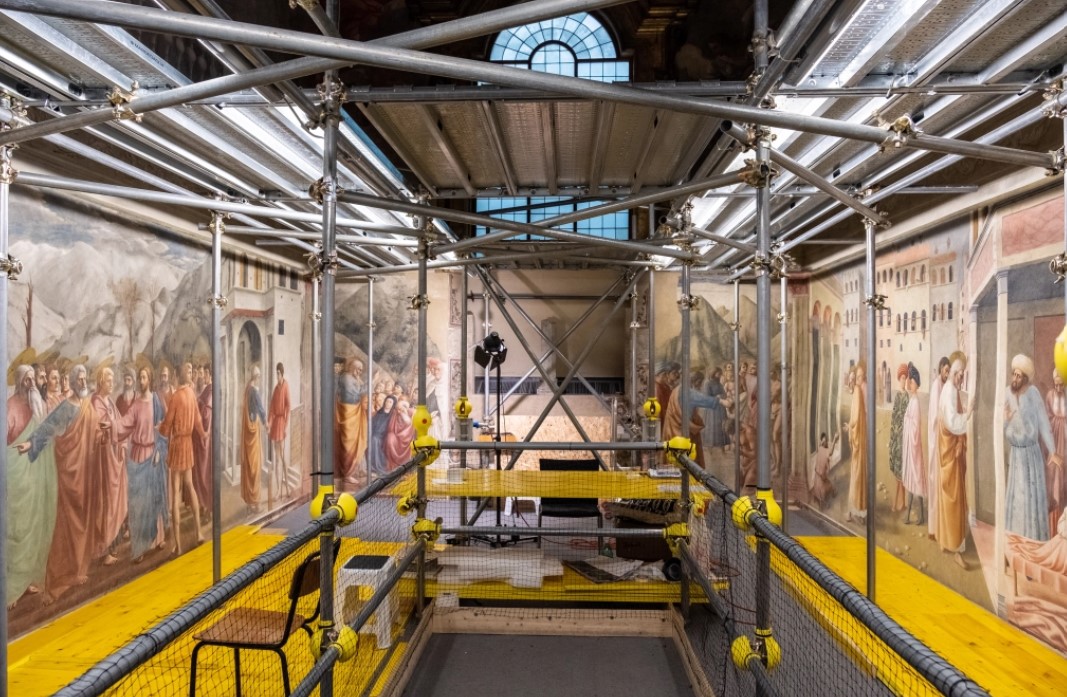
Cappella Bancacci: le novità della seconda fase del restauro
Grazie ai risultati emersi nella prima fase, nella seconda parte sarà possibile sperimentare l’applicazione delle malte compatibili con l’intonaco che, a partire da quelle utilizzate nell’intervento eseguito negli anni Ottanta e studiate nella prima tranche di lavoro, sono state riformulate, e che potranno essere impiegate nei consolidamenti delle parti di affreschi a rischio di distacco come nelle porzioni della scena dei due miracoli intitolate rispettivamente San Pietro che risana lo storpio e il Miracolo di Tabitha, entrambe dipinte da Masolino.
Inoltre questa seconda fase di lavori consentirà di eseguire prove di pulitura sperimentando un gel innovativo formulato da ricercatori del CSGI presso il Dipartimento di Chimica dell’Università di Firenze, che permetterebbe di eseguire la pulitura delle superfici dipinte con maggiore facilità, senza effettuare un vero e proprio restauro, anche durante le campagne di manutenzione che il Comune di Firenze programmerà negli anni a venire.
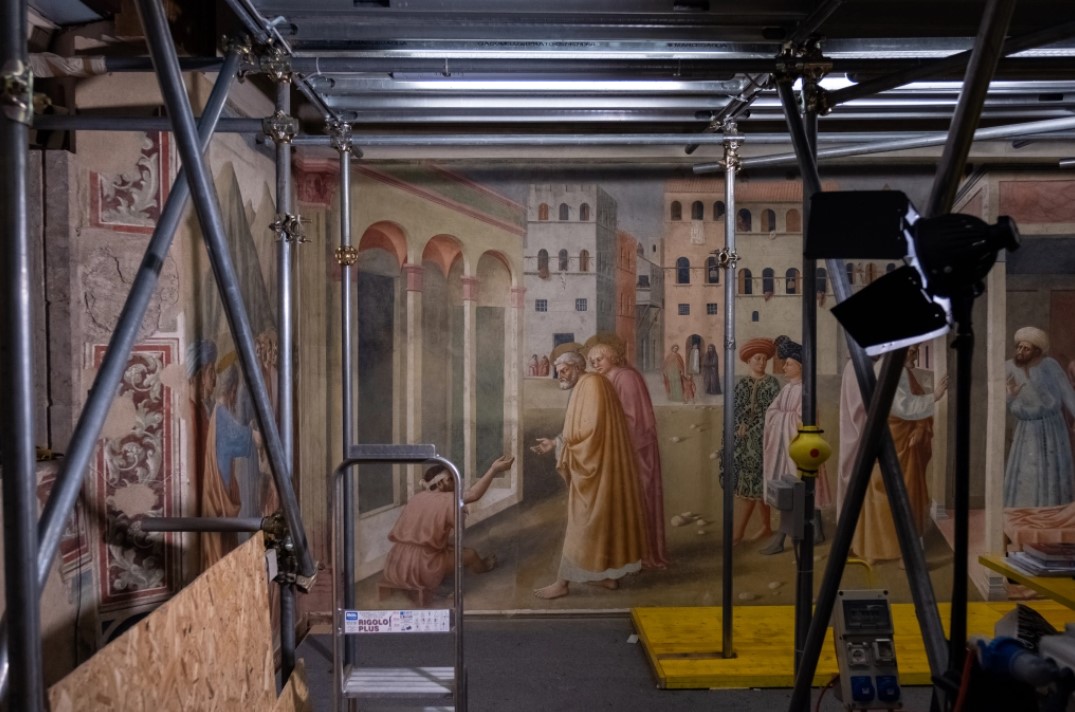
Visite a cantiere aperto nella Cappella Brancacci
La Cappella Brancacci è aperta al pubblico il venerdì, sabato, lunedì: orario 10-17; domenica orario 13-17.
Per ragioni di sicurezza gli accessi sono con prenotazione obbligatoria e non oltre 10 persone ogni 30 minuti. Visite guidate a cura di MUS.E: Lunedì – venerdì e sabato ore 10.00-11.00-12.00-13.30-14.30-15.30 – Domenica 13.30-14.30-15.30.
Per prenotare: 0552768224, bigliettimusei@comune.fi.it o cappellabrancacci@musefirenze.it. Martedì, mercoledì e giovedì resta chiusa al pubblico per consentire le attività di diagnostica che richiedono assenza di pubblico.

Per il momento il vostro Michelangelo Buonarroti vi saluta dandovi appuntamento ai prossimi post e suo social.
Brancacci Chapel: the state of the art on the restoration
The second phase of the restoration begins in the Brancacci Chapel.
The monitoring, study and conservative restoration operations continue in the precious chapel frescoed by Masolino, Masaccio and Lippi of the Carmine church, which is part of the Florentine Civic Museums and owned by the Fondo Edifici di Culto of the Ministry of the Interior.
In the construction site open to the public four days a week, further diagnostic investigations were carried out to identify the executive techniques, the materials used and to analyze the causes of deterioration with the aim of improving the conservation conditions of the Brancacci Chapel.
The works will continue until the end of 2023 thanks to the fundamental economic support of the Friends of Florence foundation and the Jay Pritzker Fund which have just signed a new protocol with the municipal administration, contained in a resolution approved by the council on the proposal of the deputy mayor and councilor to Cultura Alessia Bettini, to finance the operations.
“Expert restorers, diagnosticians, art historians and researchers will continue to work on the Brancacci al Carmine Chapel. The research project, born on the initiative of the Superintendency and the Municipality of Florence, was possible thanks to the support of Friends of Florence, which I take this opportunity to thank. The results of the first phase which ended in June have encouraged us to continue by renewing our mutual commitments. The second phase of research and investigations begins: an unmissable opportunity. Climbing the scaffolding of the chapel allows a close-up view of the admirable frescoes that marked a fundamental passage in the visual art of the fifteenth century: face to face with the adored Masaccio, but also face to face with fifteenth century Florence, portrayed here , with the work of Masolino and then with the completion of Filippino Lippi. If so much has been written about the Brancacci Chapel, new tools are being offered to deepen knowledge of the techniques, the composition of the colours, the repentances and the lost elements up to monitoring the state of health of the frescoes. And that’s what we expect.”
– Says Superintendent Antonella Ranaldi –
Brancacci Chapel: the works of the first phase
The last restoration by Brancacci, before the one currently in progress, dated back to the 1980s.Brancacci Chapel: the works of the first phase
In November 2020, the chapel underwent an initial monitoring which highlighted some critical issues from the point of view of conservation and the need to stabilize some potential deterioration phenomena present on the wall paintings by Masolino, Masaccio and Filippino Lippi such as the detachments of the plaster, localized losses of cohesion and incoherent surface deposits, as well as performing a general check on the stability of the entire pictorial cycle.
Thanks to the construction site already assembled in the first phase of the work, it was possible to carry out a new diagnostic campaign by the Cnr-Ispc, more thorough and exhaustive than the one carried out in the 1980s, conducted with the most up-to-date techniques and the best skills available on the market. international panorama thanks to the collaboration between SABAP, Cnr-Ispc, UNIFI and OPD which are responsible for the design and implementation of the actual conservation intervention.
The non-invasive techniques used have allowed for in-depth knowledge of the materials used, the executive techniques, the phenomenologies of alteration or degradation and the causes that produced them, essential information for correct planning of the intervention. The diagnostic campaign has been joined by a model for monitoring complex decorative systems.
The survey of the state of conservation focused particularly on the analysis of the plaster detachments, which represented the most worrying phenomenon and on which to intervene more urgently.
The portions of plaster classified in the most serious level were made safe by the technicians of the Opificio delle Pietre Dure. A project was then launched, again in collaboration with Cnr-Ispc, UNIFI, OPD and SABAP, to evaluate the characteristics of the mortar used in the previous intervention, with the aim of stabilizing the plaster detachments.
Cappella Bancacci: the news of the second phase of the restoration
Thanks to the results that emerged in the first phase, in the second part it will be possible to experiment with the application of mortars compatible with the plaster which, starting from those used in the intervention carried out in the 1980s and studied in the first tranche of work, have been reformulated, and which can be used to consolidate the parts of frescoes at risk of detachment, such as in the portions of the scene of the two miracles entitled respectively St. Peter healing the cripple and the Miracle of Tabitha, both painted by Masolino.
In addition, this second phase of work will allow cleaning tests to be carried out by experimenting with an innovative gel formulated by CSGI researchers at the Chemistry Department of the University of Florence, which would allow painted surfaces to be cleaned more easily, without carrying out a real own restoration, even during the maintenance campaigns that the Municipality of Florence will plan in the years to come.
Cappella Bancacci: the news of the second phase of the restoration
Thanks to the results that emerged in the first phase, in the second part it will be possible to experiment with the application of mortars compatible with the plaster which, starting from those used in the intervention carried out in the 1980s and studied in the first tranche of work, have been reformulated, and which can be used to consolidate the parts of frescoes at risk of detachment, such as in the portions of the scene of the two miracles entitled respectively St. Peter healing the cripple and the Miracle of Tabitha, both painted by Masolino.
In addition, this second phase of work will allow cleaning tests to be carried out by experimenting with an innovative gel formulated by CSGI researchers at the Chemistry Department of the University of Florence, which would allow painted surfaces to be cleaned more easily, without carrying out a real own restoration, even during the maintenance campaigns that the Municipality of Florence will plan in the years to come.
Visits to the open construction site in the Brancacci Chapel
The Brancacci Chapel is open to the public on Fridays, Saturdays, Mondays: 10am-5pm; Sunday 13-17.
For security reasons, access is by reservation only and no more than 10 people every 30 minutes. Guided tours by MUS.E: Monday – Friday and Saturday 10.00-11.00-12.00-13.30-14.30-15.30 – Sunday 13.30-14.30-15.30.
To book: 0552768224,ticheimusei@comune.fi.it or cappellabrancacci@musefirenze.it. On Tuesdays, Wednesdays and Thursdays it is closed to the public to allow for diagnostic activities that require the absence of the public.
For the moment, your Michelangelo Buonarroti greets you by making an appointment for the next posts and his social networks.

Sostienici – Support Us
Se questo blog ti piace e ti appassiona, puoi aiutarci a farlo crescere sempre più sostenendoci in modo concreto condividendo i post, seguendo le pagine social e con un contributo che ci aiuta ad andare avanti con il nostro lavoro di divulgazione. . ENGLISH: If you like and are passionate about this blog, you can help us make it grow more and more by supporting us in a concrete way by sharing posts, following social pages and with a contribution that helps us to move forward with our dissemination work.
10,00 €
-
La Pietà di Tincolini: a Pontedera l’arte torna a fare domande scomode
🇮🇹“Pietà”, la scultura di Filippo Tincolini, insieme alle parole di Federico Quaranta e Andrea Pezzi, non è stato solo uno spettacolo. È stata una domanda lanciata in faccia al pubblico, impossibile da evitare: siamo ancora capaci di provare pietà? 🇬🇧 “Pietà,” Filippo Tincolini’s sculpture, along with the words of Federico Quaranta and Andrea Pezzi, wasn’t…
-
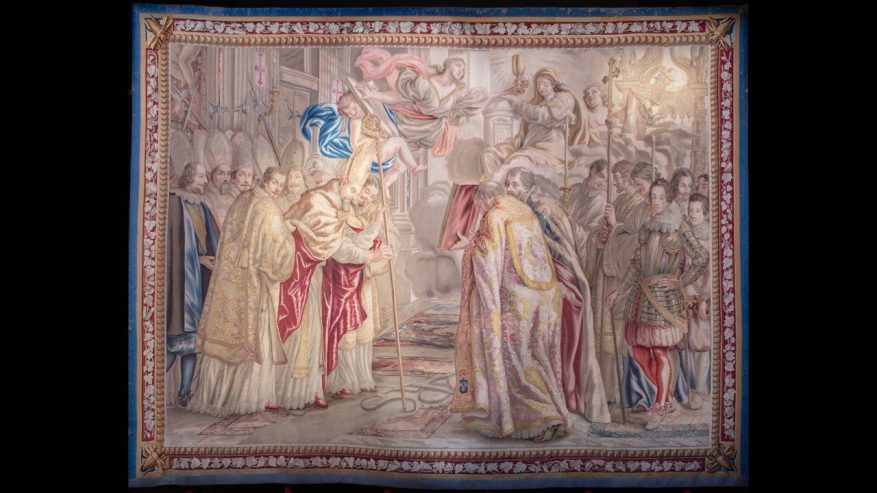
Ai Musei Vaticani i fasti barocchi di Urbano VIII: in mostra gli arazzi della manifattura Barberini
🇮🇹A quattro secoli dalla consacrazione della Basilica di San Pietro, i Musei Vaticani dedicano una mostra all’Arazzeria Barberini, simbolo di una cultura visiva capace di fondere magnificenza estetica e affermazione politica… 🇬🇧Four centuries after the consecration of St. Peter’s Basilica, the Vatican Museums are dedicating an exhibition to the Barberini Tapestry Factory, a symbol of…
-
Le Opere della Pasqua: come la Resurrezione ha ispirato Arte e Cultura
🇮🇹La Pasqua, oltre ad essere una ricorrenza religiosa è un momento in cui la storia, l’arte e la spiritualità si intrecciano per raccontare il fulcro della fede cristiana: la resurrezione di Cristo. .. 🇬🇧Easter, beyond being a religious holiday, is a moment when history, art, and spirituality intertwine to recount the core of the Christian…
Condividi:


Questo sono io





sostienici

Sostienici – Support Us
Se questo blog ti piace e ti appassiona, puoi aiutarci a farlo crescere sempre più sostenendoci in modo concreto condividendo i post, seguendo le pagine social e con un contributo che ci aiuta ad andare avanti con il nostro lavoro di divulgazione. . ENGLISH: If you like and are passionate about this blog, you can help us make it grow more and more by supporting us in a concrete way by sharing posts, following social pages and with a contribution that helps us to move forward with our dissemination work.
€10,00


