

La Giuditta: eroina nella Cappella Sistina
Quando salii sui ponteggi della Cappella Sistina non immaginavo fino in fondo quanto quella volta alla fine avrebbe cominciato ad assomigliarmi: fatica, pensiero, furia e visione.
Nei quattro pennacchi angolari volli narrare le miracolose salvazioni del popolo d’Israele, episodi di coraggio e intervento divino che si intrecciano con il destino umano. Tra essi, oggi voglio soffermarmi su Giuditta e Oloferne, scena che concepii attorno al 1508, tra le prime a prendere forma.
Una scena narrata oltre la violenza
Non scelsi di mostrare l’atto cruento nel suo culmine, come altri avrebbero fatto. Preferii invece suggerire, alludere, lasciare che l’osservatore ricostruisse l’evento.
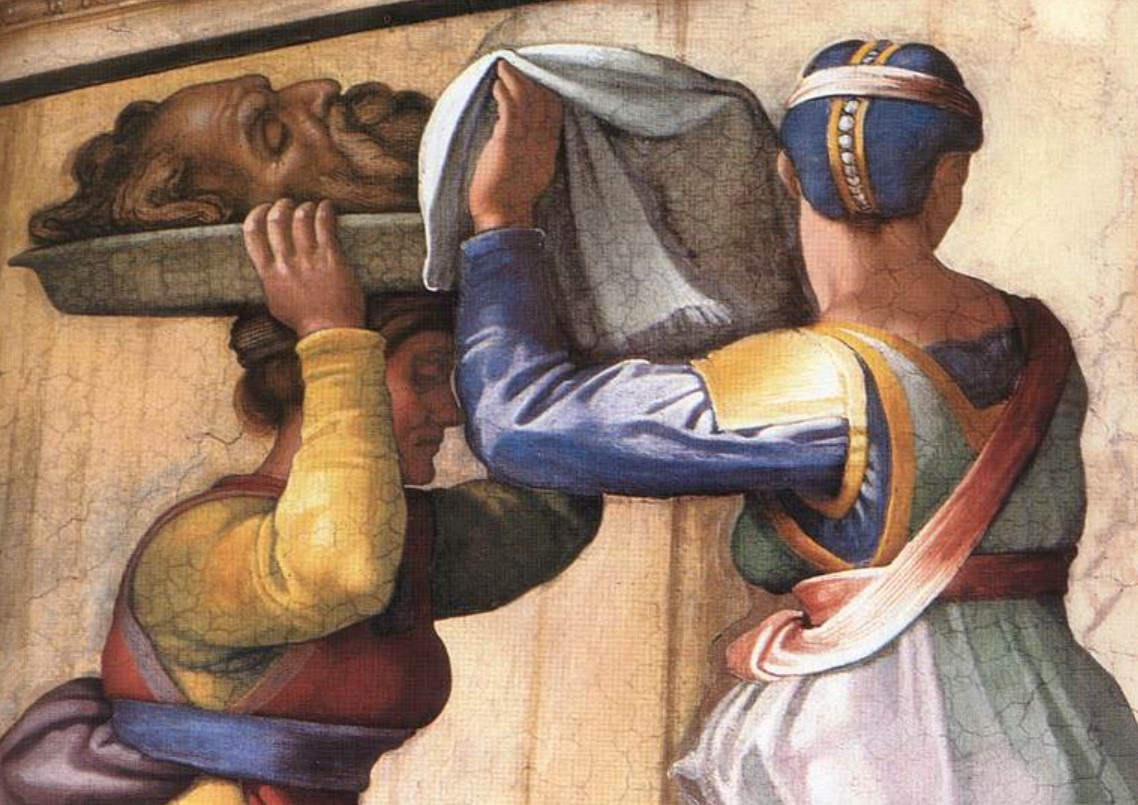
Giuditta, l’eroina, è già in atto di uscire dalla scena: con gesto fermo e composto, sistema un panno sopra la cesta che la sua ancella regge sul capo. Dentro quel recipiente si cela la testa di Oloferne, il generale assiro che aveva oppresso gli israeliti.
Ho voluto che il macabro trofeo fosse nascosto, quasi negato allo sguardo, coperto da un velo che attenua la violenza del gesto.

La composizione in tre momenti
Se osservate con attenzione, noterete come l’intera composizione sia costruita in tre momenti distinti.
A sinistra, una guardia dorme, ignara di quanto è appena accaduto: è il simbolo della mancata vigilanza.
Al centro, in piena luce, Giuditta e l’ancella avanzano: la prima copre il capo mozzato, la seconda lo sostiene.
A destra, il corpo di Oloferne giace sul letto, visto di scorcio, ancora percorso da un ultimo fremito.
È un racconto che si svolge nello stesso spazio ma in tempi diversi compressi in un solo pennacchio.

Tecnica e rapidità esecutiva
Per Giuditta e l’ancella lavorai con estrema cura, trasferendo il disegno dal cartone preparatorio sull’intonaco fresco mediante la tecnica dello spolvero. Volevo precisione, eleganza, controllo.
Oloferne, invece, lo affrontai in una sola giornata, con incisione rapida: un corpo nato quasi d’impeto. La guardia dormiente la dipinsi senza preparazione, lasciando che la mano seguisse l’istinto.
Un possibile autoritratto nascosto?
Qualcuno ha detto che il volto di Oloferne possa somigliare al mio. Non so se sia vero, né se lo feci consapevolmente. Ma ogni artista lascia sempre qualcosa di sé nelle proprie opere, anche quando non lo desidera.

Un invito a guardare la Sistina con occhi nuovi
Se vi capiterà di entrare nella Cappella Sistina, alzate lo sguardo verso il primo pennacchio a sinistra dell’ingresso. Lì troverete questa scena: non la più celebre tra le rappresentazioni di Giuditta, ma una che parla con voce propria.
Io non cercai la spettacolarità del gesto, bensì il suo eco: il momento successivo, quando l’azione è compiuta e il silenzio inizia a raccontare.
Per il momento il sempre vostro Michelangelo Buonarroti vi saluta dandovi appuntamento ai prossimi post e sui social.
Judith: Heroine in the Sistine Chapel
When I climbed the scaffolding of the Sistine Chapel, I couldn’t fully imagine how much that vault would eventually begin to resemble me: toil, thought, fury, and vision. In the four corner pendentives, I wanted to narrate the miraculous salvations of the people of Israel, episodes of courage and divine intervention intertwined with human destiny. Among them, today I want to focus on Judith and Holofernes, a scene I conceived around 1508, among the first to take shape.
A Scene Narrated Beyond Violence
I didn’t choose to show the bloody act at its climax, as others would have done. I preferred instead to suggest, allude, and let the viewer reconstruct the event.
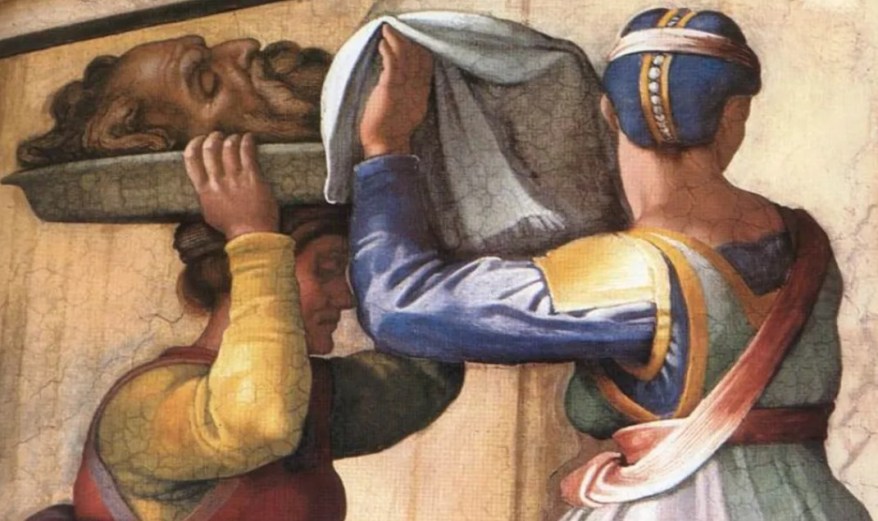
Judith, the heroine, is already in the act of exiting the scene: with a firm and composed gesture, she arranges a cloth over the basket held by her handmaid on her head. Inside that vessel lies the head of Holofernes, the Assyrian general who oppressed the Israelites.
I wanted the macabre trophy to be hidden, almost hidden from view, covered by a veil that softens the violence of the gesture.
The Composition in Three Moments
If you look carefully, you’ll notice how the entire composition is constructed in three distinct moments.
On the left, a guard sleeps, unaware of what has just happened: it’s the symbol of a lack of vigilance.
In the center, in full light, Judith and her handmaid advance: the former covers the severed head, the latter supports it.
On the right, Holofernes’ body lies on the bed, seen from a foreshortened angle, still trembling with a final shudder.
It’s a story that unfolds in the same space but at different times, compressed into a single spandrel.
Technique and Speed of Execution
For Judith and the Handmaid, I worked with extreme care, transferring the drawing from the preparatory cartoon onto the fresh plaster using the spolvero technique. I wanted precision, elegance, and control.
Holofernes, on the other hand, I tackled in a single day, with rapid engraving: a body born almost impulsively. I painted the Sleeping Guard without preparation, letting my hand follow instinct.
A possible hidden self-portrait?
Someone has said that Holofernes’s face resembles mine. I don’t know if this is true, nor if I did it consciously. But every artist always leaves something of themselves in their works, even when they don’t intend it.
An Invitation to See the Sistine Chapel with New Eyes
If you happen to enter the Sistine Chapel, look up at the first pendentive to the left of the entrance. There you will find this scene: not the most famous of the depictions of Judith, but one that speaks with its own voice.
I wasn’t looking for the spectacularity of the gesture, but rather its echo: the moment afterward, when the action is complete and the silence begins to tell its story.
For now, yours truly, Michelangelo Buonarroti bids you farewell, saying he’ll see you in future posts and on social media.

Sostienici – Support Us
Se questo blog ti piace e ti appassiona, puoi aiutarci a farlo crescere sempre più sostenendoci in modo concreto condividendo i post, seguendo le pagine social e con un contributo che ci aiuta ad andare avanti con il nostro lavoro di divulgazione. . ENGLISH: If you like and are passionate about this blog, you can help us make it grow more and more by supporting us in a concrete way by sharing posts, following social pages and with a contribution that helps us to move forward with our dissemination work.
10,00 €
Condividi:


Questo sono io





sostienici

Sostienici – Support Us
Se questo blog ti piace e ti appassiona, puoi aiutarci a farlo crescere sempre più sostenendoci in modo concreto condividendo i post, seguendo le pagine social e con un contributo che ci aiuta ad andare avanti con il nostro lavoro di divulgazione. . ENGLISH: If you like and are passionate about this blog, you can help us make it grow more and more by supporting us in a concrete way by sharing posts, following social pages and with a contribution that helps us to move forward with our dissemination work.
€10,00


