

Isaia: il profeta che annunciò Cristo nella Cappella Sistina
Quando salii sui ponteggi della Cappella Sistina ebbi fin da subito la consapevolezza di voler dare carne e spirito alle figure attraverso la Parola. Tra i dodici veggenti che affrescai nella Volta, Isaia occupa un posto solenne: è uno dei profeti maggiori, voce potente che annunciò la venuta del Salvatore, l’era messianica e la nascita della Vergine Maria.
Isaia non è mica solo colore e forma: è ascolto, attesa, rivelazione.
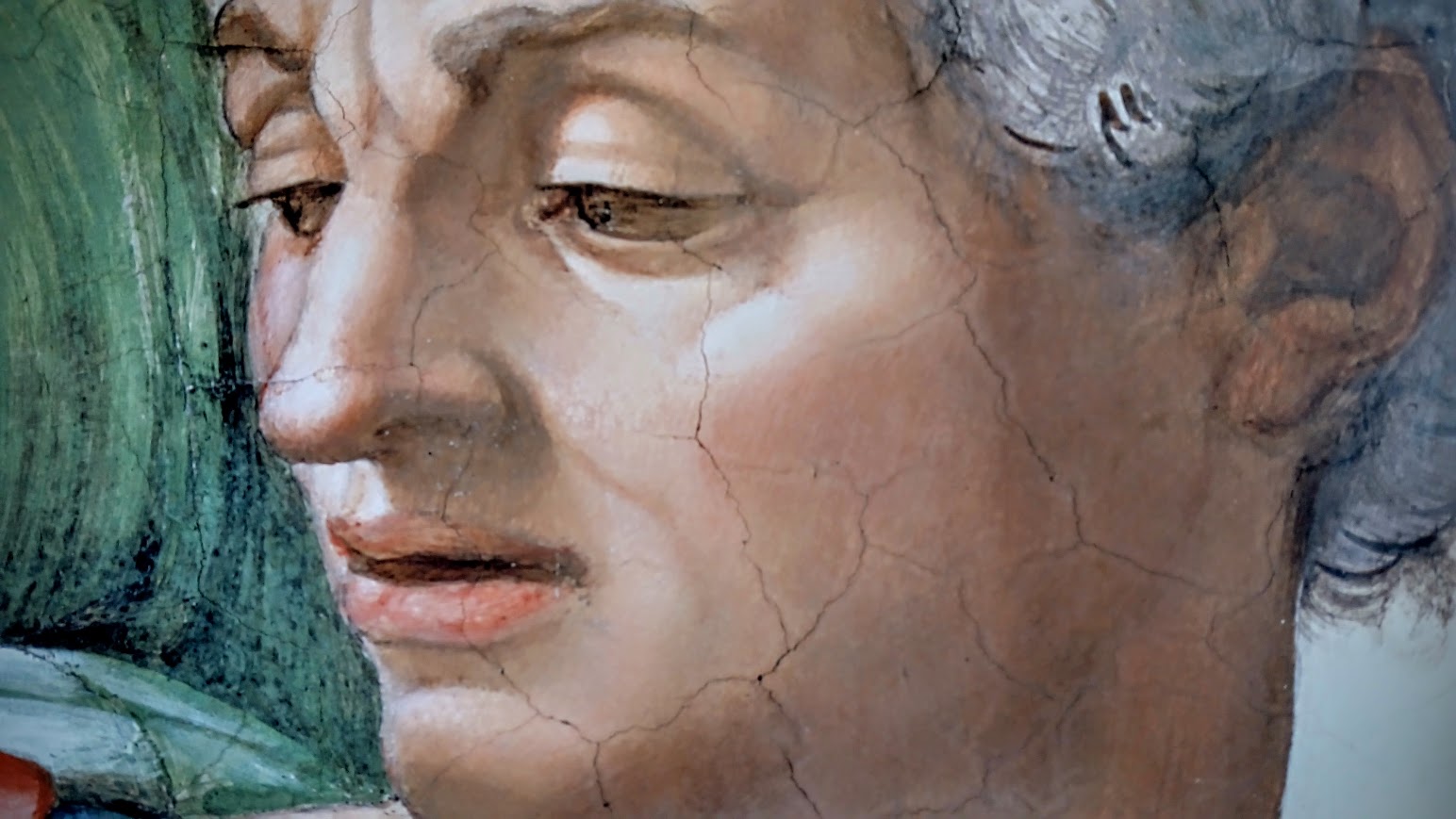
Isaia, il profeta dell’era messianica
Fu lui a proclamare:
“Lo Spirito del Signore Dio è su di me, perché il Signore mi ha consacrato con l’unzione; mi ha mandato a portare il lieto annunzio ai miseri…” (Isaia 61,1)
Nelle sue parole vibra la promessa del Cristo. Egli parlò del Servo sofferente, della luce che avrebbe rischiarato le genti, della Vergine che avrebbe concepito. Isaia vide ciò che ancora non era visibile.
E quando dipingevo il suo volto, meditavo sulle sue parole:
“Il cielo è il mio trono e la terra è lo sgabello dei miei piedi… Su chi volgerò lo sguardo? Su chi è umile, ha lo spirito contrito e trema alla mia Parola.” (Isaia 66, 1-2)
Volevo che quell’umiltà e quella forza trasparissero nella sua figura.
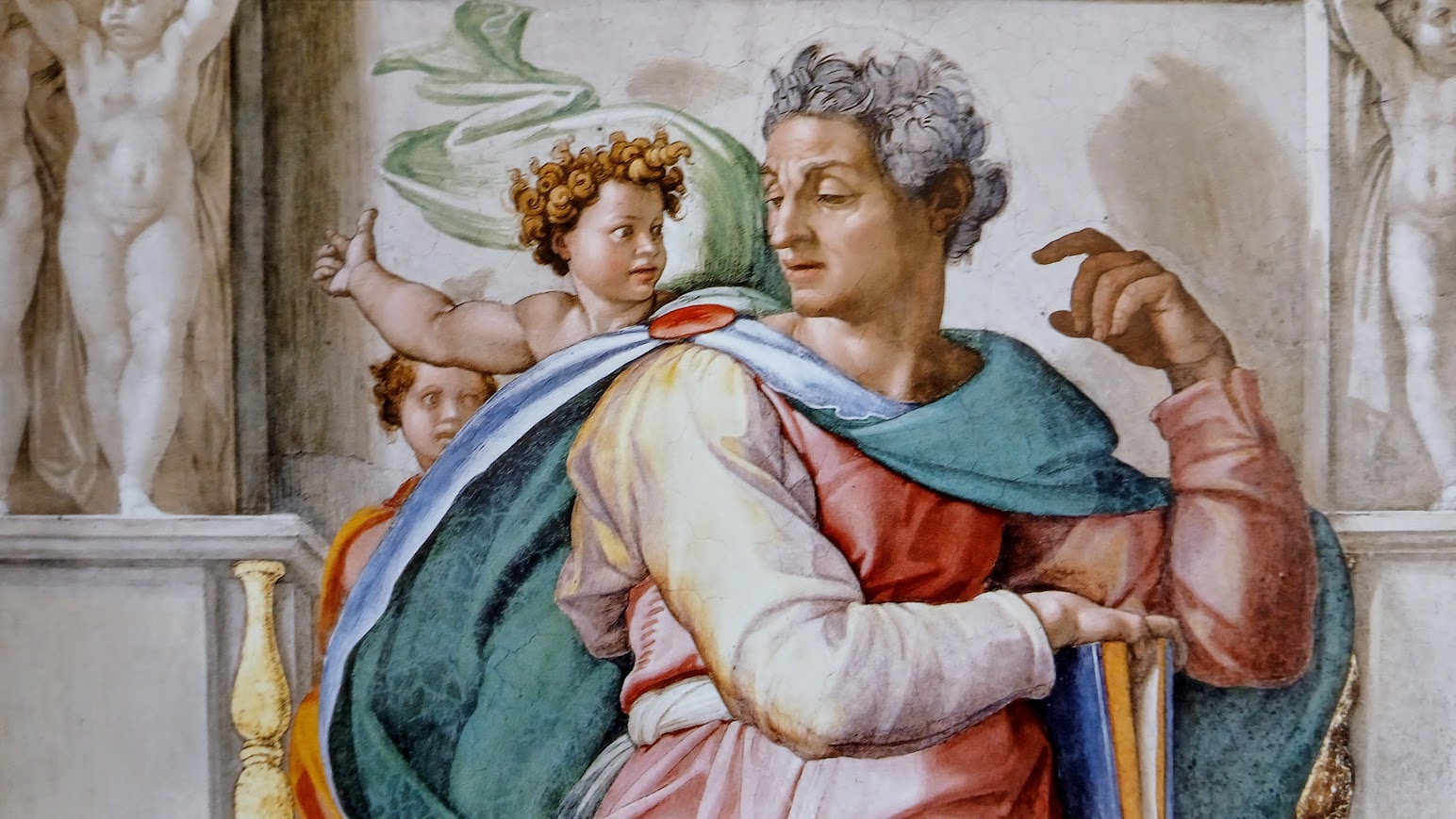
I Sette Doni dello Spirito Santo nei miei profeti
Dipingendo i sette profeti, attribuii a ciascuno uno dei Sette Doni dello Spirito Santo che proprio Isaia menzionò per primo: sapienza, intelletto, consiglio, fortezza, conoscenza, pietà e timore di Dio.
Nei loro volti e nei loro atteggiamenti noterete il trasparire di queste qualità. In Isaia volli esprimere soprattutto la sapienza che ascolta e la fortezza che sostiene. Non una forza violenta, ma composta, interiore, piena di autocontrollo.
La posa di Isaia: ascolto e rivelazione
Osservate bene Isaia nella Volta della Cappella Sistina.
Egli volge il capo in segno di ascolto verso il genio che gli parla all’orecchio. È colto nell’istante in cui viene richiamato da una voce improvvisa. Prima stava consultando il suo grande libro dalla copertina in smaltino; per non perdere il segno, infila fra le pagine le dita della mano sinistra.
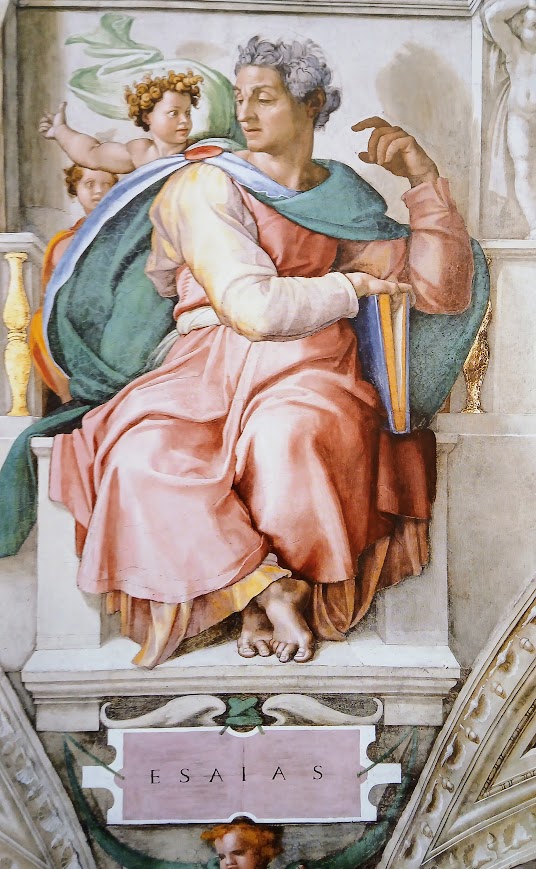
La torsione del capo dà inizio a una spirale che attraversa tutto il corpo. È la posa contrapposta che spesso usai per infondere dinamismo a dipinti e sculture. Nulla è statico: Isaia è colto nel momento della rivelazione, nel passaggio tra silenzio e parola.
Che cosa gli sta sussurrando il giovane alle sue spalle? Forse proprio l’annuncio della venuta di Cristo o chissà.
L’espressione e i capelli: il movimento dello spirito
Il profeta ha un’espressione di profonda concentrazione. Il suo sguardo non è turbato, ma raccolto. In lui convivono mansuetudine e potenza.
Osservate i capelli: come feci per Dio Padre nei riquadri centrali della volta, aggiunsi pennellate brune molto scure alla massa grigia per dare vigore e movimento. La chioma diventa eco della sua interiorità: forte, controllata, viva.
Isaia si mostra saldo, pieno di autocontrollo e mansueto, così come lo descrivono le Scritture. Non è travolto dalla visione, ma la accoglie con spirito contrito.
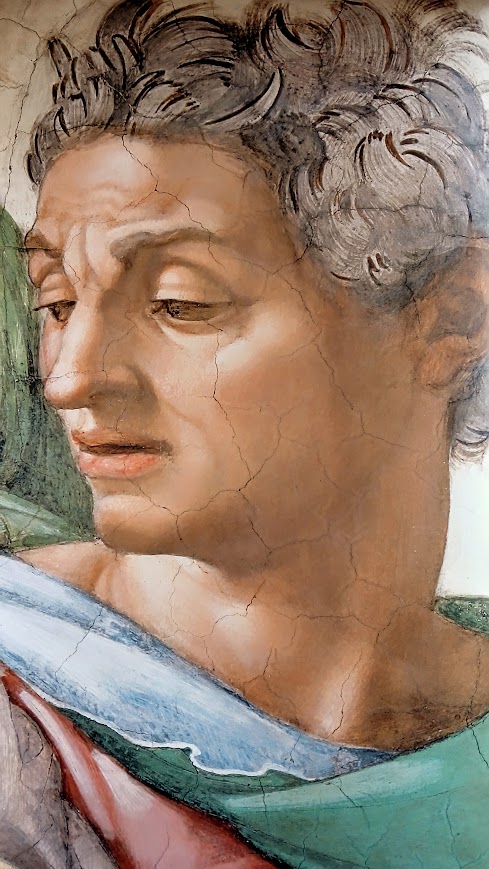
Se vi fermate sotto la sua figura e alzate lo sguardo, comprenderete ciò che cercai di esprimere: l’attimo in cui l’uomo ascolta Dio. Isaia non grida. Ascolta.
E in quell’ascolto nasce la speranza dell’umanità: la promessa del Salvatore, la luce dell’era messianica, la misericordia che si fa carne.
Così lo immaginai e così lo dipinsi.
Per il momento il sempre vostro Michelangelo Buonarroti vi saluta dandovi appuntamento ai prossimi post e sui social.
Isaiah: the prophet who proclaimed Christ in the Sistine Chapel
When I climbed the scaffolding of the Sistine Chapel, I immediately realized that I wanted to give flesh and spirit to the figures through the Word. Among the twelve visionaries I frescoed on the ceiling, Isaiah occupies a solemn place: he is one of the major prophets, a powerful voice who announced the coming of the Savior, the messianic era, and the birth of the Virgin Mary.
Isaiah is not just color and form: he is listening, waiting, revelation.
Isaiah, the prophet of the messianic era
It was he who proclaimed:
“The Spirit of the Lord God is upon me, because the Lord has anointed me; he has sent me to bring good news to the poor…” (Isaiah 61:1)
His words resonate with the promise of Christ. He spoke of the suffering Servant, of the light that would enlighten the people, of the Virgin who would conceive. Isaiah saw what was not yet visible.
And when I painted his face, I meditated on his words:
“Heaven is my throne, and the earth is my footstool… To whom shall I look? To him who is humble and contrite in spirit, and trembles at my word.” (Isaiah 66:1-2)
I wanted that humility and strength to shine through in his image.
The Seven Gifts of the Holy Spirit in my prophets
In painting the seven prophets, I attributed to each one one of the Seven Gifts of the Holy Spirit, which Isaiah himself first mentioned: wisdom, understanding, counsel, fortitude, knowledge, piety, and fear of the Lord.
You will notice these qualities shining through in their faces and attitudes. In Isaiah, I wanted to express above all the wisdom that listens and the fortitude that sustains. Not a violent force, but a composed, interior one, full of self-control.
Isaiah’s Pose: Listening and Revelation
Look closely at Isaiah in the Sistine Chapel Ceiling.
He turns his head in a gesture of listening to the genius speaking in his ear. He is captured in the moment in which he is summoned by a sudden voice. Earlier, he was consulting his large book with its enameled cover; to avoid losing his place, he slips the fingers of his left hand between the pages.
The twist of his head initiates a spiral that runs through his entire body. It is the contraposto pose I often used to infuse dynamism into paintings and sculptures. Nothing is static: Isaiah is captured in the moment of revelation, in the transition between silence and speech.
What is the young man behind him whispering to him? Perhaps it is the announcement of Christ’s coming, or who knows?
The Expression and Hair: The Movement of the Spirit
The prophet has an expression of deep concentration. His gaze is not troubled, but collected. Meekness and power coexist in him.
Look at his hair: as I did for God the Father in the central panels of the vault, I added very dark brown brushstrokes to the gray mass to give it vigor and movement. The hair becomes an echo of his inner self: strong, controlled, alive.
Isaiah appears steadfast, self-controlled, and meek, just as the Scriptures describe him. He is not overwhelmed by the vision, but welcomes it with a contrite spirit.
If you pause beneath his figure and raise your gaze, you will understand what I was trying to express: the moment in which man listens to God. Isaiah does not shout. He listens.
And in that listening, humanity’s hope is born: the promise of the Savior, the light of the messianic era, mercy made flesh.
This is how I imagined him, and this is how I painted him.
For now, yours truly, Michelangelo Buonarroti bids you farewell, and we look forward to seeing you in future posts and on social media.

Sostienici – Support Us
Se questo blog ti piace e ti appassiona, puoi aiutarci a farlo crescere sempre più sostenendoci in modo concreto condividendo i post, seguendo le pagine social e con un contributo che ci aiuta ad andare avanti con il nostro lavoro di divulgazione. . ENGLISH: If you like and are passionate about this blog, you can help us make it grow more and more by supporting us in a concrete way by sharing posts, following social pages and with a contribution that helps us to move forward with our dissemination work.
10,00 €
Articoli
Condividi:


Questo sono io





sostienici

Sostienici – Support Us
Se questo blog ti piace e ti appassiona, puoi aiutarci a farlo crescere sempre più sostenendoci in modo concreto condividendo i post, seguendo le pagine social e con un contributo che ci aiuta ad andare avanti con il nostro lavoro di divulgazione. . ENGLISH: If you like and are passionate about this blog, you can help us make it grow more and more by supporting us in a concrete way by sharing posts, following social pages and with a contribution that helps us to move forward with our dissemination work.
€10,00


