

Castel Sant’Angelo: il Cortile D’onore con l’Edicola che io progettai
Il Cortile d’Onore di Castel Sant’Angelo assunse l’aspetto con il quale lo possiamo vedere oggi nella prima metà del Cinquecento, tra il pontificato di papa Leone X de’ Medici salito al soglio di Pietro nel 1513 e quello di papa Paolo III Farnese, deceduto nel 1549.
Mi preme dire che per entrambi i papi ebbi modo di lavorare a lungo: per Leone X a Firenze e per Paolo III a Roma nella Cappella Sistina, nella Paolina ma anche al progetto della Basilica di San Pietro e ad altre architetture.

Il Cortile d’Onore ha una pianta rettangolare ed è chiuso da un lato dalle Armerie e dall’altro dalle sale che un tempo erano residenza papale.
Era il 1514 quando papa Leone X de’ Medici mi chiese di realizzare l’edicola della cappella papale dei Santi Cosma e Damiano in Castel Sant’Angelo: i due santi gemelli che i Medici si erano scelti come protettori della loro casata.
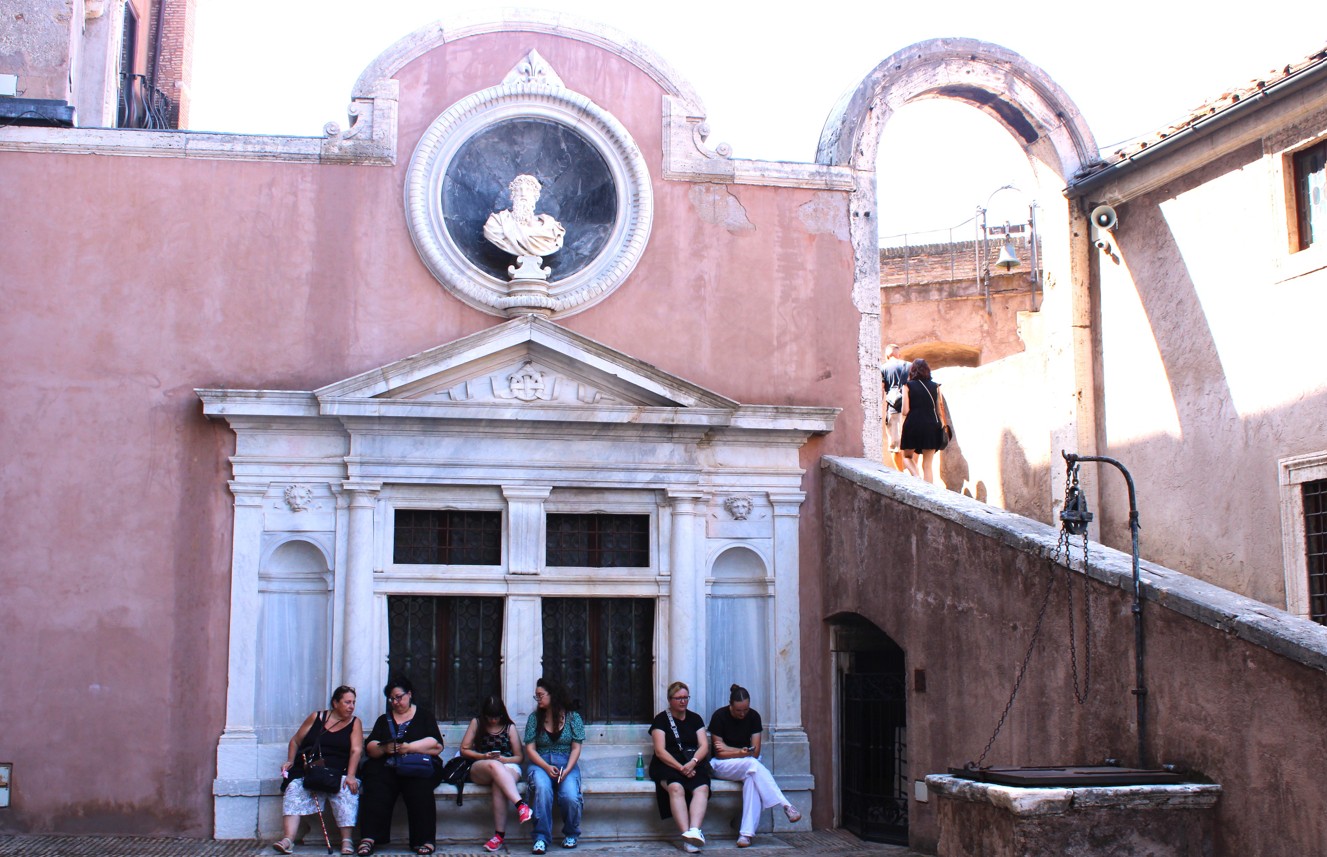
Mi misi al lavoro e progettai un’edicola in marmo bianco di Carrara, realizzata successivamente da altra mano. Ancora non ho capito perché il Sangallo, in un suo brogliaccio di schizzi, ne fa menzione come se fosse di travertino: “questo in chastello di Roma di mano di Michelagnolo di travertino…”.
Gli studi che misi nero su bianco per questo progetto sono sopravvissuti ai miei roghi e allo scorrere inesorabile del tempo. Attualmente appartengono alla grande collezione dei disegni di Casa Buonarroti, a Firenze.
Dalla parte opposta rispetto alla mia edicola, potete apprezzare l’architettura realizzata da Raffaello da Montelupo, mio stretto collaboratore sia a Roma che a Firenze. Aveva infatti lavorato per me alla Sagrestia Nuova, scolpendo il San Damiano.

Sapete, i busti all’antica presenti al di sopra della mia edicola e della struttura del Montelupo furono scolpiti da Guglielmo della Porta attorno al 1540.
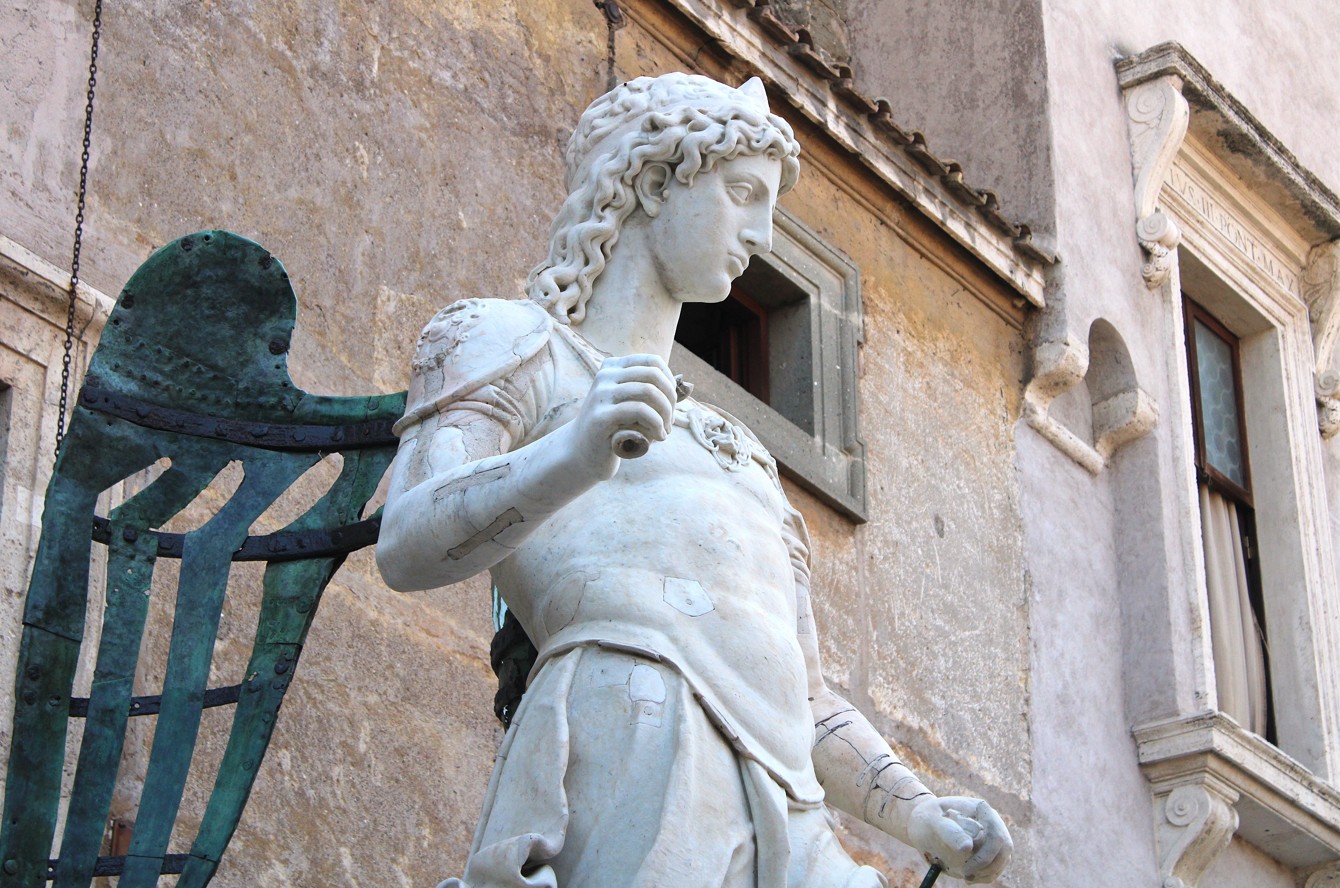
La scultura che la fa da padrona nel Cortile raffigura San Michele Arcangelo come si può intuire anche dai suoi attributi iconografici. Venne realizzata dal Montelupo nel 1544 e collocata inizialmente sopra Castel Sant’Angelo.
Da lì fu rimossa per ragioni conservative nel 1747 e sostituita con l’attuale scultura dell’Arcangelo realizzata da Peter Anton Van Verschaffelt.
A proposito, prima che me ne dimentichi, il Cortile di Castel Sant’Angelo è stato sottoposto a un accurato restauro, ultimato nel luglio 2025.
Per il momento il sempre vostro Michelangelo Buonarroti vi saluta dandovi appuntamento ai prossimi post e sui social.
Castel Sant’Angelo: the Courtyard of Honor with the Aedicule I Designed
The Courtyard of Honor of Castel Sant’Angelo took on the appearance we see today in the first half of the 16th century, between the prestigious pontificates of Pope Leo X de’ Medici, who ascended to the throne of Peter in 1513, and that of Pope Paul III Farnese, who died in 1549.
I should point out that I had the opportunity to work extensively for both popes: for Leo X in Florence and for Paul III in Rome, on the Sistine Chapel and the Pauline Chapel, as well as on the design of St. Peter’s Basilica and other architectural projects.
The Courtyard of Honor has a rectangular plan and is enclosed on one side by the Armories and on the other by the rooms that once served as the papal residence.
It was 1514 when Pope Leo X de’ Medici asked me to create the aedicule for the papal chapel of Saints Cosmas and Damian in Castel Sant’Angelo: the twin saints the Medici had chosen as protectors of their house.
I set to work and designed a shrine in white Carrara marble, later built by another hand. I still don’t understand why Sangallo, in one of his sketchbooks, refers to it as if it were made of travertine: “this in a castle in Rome by the hand of Michelangelo in travertine…”
The studies I put down for this project have survived my burnings and the inexorable passage of time. They currently belong to the great collection of drawings at Casa Buonarroti in Florence.
Across from my shrine, you can appreciate the architecture created by Raffaello da Montelupo, my close collaborator in both Rome and Florence. He had, in fact, worked for me on the New Sacristy, sculpting the San Damiano.
You know, the ancient busts above my shrine and the Montelupo structure were sculpted by Guglielmo della Porta around 1540.
The sculpture that dominates the courtyard depicts Saint Michael the Archangel, as can be deduced from its iconographic attributes. It was created by Montelupo in 1544 and initially placed above Castel Sant’Angelo.
From there, it was removed for conservation reasons in 1747 and replaced with the current sculpture of the Archangel by Peter Anton Van Verschaffelt.
By the way, before I forget, the courtyard of Castel Sant’Angelo has undergone a thorough restoration, completed in July 2025.
For now, yours truly, Michelangelo Buonarroti bids you farewell and invites you to see him in future posts and on social media.

Sostienici – Support Us
Se questo blog ti piace e ti appassiona, puoi aiutarci a farlo crescere sempre più sostenendoci in modo concreto condividendo i post, seguendo le pagine social e con un contributo che ci aiuta ad andare avanti con il nostro lavoro di divulgazione. . ENGLISH: If you like and are passionate about this blog, you can help us make it grow more and more by supporting us in a concrete way by sharing posts, following social pages and with a contribution that helps us to move forward with our dissemination work.
10,00 €
Articoli
Condividi:


Questo sono io





sostienici

Sostienici – Support Us
Se questo blog ti piace e ti appassiona, puoi aiutarci a farlo crescere sempre più sostenendoci in modo concreto condividendo i post, seguendo le pagine social e con un contributo che ci aiuta ad andare avanti con il nostro lavoro di divulgazione. . ENGLISH: If you like and are passionate about this blog, you can help us make it grow more and more by supporting us in a concrete way by sharing posts, following social pages and with a contribution that helps us to move forward with our dissemination work.
€10,00


