
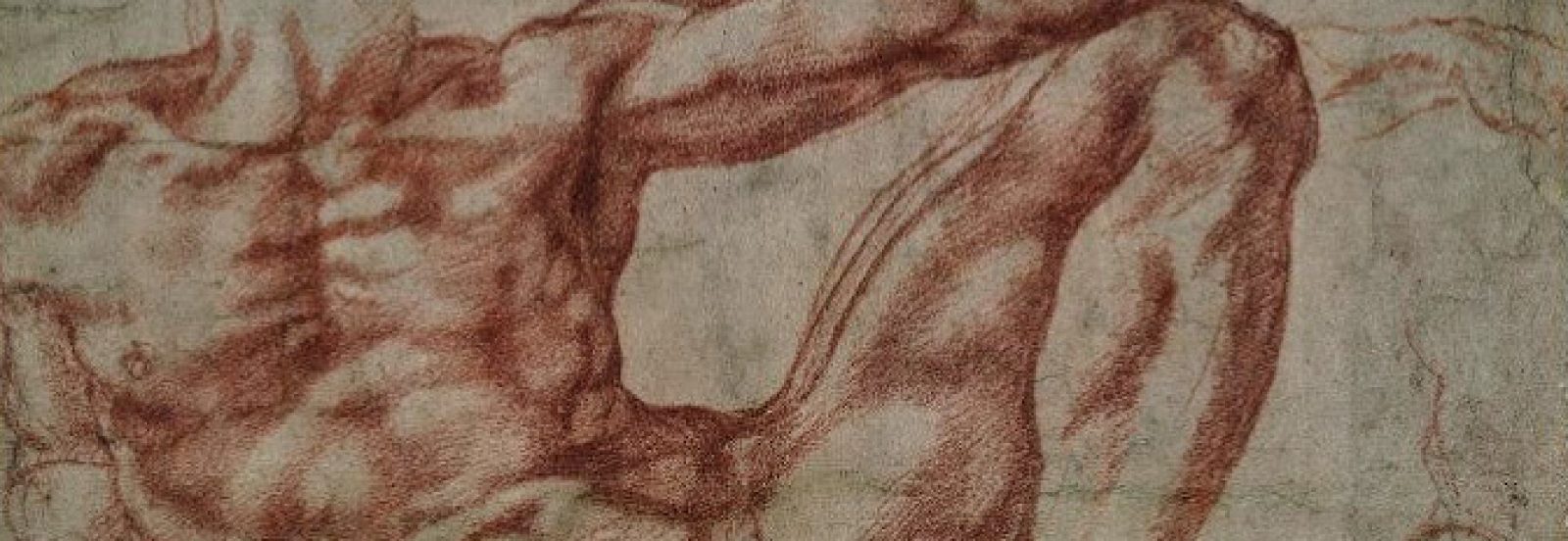
Gli ignudi del Tondo Doni: il loro significato
Nel Tondo Doni, alle spalle della Sacra famiglia e al di là del parapetto che divide la scena in due, volli dipingere cinque ignudi.
Su quella scelta, non certo fatta senza criterio, a lungo si è discusso e ancora oggi sono diverse le ipotesi in merito. I giovani sono privi di vesti ma, tre di loro, hanno un nastro semi nascosto tra i capelli che serve per trattenere parte delle chiome.

Osservando con attenzione gli ignudi, ci si può rendere conto che il loro atteggiamento deriva da modelli di arte antica che ben conoscevo.
Come ha osservato puntualmente Antonio Natali, la prima figura a sinistra ha molte assonanze con la posa dell’Apollo Seduto che si trova oggi alle Gallerie degli Uffizi mentre la seconda, ancora più lampante, riprende l’Apollo del Belvedere sia nella dinamica del corpo che nel panneggio posto sul braccio.
Non solo. Il braccio dell’ignudo si interrompe finendo dietro la schiena della Madonna laddove era mancante la parte in marmo sulla scultura. Oggi l’Apollo quel braccio ce l’ha ma è frutto di un rifacimento successivo.

Cosa simboleggiano gli ignudi?
Gli ignudi rappresentano l’era pagana, quella prima della venuta di Cristo.
Osservate la posizione di San Giovannino, per altro patrono di Firenze spesso presente nelle opere commissionate in città nel Quattrocento e nel Cinqueccento.
Posizionato dalla parte dell’era pagana, San Giovannino si affaccia a quella messianica guardando in direzione di Gesù Bambino. Questa è la ragione che sento più affine al mio pensiero che venne fortemente sostenuta da Charles de Tolnay secondo il quale l’opera rappresenterebbe il percorso di salvezza dell’umanità.

Dall’Ante Legem, al Sub Lege arrivando allo stato di Sub Gratia. rinnovato dalla venuta sulla terra di Cristo.
In pratica sul fondo del Tondo Doni, secondo la visione di De Tolnay, avrei dipinto l’umanità pagana prima della venuta di Cristo poi San Giovannino che fa da tramite ma che ancora rimane nell’era premessianica e infine la Sacra Famiglia che rappresenta l’umanità nello stato di grazia.
Per il momento il sempre vostro Michelangelo Buonarroti vi saluta dandovi appuntamento ai prossimi post e sui social.
The nudes of the Doni Tondo: their meaning
In the Doni Tondo, behind the Holy Family and beyond the parapet that divides the scene in two, I wanted to paint five nudes.
That choice, certainly not made without criteria, has been discussed for a long time and even today there are different hypotheses about it.
The young people are without clothes but, three of them, have a ribbon half hidden in their hair that serves to hold back part of the hair.
Observing the nudes carefully, one can realize that their attitude derives from models of ancient art that I knew well. As Antonio Natali has pointed out, the first figure on the left has many assonances with the pose of the Seated Apollo that is today in the Uffizi Galleries while the second, even more obvious, takes up the Apollo Belvedere both in the dynamics of the body and in the drapery placed on the arm.
Not only that. The arm of the naked man is interrupted, ending behind the Madonna’s back where the marble part was missing on the sculpture. Today the Apollo has that arm but it is the result of a later remake.
What do the naked men symbolize?
The naked men represent the pagan era, the one before the coming of Christ.
Observe the position of San Giovannino, also the patron saint of Florence often present in the works commissioned in the city in the fifteenth and sixteenth centuries.
Positioned on the side of the pagan era, San Giovannino faces the messianic era looking in the direction of Baby Jesus. This is the reason that I feel most similar to my thought, which was strongly supported by Charles de Tolnay according to whom the work would represent the path of salvation of humanity.
From the Ante Legem, to the Sub Lege arriving at the state of Sub Gratia, renewed by the coming of Christ to earth.
In practice, on the bottom of the Tondo Doni, according to De Tolnay’s vision, I would have painted pagan humanity before the coming of Christ, then Saint John the Baptist who acts as an intermediary but who still remains in the pre-Messianic era, and finally the Holy Family who represents humanity in the state of grace.
For the moment, yours truly Michelangelo Buonarroti bids you farewell, making an appointment with you in the next posts and on social media.

Sostienici – Support Us
Se questo blog ti piace e ti appassiona, puoi aiutarci a farlo crescere sempre più sostenendoci in modo concreto condividendo i post, seguendo le pagine social e con un contributo che ci aiuta ad andare avanti con il nostro lavoro di divulgazione. . ENGLISH: If you like and are passionate about this blog, you can help us make it grow more and more by supporting us in a concrete way by sharing posts, following social pages and with a contribution that helps us to move forward with our dissemination work.
10,00 €
Condividi:


Questo sono io





sostienici

Sostienici – Support Us
Se questo blog ti piace e ti appassiona, puoi aiutarci a farlo crescere sempre più sostenendoci in modo concreto condividendo i post, seguendo le pagine social e con un contributo che ci aiuta ad andare avanti con il nostro lavoro di divulgazione. . ENGLISH: If you like and are passionate about this blog, you can help us make it grow more and more by supporting us in a concrete way by sharing posts, following social pages and with a contribution that helps us to move forward with our dissemination work.
€10,00


