

L’Anello del Pescatore: tutto quello che c’è da sapere
Il nuovo pontefice papa Leone XIV tra poche ore indosserà all’anulare della mano destra l’Anello del Pescatore, noto anche come anello piscatorio.
Il nome di questo anello-sigillo deriva simbolicamente dall’episodio evangelico in cui Gesù invita Pietro a diventare pescatore di uomini come pescatore di uomini è richiamato ad essere ciascun papa. Rappresenta sì l‘autorità spirituale del Papa ma è simbolo anche della sua missione di guida spirituale della Chiesa Cattolica.

L’Ufficio delle Celebrazioni Liturgiche di papa Leone XIV ha reso nota l’immagine dell’Anello del Pescatore che a breve verrà consegnato al pontefice assieme al Pallio. Questi due simboli assieme rappresentano le cosiddette insegne episcopali petrine.
Perché si chiama Anello del Pescatore
Ogni papa ha un anello piscatorio differente dall’altro. Appena un pontefice muore, attraverso un particolare rito, viene annullato con una graffiatura superficiale. Fino a non molti anni fa invece veniva letteralmente rotto per evitare che altri potessero impossessarne.
“Pietro è l’Apostolo pescatore che, avendo avuto fede nella parola di Gesù, dalla barca ha tratto a terra le reti della pesca miracolosa” e quindi il papa assume il suo ruolo da ‘pescatore di anime’.

Anelli del Pescatore dei precedenti pontefici
Ogni papa ha il suo anello personale che abitualmente è in oro.
La menzione più remota dell’uso dell’anello piscatorio risale addirittura al Tredicesimo secolo e si trova all’interno di una missiva scritta di pugno da papa Clemente VI al cugino.
Il origine l’anello veniva adoperato per sigillare con ceralacca tutta la corrispondenza privata mentre oggi ha assunto una valenza prettamente simbolica.
Papa Francesco volle che fosse realizzato per lui un più semplice anello in argento dorato. L’immagine riprodotta sopra era quella delle chiavi di San Pietro: espressione della sua visione di una chiesa al servizio di tutti e di umiltà.
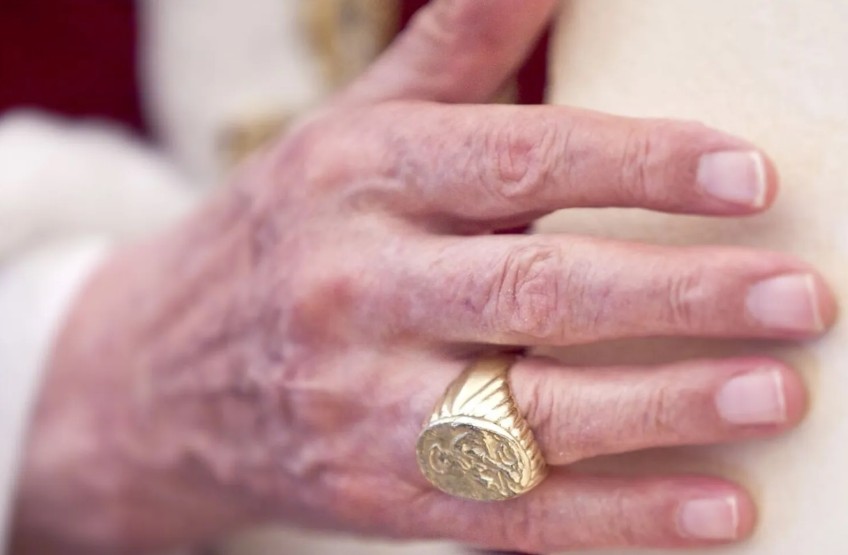
L’Anello del Pescatore di papa Leone XIV
Sulla superficie dell’Anello è stata riprodotto San Pietro con la rete mentre il nome del pontefice Leone XIV è stato inciso all’interno.
L’Anello del Pescatore verrà consegnato ufficialmente al papa durante le celebrazioni liturgiche di questa mattina, domenica 18 maggio, quando avrà inizio il Ministero Petrino.
Il Pallio
Assieme all’Anello del Pescatore, il papa riceverà anche il Pallio realizzato in lana bianca, simbolo del vescovo come buon Pastore e, insieme, dell’Agnello crocifisso per la salvezza dell’umanità.

Ha le sembianze di una fascia di lana stretta che viene appoggiata sopra la veste liturgica, nota come casula. E’ decorata con sei croci ricamate in seta nera e ha due lembi sempre neri che pendono davanti e dietro. Davanti e dietro è dotata di tre spille, dette acicula, che rappresentano i tre chiodi della croce di Cristo.
Per il momento il sempre vostro Michelangelo Buonarroti vi saluta dandovi appuntamento ai prossimi post e sui social.
The Fisherman’s Ring: Everything You Need to Know
In a few hours, the new pontiff, Pope Leo XIV, will wear the Fisherman’s Ring, also known as the fisherman’s ring, on the ring finger of his right hand.
The name of this seal ring symbolically derives from the Gospel episode in which Jesus invites Peter to become a fisherman of men, as each pope is called to be a fisherman of men. It represents the spiritual authority of the Pope, but it is also a symbol of his mission as spiritual leader of the Catholic Church.
The Office of Liturgical Celebrations of Pope Leo XIV has released the image of the Fisherman’s Ring, which will soon be given to the pontiff together with the Pallium. These two symbols together represent the so-called Petrine episcopal insignia.
Why is it called the Fisherman’s Ring?
Each pope has a different fisherman’s ring. As soon as a pontiff dies, through a particular rite, it is cancelled with a superficial scratch. Until a few years ago, however, it was literally broken to prevent others from taking possession of it.
“Peter is the Apostle fisherman who, having had faith in the word of Jesus, hauled the nets of the miraculous catch of fish from the boat to land” and therefore the pope assumes his role as a ‘fisher of souls’.
Fisherman’s Rings of previous pontiffs
Each pope has his own personal ring which is usually made of gold.
The earliest mention of the use of the fisherman’s ring dates back to the thirteenth century and is found in a letter written by Pope Clement VI to his cousin.
Originally, the ring was used to seal all private correspondence with sealing wax, while today it has taken on a purely symbolic value.
Pope Francis wanted a simpler ring made of gilded silver for him. The image reproduced above was that of the keys of Saint Peter: an expression of his vision of a church at the service of all and of humility.
The Fisherman’s Ring of Pope Leo XIV
The surface of the Ring features a reproduction of St. Peter’s boat complete with keys and net, surrounded by the engraving of the name of Leo XIV.
The Fisherman’s Ring will be officially delivered to the Pope during the liturgical celebrations this morning, Sunday 18 May, when the Petrine Ministry will begin.
The Pallium
Together with the Fisherman’s Ring, the Pope will also receive the Pallium made of white wool, a symbol of the bishop as the Good Shepherd and, at the same time, of the Lamb crucified for the salvation of humanity.
It has the appearance of a narrow wool band that is placed over the liturgical vestment, known as the chasuble. It is decorated with six crosses embroidered in black silk and has two black flaps that hang down at the front and back. At the front and back it is equipped with three pins, called acicula, which represent the three nails of the cross of Christ.
For now, yours ever Michelangelo Buonarroti bids you farewell, making an appointment to see you in the next posts and on social media.

Sostienici – Support Us
Se questo blog ti piace e ti appassiona, puoi aiutarci a farlo crescere sempre più sostenendoci in modo concreto condividendo i post, seguendo le pagine social e con un contributo che ci aiuta ad andare avanti con il nostro lavoro di divulgazione. . ENGLISH: If you like and are passionate about this blog, you can help us make it grow more and more by supporting us in a concrete way by sharing posts, following social pages and with a contribution that helps us to move forward with our dissemination work.
10,00 €
Condividi:


Questo sono io





sostienici

Sostienici - Support Us
Se questo blog ti piace e ti appassiona, puoi aiutarci a farlo crescere sempre più sostenendoci in modo concreto condividendo i post, seguendo le pagine social e con un contributo che ci aiuta ad andare avanti con il nostro lavoro di divulgazione. . ENGLISH: If you like and are passionate about this blog, you can help us make it grow more and more by supporting us in a concrete way by sharing posts, following social pages and with a contribution that helps us to move forward with our dissemination work.
€10,00


Grazie.
"Mi piace"Piace a 1 persona
Prego :-*
"Mi piace"Piace a 1 persona