
Urbino: riapre lo Studiolo di Federico da Montefeltro
Finalmente riapre al pubblico lo Studiolo di Federico da Montefeltro a Palazzo Ducale di Urbino, dopo l’intervento di restauro che ha interessato l’ambiente, a partire dal 4 novembre scorso.
Venerdì 30 maggio alle ore 16:00 verrà presentato al pubblico il risultato del delicato intervento effettuato nello Studiolo.

“I finanziamenti del PNRR hanno permesso di affrontare il necessario rinnovo degli impianti del museo che erano obsoleti – afferma il direttore Gallo – con l’occasione, visto anche il considerevole coinvolgimento della struttura, si è proceduto a un’operazione accurata di restauro e studio dell’edificio, nonché al completo riallestimento delle opere.“
La storia dello Studiolo di Federico da Montefeltro
Lo Studiolo è l’ambiente più intimo dell’appartamento di Federico da Montefeltro e allo stesso tempo quello più rappresentativo della figura pubblica del Duca. Era un luogo sì di studio ma anche di meditazione personale, realizzato traendo ispirazione dagli sudi di meditazione presenti nei monasteri medievali.
Sulla porta d’accesso dal lato della Sala delle Udienze si veniva introdotti all’interno dello Studiolo passando dinanzi al ritratto dinastico di Federico e del figlio Guidubaldo realizzato dal pittore spagnolo Berruguete.
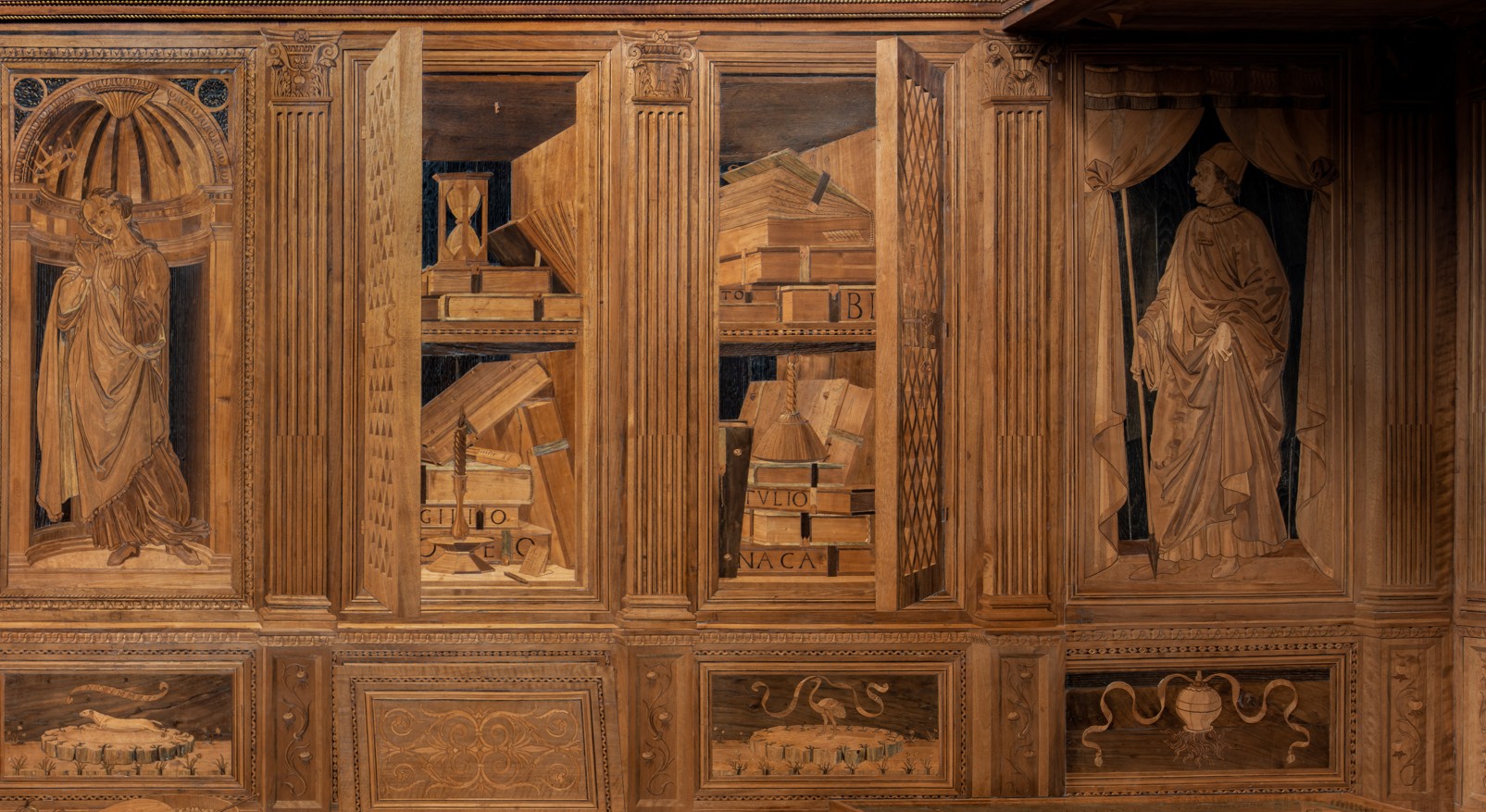
Il pittore aveva messo in evidenza i riconoscimenti ricevuti nell’estate del 1474 da Ferdinando d’Aragona re di Napoli, e da Edoardo IV d’Inghilterra: il collare dell’ermellino e la giarrettiera, ripetuti anche nelle tarsie.
I lavori di realizzazione della decorazione dello Studiolo terminarono nel 1476, data scritta nella fascia celebrativa al di sotto del soffitto.
Dovete sapere che le tarsie vennero realizzate a Firenze dai fratelli Giuliano e Benedetto da Maiano. Invece, i dipinti dei 28 illustri personaggi del mondo greco-romano e del medioevo con l’aggiunta di personaggi contemporanei come Vittorino da Feltre, l’amico Bessarione e papa Sisto IV, vennero commissionati a Giusto di Gand e poi completati dallo stesso Berruguete a Urbino.
La collocazione su due livelli separa gli uomini di chiesa in basso con l’aggiunta dei poeti cristiani Dante e Petrarca e dai laici in alto. Di tutti loro Federico possedeva gli scritti nella sua biblioteca.

Più in basso, le tarsie, raffigurano scansie sui ripiani delle quali sono sparsi armi, libri e pergamene, strumenti musicali e matematici, persino pedine degli scacchi, le Virtù teologali (Speranza, Fede e Carità) e Federico in persona.
Al di sotto si nota la fascia divisa in riquadri con le imprese araldiche personali del Ducacon le simbologie che fanno diretto riferimento alle sue qualità morali.
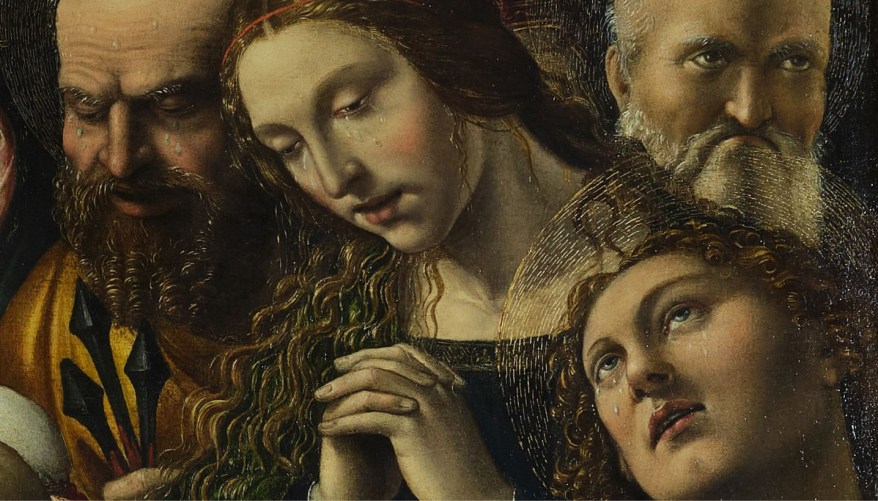
Nel 1631, con la morte di Francesco Maria II della Rovere, il ducato d’Urbino tornò alla Chiesa. Fu allora che il cardinale Antonio Barberini, appassionato d’arte, si fece donare i dipinti dello Studiolo dallo zio papa Urbano VIII.

Le grandi tavole furono strappate dalle pareti, segate in singoli riquadri e trasferite a Roma nella sua collezione; passarono quindi in quella di famiglia, dove rimasero fino al 1812.
Nel 1861, ben 14 ritratti furono acquistati da Napoleone III per il nascente Musée Napoleon, il futuro Louvre, dove attualmente si trovano. I ritratti rimasti in Italia furono acquistati dallo Stato nel 1934 e destinati alla Galleria Nazionale delle Marche.
Il restauro
Le tarsie dello Studiolo e il soffitto a cassettoni nei mesi scorsi sono stati smontati e ricoverati nei depositi temporanei del museo per consentire anche in quest’area del palazzo i lavori di adeguamento impiantistico elettrico e antincendio.

Tutti i pannelli sono stati sottoposti a trattamento anossico in combinazione all’applicazione di prodotti antitarlo, al pari dei dipinti su tavola che saranno riallestiti nell’appartamento del Duca e delle porte intarsiate delle sale, così come sono stati trattati i dipinti dei quattordici Uomini illustri, oggetto di una revisione dello stato conservativo e di interventi di manutenzione.
Il nuovo allestimento
Il nuovo allestimento dello Studiolo del Duca farà tesoro dei lunghi studi relativi alla sua primitiva realizzazione e alle vicende che ne hanno la sua esistenza.
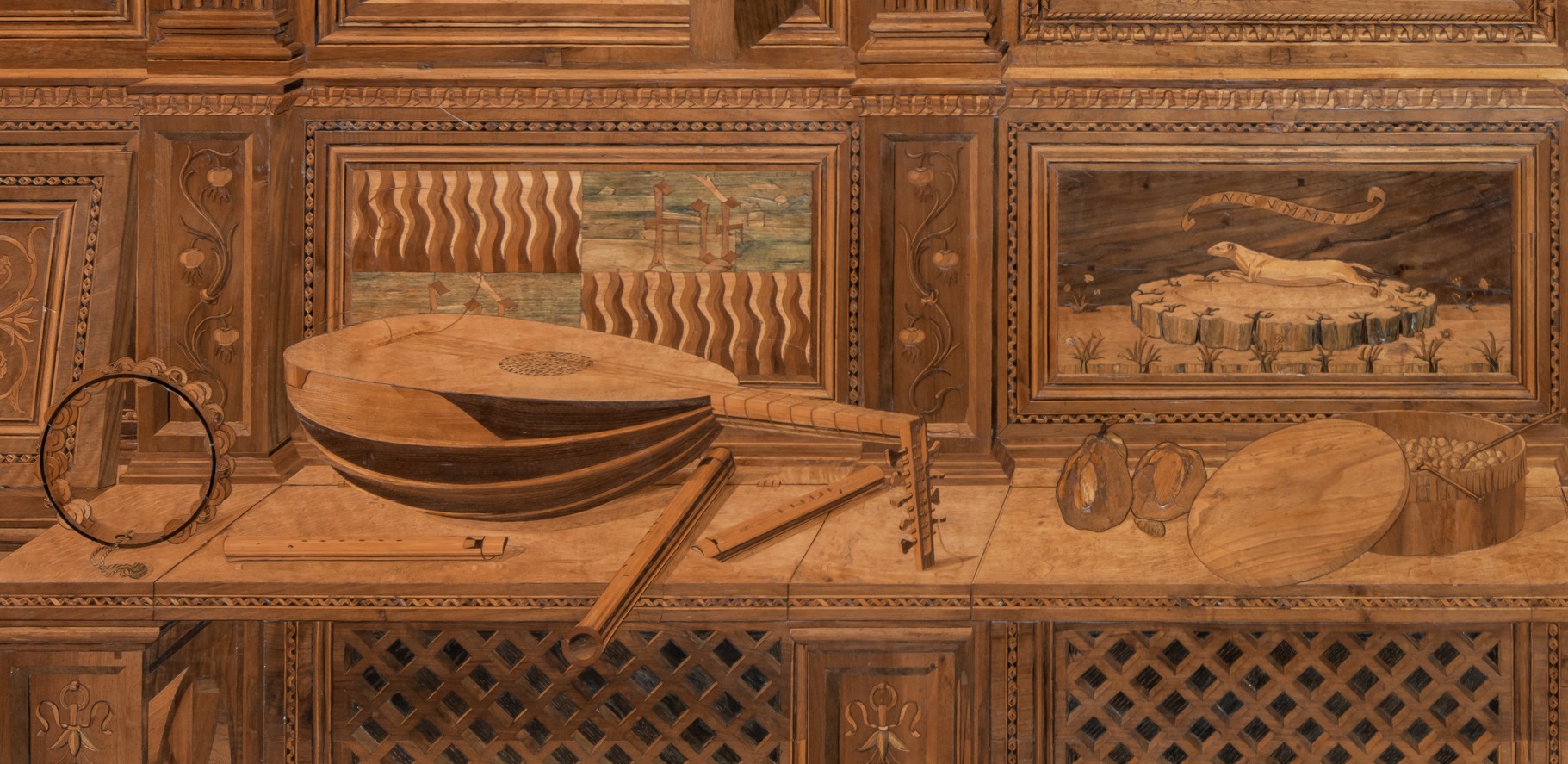
Un tempo, come accennato prima, all’interno dello Studiolo erano presenti tarsie, pitture e intaglio ligneo, realizzati sia a Firenze, sia a Urbino, nella prima metà degli anni settanta del XV secolo.
La proposta di riallestimento ha dovuto tener conto della perdita parziale delle pitture causata dall’asportazione barberininiana del 1632 e delle modifiche che la stanza ha subito, specialmente nella parte superiore, dal 1632 alla fine degli anni settanta del secolo scorso.
Per il momento il sempre vostro Michelangelo Buonarroti vi saluta dandovi appuntamento ai prossimi post e sui social.
Urbino: Federico da Montefeltro’s Studiolo reopens
The Studiolo of Federico da Montefeltro at the Palazzo Ducale in Urbino finally reopens to the public, after the restoration work that affected the environment, starting from November 4th.
On Friday, May 30th at 4:00 pm, the result of the delicate work carried out in the Studiolo will be presented to the public.
“The funding from the PNRR has made it possible to tackle the necessary renovation of the museum’s systems that were obsolete – says director Gallo – on this occasion, given the considerable involvement of the structure, we proceeded with an accurate operation of restoration and study of the building, as well as the complete reorganization of the works. “
The history of Federico da Montefeltro’s Studiolo
The Studiolo is the most intimate room in Federico da Montefeltro’s apartment and at the same time the most representative of the Duke’s public figure. It was a place of study but also of personal meditation, created drawing inspiration from the meditation studios present in medieval monasteries.
On the entrance door on the side of the Audience Hall, one was introduced into the Studiolo by passing in front of the dynastic portrait of Federico and his son Guidubaldo made by the Spanish painter Berruguete.
The painter had highlighted the recognitions received in the summer of 1474 from Ferdinand of Aragon, King of Naples, and from Edward IV of England: the ermine collar and the garter, also repeated in the inlays.
The works for the decoration of the Studiolo were completed in 1476, a date written in the commemorative band below the ceiling.
You should know that the inlays were made in Florence by the brothers Giuliano and Benedetto da Maiano. Instead, the paintings of the 28 illustrious figures of the Greco-Roman world and the Middle Ages with the addition of contemporary figures such as Vittorino da Feltre, his friend Bessarione and Pope Sixtus IV, were commissioned to Giusto di Gand and then completed by Berruguete himself in Urbino.
The placement on two levels separates the men of the church at the bottom with the addition of the Christian poets Dante and Petrarca and the lay people at the top. Federico possessed the writings of all of them in his library.
Lower down, the inlays depict shelves on which are scattered weapons, books and parchments, musical and mathematical instruments, even chess pieces, the theological Virtues (Hope, Faith and Charity) and Federico himself.
Below you can see the band divided into panels with the personal heraldic devices of the Duke with the symbols that make direct reference to his moral qualities.
In 1631, with the death of Francesco Maria II della Rovere, the Duchy of Urbino returned to the Church. It was then that Cardinal Antonio Barberini, an art lover, had the paintings of the Studiolo donated by his uncle Pope Urban VIII.
The large panels were torn from the walls, sawn into individual panels and transferred to Rome in his collection; they then passed into the family collection, where they remained until 1812.
In 1861, 14 portraits were purchased by Napoleon III for the nascent Musée Napoleon, the future Louvre, where they are currently located. The portraits that remained in Italy were purchased by the State in 1934 and destined for the Galleria Nazionale delle Marche.
The restoration
The Studiolo inlays and the coffered ceiling were dismantled in recent months and placed in the museum’s temporary storage to allow for work to update the electrical and fire prevention systems in this area of the building as well.
All the panels have been subjected to an anoxic treatment in combination with the application of anti-woodworm products, like the paintings on wood that will be re-arranged in the Duke’s apartment and the inlaid doors of the rooms, just as the paintings of the fourteen illustrious men have been treated, subject to a review of the state of conservation and maintenance interventions.
The new arrangement
The new arrangement of the Studiolo del Duca will draw on the long studies relating to its original construction and the events that have led to its existence.
As mentioned above, the Studiolo once featured inlays, paintings and wood carvings, made both in Florence and Urbino, in the first half of the seventies of the fifteenth century.
The re-arrangement proposal had to take into account the partial loss of the paintings caused by the Barberini removal of 1632 and the modifications that the room underwent, especially in the upper part, from 1632 to the end of the seventies of the last century.
For now, yours ever Michelangelo Buonarroti bids you farewell and gives you an appointment for the next posts and on social media.

Sostienici – Support Us
Se questo blog ti piace e ti appassiona, puoi aiutarci a farlo crescere sempre più sostenendoci in modo concreto condividendo i post, seguendo le pagine social e con un contributo che ci aiuta ad andare avanti con il nostro lavoro di divulgazione. . ENGLISH: If you like and are passionate about this blog, you can help us make it grow more and more by supporting us in a concrete way by sharing posts, following social pages and with a contribution that helps us to move forward with our dissemination work.
10,00 €
Condividi:


Questo sono io





sostienici

Sostienici – Support Us
Se questo blog ti piace e ti appassiona, puoi aiutarci a farlo crescere sempre più sostenendoci in modo concreto condividendo i post, seguendo le pagine social e con un contributo che ci aiuta ad andare avanti con il nostro lavoro di divulgazione. . ENGLISH: If you like and are passionate about this blog, you can help us make it grow more and more by supporting us in a concrete way by sharing posts, following social pages and with a contribution that helps us to move forward with our dissemination work.
€10,00


