

Rocchetta Mattei: le meraviglie del castello eclettico dell’Appennino
Se desiderate visitare un luogo diverso da tutti gli altri, tanto eccentrico quanto fiabesco, la Rocchetta Mattei è ciò che, senza sapere, state cercando.
Ubicato nel cuore dell’Appennino Bolognese, nel comune di Grizzana Morandi, la sua costruzione fu voluta dal conte Cesare Mattei e fu edificata al di sopra delle rovine di un’antico complesso medievale, un tempo appartenuto a Federico Barbarossa.
Intravedendo la sagoma del castello da lontano, già si intuisce lo stile eclettico che mescola stili differenti che spaziano dal medievale al moresco, dal neorinascimentale al Liberty.

La storia di Rocchetta Mattei
Avviata nel 1850, la costruzione del castello proseguì fino agli inizi del Novecento e Mattei non ebbe modo di vedere l’opera terminata.
Torri, terrazze, passaggi segreti e sale si susseguono offrendo spettacolari viste sugli Appennini. Non mancano gli effetti a sorpresa e illusioni ottiche sorprendenti come l’intreccio di archi bianchi e neri nella spettacolare cappella o le scale a chiocciola che, con la loro colorazione bicroma, danno l’impressione di avere a che fare con due rampe.
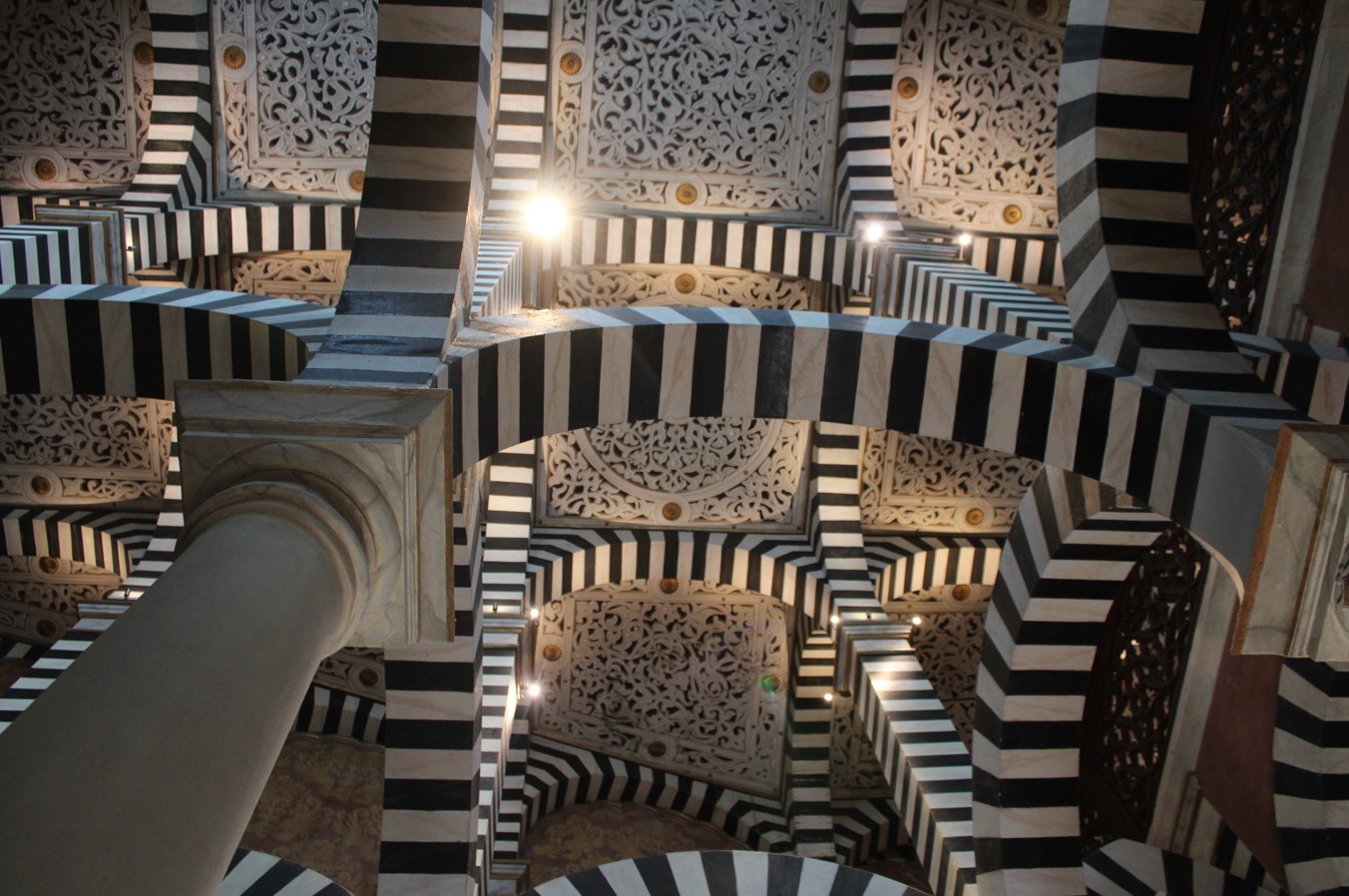
L’interesse per culture diverse di Mattei, gli permise di arricchire la Rocchetta con opere antiche straordinarie, mescolandole all’architettura a lui contemporanea.
Il cortile centrale
Nei primi anni di esistenza della Rocchetta Mattei, quando ancora era in costruzione, il cortile centrale era adoperato come deposito per i materiali. Dal cortile si dipartono tutte le ali del castello e al suo interno sono collocate alcune delle opere più preziose.
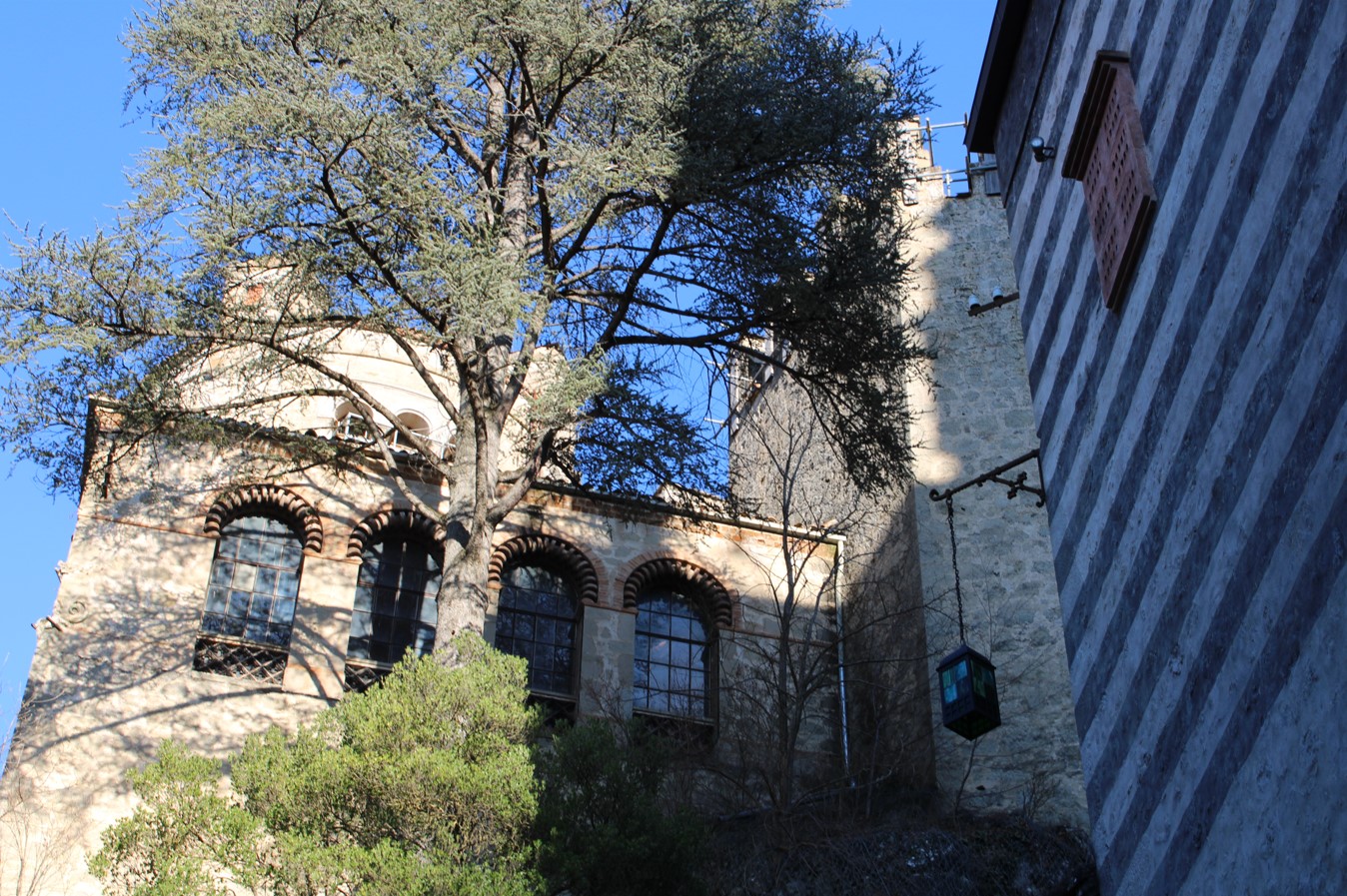
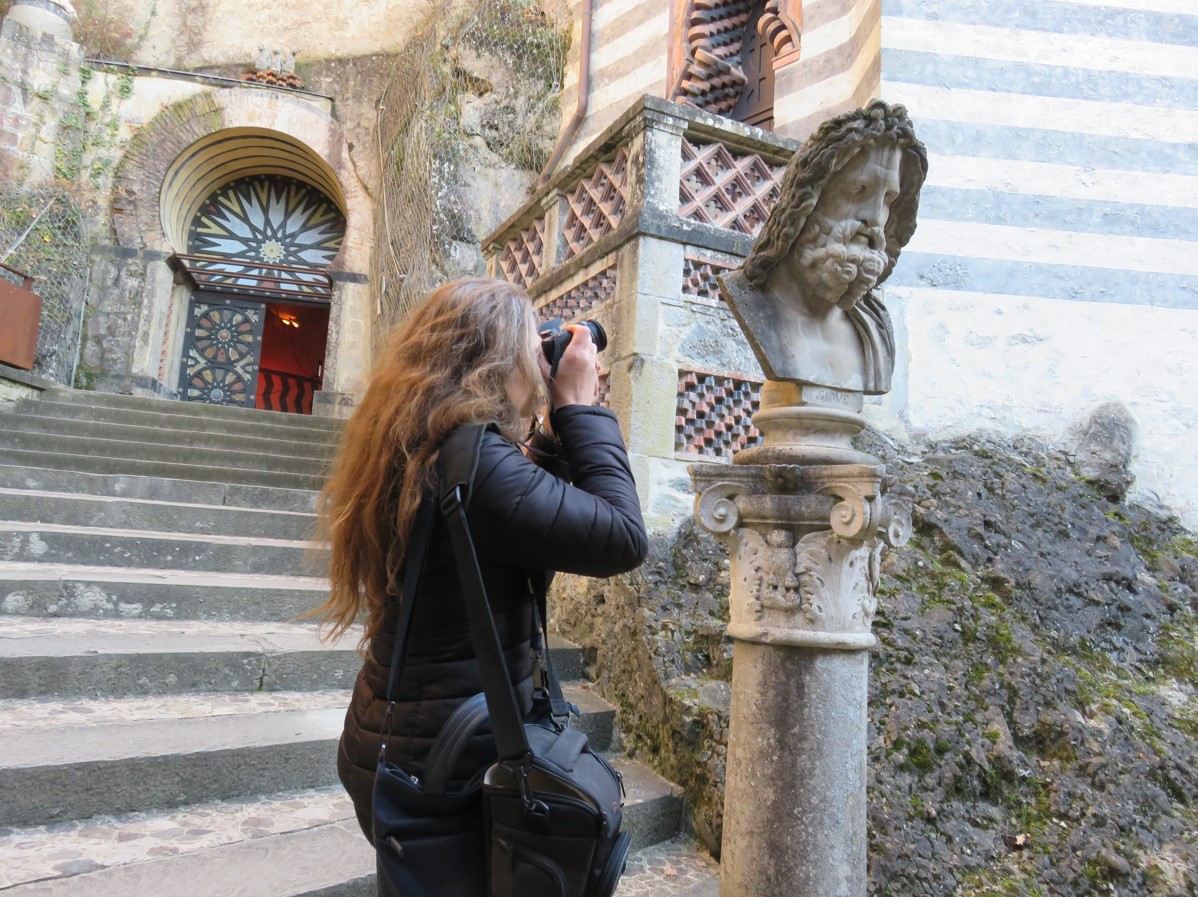
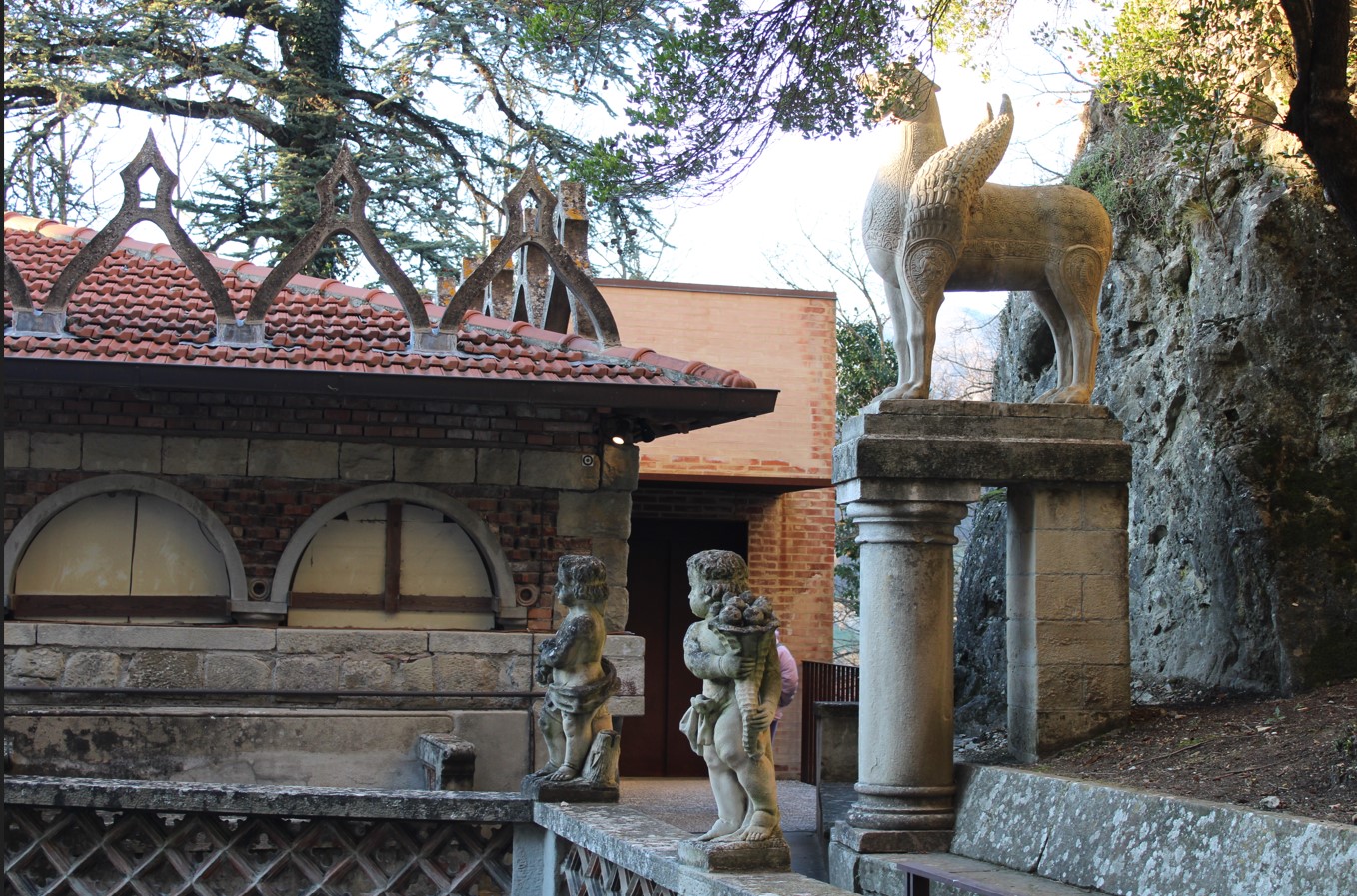
Quello che sembra un pozzo è in realtà un fonte battesimale medievale che Mattei recuperò da una chiesa crollata nelle vicinanze, quella di Verzuno. Invece, i telamoni in marmo di Verona che sostengono l’arco, sono opere originali romaniche risalenti al XII secolo del maestro Nicholaus della Cattedrale di Ferrara, vincolate dalla Soprintendenza.
La struttura che fa da entrata a una porta laterale non è altro che il fronte di un antico caminetto mentre in alto, alle finestre, si vedono antichi pulpiti.
La Cappella della Rocchetta Mattei
Tra gli ambienti più sorprendenti della Rocchetta, c’è sicuramente la Cappella con la iconica foresta di archi bianchi e neri.
La sua edificazione fu voluta dal conte ma venne ultimata dal figlio adottivo Mario Venturoli. E’ ispirata alla sontuosa Mezquita di Cordoba, oggi cattedrale cattolica ma un tempo una delle più grandi moschee di tutto il bacino del Mediterraneo.
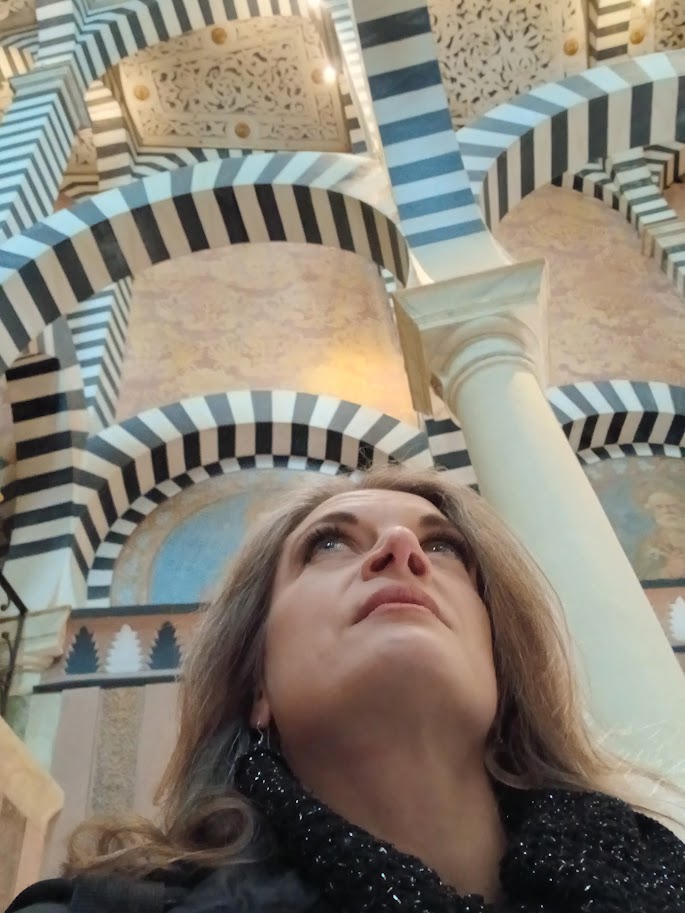
Difficile rimanere indifferenti a uno spettacolo simile che inganna continuamente l’occhio grazie all’uso di tecniche costruttive scenografiche. Il soffitto che sembra realizzato con gli stucchi è invece in stoffe dipinte, fissate con bottoni dorati.
Le doppie arcate a strisce bianche e nere non sono in muratura come sembrano ma in legno mentre i capitelli delle colonne sono di gesso dipinto.

Quelli che a un disattento sguardo possono sembrare lunette con i mosaici degli apostoli, sono in
realtà affreschi successivamente incisi per simulare le tessere di un mosaico.
Il Conte Mattei è sepolto proprio in questa cappella, nella tribuna sopra l’altare. Il sarcofago coperto di maioliche realizzate dai fratelli Minghetti di Bologna custodisce ancora le sue spoglie.

Il cortile interno
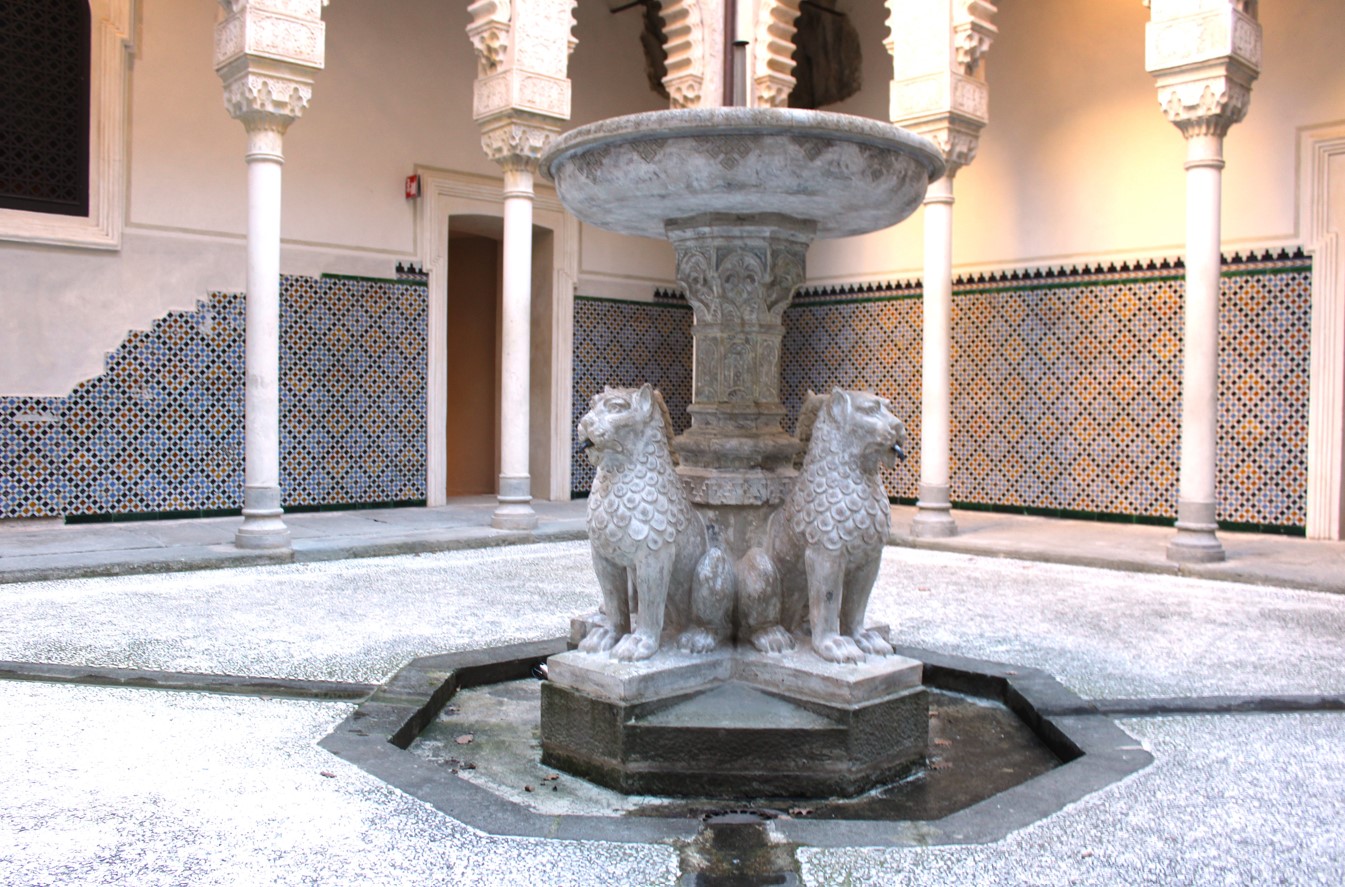
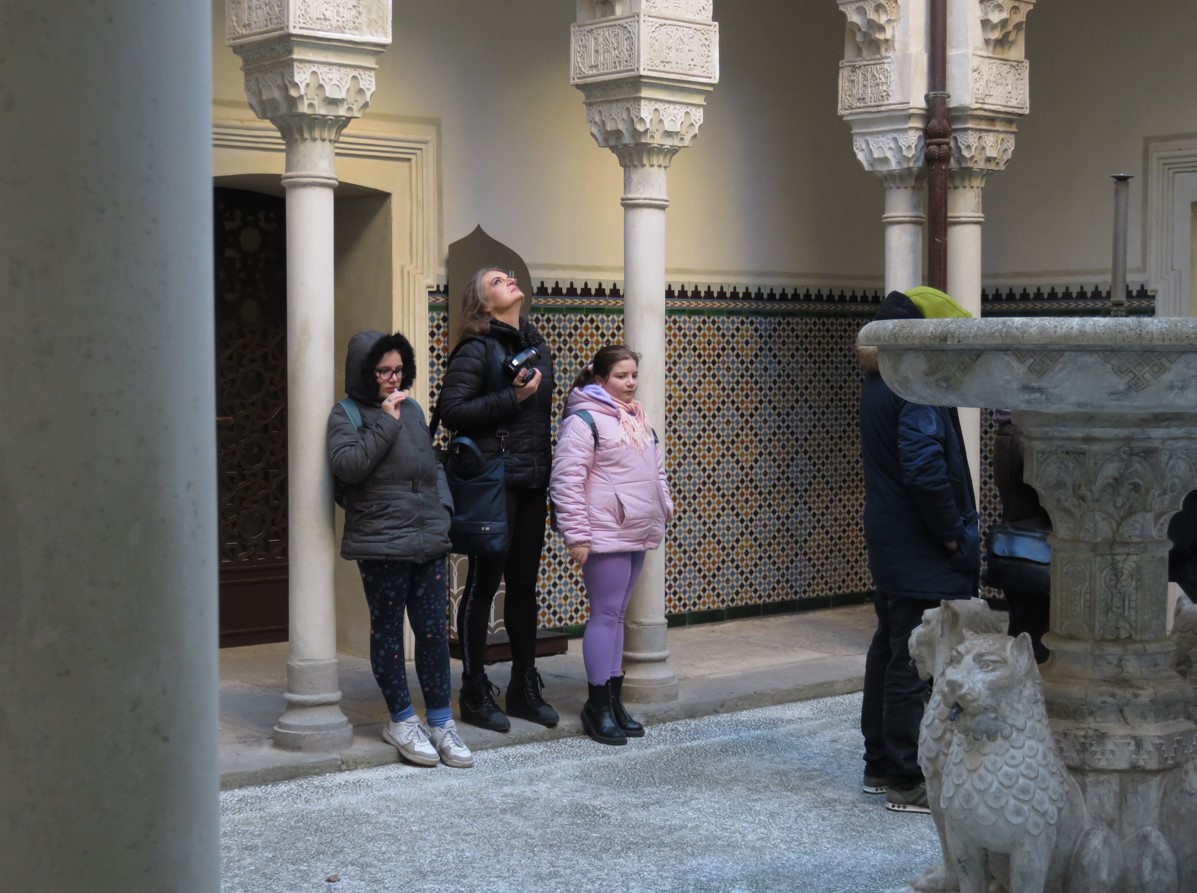
Passando da una sala a un’altra ci si ritrova nel Cortile interno della Rocchetta e, con grande sorpresa, sembra di essere al centro del Patio de los Leones nell’Alhambra di Granada.
Fu Cesare Mattei a volere dentro la sua dimora la riproduzione del patio spagnolo e fu riprodotto molto probabilmente usando le pubblicazioni di architetti al tempo celebri come Owen Jones che contribuì nell’Ottocento alla diffusione dello stile moresco.
Gli stucchi policromi tipici arabeggianti assieme gli stucchi che riproducono quelli dell’Alahambra e le pareti coperte di azulejos provenienti da Siviglia, riportano con la mente alle atmosfere iberiche.
Sala della musica
Dopo un percorso di scale e ponti realizzati in finto legno, ovvero in pietra lavorata per darle l’aspetto del legno, si entra nella sala della musica, quella più calda del castello.
Esposta al sole, con le sue vetrate e il pavimento in parquet, assorbe l’irradiazione solare divenendo tiepida negli inverni più rigidi e caldissima in estate.

Tutta la famiglia Mattei era appassionata di musica e volle dedicare un’intera stanza all’ascolto di musicisti e poeti.
I Mattei intrattennero stretti rapporti niente meno che con Rossini, abituale utilizzatore dei rimedi elettromeopatici.

Oggi nella sala sono esposti una serie di strumenti musicali meccanici dell’epoca provenienti dalla
“Collezione Marino Marini” di proprietà della Fondazione Cassa di Risparmio in Bologna.
Questi strumenti meccanici funzionanti permettevano e permettono tutt’oggi di riprodurre melodie e suoni anche senza musicisti che si esibivano dal vero.

Uscendo dalla sala verrete introdotti in un corridoio con una spettacolare vista sugli Appennini: fate caso però anche al pavimento realizzato in madreperla e ai soffitti decorati in stile moresco.
Altre curiosità
Le particolarità presenti nella Rocchetta Mattei sono tantissime e val bene una o più visite per conoscerle tutte. C’è ad esempio la scala a chiocciola, tinteggiata in modo tale da dare l’impressione di avere a che fare due scale sovrapposte.

All’interno del castello è stata girato nel periodo di chiusura per il Covid il reality ‘Voglio essere un mago’ con i ragazzi che aspiravano a diventare dei novelli Harry Potter, una serie che le bimbe del mio alter ego hanno particolarmente apprezzato.
Ma chi era il conte Cesare Mattei?
Mattei era un nobiluomo, inventore di una pratica medica che divenne molto popolare durante l’Ottocento: l’elettromeopatia.
Nato a Bologna da una famiglia benestante, intraprese la carriera politica nel 1837, divenendo uno dei fondatori della Cassa di Risparmio di Bologna. Aveva 18 anni quando il padre morì e assieme al fratello eredità il canale di Magnavacca, vicino Comacchio. La zona era sotto il dominio austriaco e i fratelli vollero disfarsene donando il terreno allo Stato Pontificio. Papa Pio IX, per ringraziarli, donò loro il titolo e ai discendenti il titolo di conti.
Era il 5 novembre 1850 quando venne posta la prima pietra della Rocchetta e solo nove anni dopo Mattei iniziò ad adoperarla come sua residenza anche se non era ultimata. Il conte, in modo anacronistico, scelse di condurre una vita da castellano con tanto di corte al seguito.

Intanto la fama del conte era sempre più nota grazie ai suoi studi sull’elettropatia: una pratica medica oggi ritenuta discutibile anche se in alcuni Paesi viene ancora adoperata. La Rocchetta era un vai e vieni continuo di persone che arrivavano lì per sottoporsi alle cure di Mattei. Furono ospiti del castello anche lo zar Alessandro II, Ludovico III di Baviera e fu visitata in via ufficiale dal Principe di Piemonte nel 1925.
Mattei tanto divenne celebre che finanche Dostoevskij lo cita in uno dei suoi capolavori letterari: ‘I fratelli Karamazov. Fa pronunciare il suo nome accennando all’elettropatia al diavolo in questi termini “Ma che filosofia e filosofia, quando tutta la parte destra del corpo mi si è paralizzata e io non faccio che gemere e lamentarmi. Ho tentato tutti i rimedi della medicina: sanno fare la diagnosi in maniera eccellente, conoscono la tua malattia come il palmo delle loro mani, ma non sono capaci di curare. […] Disperato, ho scritto al conte Mattei a Milano, che mi ha mandato un libro e delle gocce, che Dio lo benedica“.

Prenotazione e costi
- La visita alla Rocchetta Mattei può essere effettuata solo prenotando mediante il sito ufficiale (cliccate QUA) ed è sempre guidata.
- Le visite vengono effettuate in piccoli gruppi e partono ogni 15 minuti.
- Il biglietto ha un costo di 10 euro per gli adulti e 5 euro per i bambini al di sotto dei 12 anni. Un prezzo più che vantaggioso considerando che la visita guidata è inclusa.
- Si può parcheggiare negli spazi adiacenti e lungo la strada, dove si trova posto anche nei momenti di maggiore affluenza.
Insomma, Rocchetta Mattei è un luogo mozzafiato, in grado di affascinare grandi e piccini.
Per il momento il sempre vostro Michelangelo Buonarroti vi saluta dandovi appuntamento ai prossimi post e sui social.

Rocchetta Mattei: the wonders of the eclectic castle of the Apennines
If you want to visit a place different from all the others, as eccentric as it is fairytale-like, Rocchetta Mattei is what you are unknowingly looking for.
Located in the heart of the Bolognese Apennines, in the municipality of Grizzana Morandi, its construction was commissioned by Count Cesare Mattei in 1850 above the ruins of an ancient medieval complex, once owned by Frederick Barbarossa.
Glimpsing the outline of the castle from afar, you can already sense the eclectic style that mixes different styles ranging from medieval to Moorish, from neo-Renaissance to Liberty.
The history of Rocchetta Mattei
Begun in 1850, the construction of the castle continued until the beginning of the twentieth century and Mattei did not have the opportunity to see his work completed.
Towers, terraces, secret passages and rooms follow one another and offer spectacular views of the Apennines. There is no shortage of surprise effects such as the interweaving of black and white arches in the spectacular chapel or the spiral staircases that with their two-tone coloring create an interesting optical illusion.
Mattei’s interest in different cultures allowed him to enrich the Rocchetta with extraordinary ancient works, mixing them with the architecture of his time.
The central courtyard
In the early years of the existence of the Rocchetta Mattei, when it was still under construction, the central courtyard was used as a warehouse for materials. All the wings of the castle branch off from the courtyard and some of the most precious works are located inside it.
What looks like a well is actually a medieval baptismal font that Mattei recovered from a collapsed church nearby, that of Verzuno. Instead, the telamons in Verona marble that support the arch are original Romanesque works dating back to the 12th century by the master Nicholaus of the Cathedral of Ferrara, protected by the Superintendence.
The structure that serves as an entrance to a side door is nothing more than the front of an ancient fireplace while above, at the windows, you can see ancient pulpits.
The Chapel of the Rocchetta Mattei
Among the most surprising rooms of the Rocchetta, there is certainly the Chapel with the iconic forest of black and white arches.
Its construction was commissioned by the count but was completed by his adopted son Mario Venturoli. It is inspired by the sumptuous Mezquita of Cordoba, today a Catholic cathedral but once one of the largest mosques in the entire Mediterranean basin.
It is difficult to remain indifferent to such a spectacle that continually deceives the eye thanks to the use of scenographic construction techniques. The ceiling that seems to be made of stucco is actually made of painted fabrics, fixed with golden buttons.
The double arches with black and white stripes are not made of brickwork as they seem but of wood while the capitals of the columns are painted plaster.
What at a casual glance may seem like lunettes with mosaics of the apostles are in reality frescoes that were subsequently engraved to simulate the tiles of a mosaic.
Count Mattei is buried in this very chapel, in the gallery above the altar. The sarcophagus covered with majolica tiles made by the Minghetti brothers of Bologna still holds his remains.
The internal courtyard
Going from one room to another you find yourself in the internal courtyard of the Rocchetta and, with great surprise, it seems like you are in the center of the Patio de los Leones in the Alhambra in Granada. It was Cesare Mattei who wanted the reproduction of the Spanish patio inside his home and it was most likely reproduced using the publications of architects who were famous at the time such as Owen Jones who contributed to the diffusion of the Moorish style in the nineteenth century.
The typical arabesque polychrome stuccos with stuccos that reproduce those of the Alhambra and the walls covered with azulejos from Seville, bring to mind the Iberian atmospheres.
Music room
After a path of stairs and bridges made of fake wood, or stone worked to give it the appearance of wood, you enter the music room, the warmest room in the castle. Exposed to the sun, with its windows and parquet floor, it absorbs solar radiation becoming warm in the coldest winters and very hot in the summer.
The entire Mattei family was passionate about music and wanted to dedicate an entire room to listening to musicians and poets. The Matteis had a close relationship with none other than Rossini, a habitual user of electro-homeopathic remedies.
Today, the room displays a series of mechanical musical instruments from the period from the
“Marino Marini Collection” owned by the Fondazione Cassa di Risparmio in Bologna. These functioning mechanical instruments allowed and still allow the reproduction of melodies and sounds even without musicians performing live.
Leaving the room you will be introduced to a corridor with a spectacular view of the Apennines: but also notice the mother-of-pearl floor and the Moorish-style decorated ceilings.
Other curiosities
The peculiarities present in the Rocchetta Mattei are many and are worth one or more visits to know them all. For example, there is the spiral staircase, painted in such a way as to give the impression of having to deal with two overlapping staircases.
Inside the castle, during the Covid closure period, the reality show ‘I want to be a magician’ was filmed with the boys who aspired to become new Harry Potters, a series that the girls of my alter ego particularly appreciated.
But who was Count Cesare Mattei?
Mattei was a nobleman, inventor of a medical practice that became very popular during the nineteenth century: electrohomeopathy.
Born in Bologna to a wealthy family, he began his political career in 1837, becoming one of the founders of the Cassa di Risparmio di Bologna. He was 18 when his father died and together with his brother he inherited the Magnavacca canal, near Comacchio. The area was under Austrian rule and the brothers wanted to get rid of it by donating the land to the Papal State. Pope Pius IX, to thank them, gave them the title and to his descendants the title of counts.
It was November 5, 1850 when the first stone of the Rocchetta was laid and only nine years later Mattei began to use it as his residence even though it was not finished. Mattei, anachronistically, chose to lead the life of a castellan with a court in tow.
Meanwhile, the count’s fame was increasingly known thanks to his studies on electropathy: a medical practice today considered questionable even if in some countries it is still used. The Rocchetta was a constant coming and going of people who came there to undergo Mattei’s treatments. Tsar Alexander II and Ludwig III of Bavaria were also guests of the castle and it was officially visited by the Prince of Piedmont in 1925.
Mattei became so famous that even Dostoevsky mentioned him in one of his literary masterpieces: ‘The Brothers Karamazov. He makes his name be pronounced while referring to electropathy to the devil in these terms “But what philosophy and philosophy, when the whole right side of my body is paralyzed and I do nothing but moan and groan. I have tried all the remedies of medicine: they know how to diagnose excellently, they know your illness like the back of their hands, but they are not capable of curing. […] In desperation, I wrote to Count Mattei in Milan, who sent me a book and some drops, may God bless him”.
Booking and costs
-The visit to Rocchetta Mattei can only be done by booking through the official website (click HERE) and is always guided.
-The visits are carried out in small groups and depart every 15 minutes.
-The ticket costs 10 euros for adults and 5 euros for children under 12. A more than advantageous price considering that the guided tour is included.
-You can park in the adjacent spaces and along the road, where there is space even at peak times.
In short, Rocchetta Mattei is a breathtaking place, capable of fascinating adults and children.
For the moment, your ever Michelangelo Buonarroti bids you farewell, making an appointment with you in the next posts and on social media.

Sostienici – Support Us
Se questo blog ti piace e ti appassiona, puoi aiutarci a farlo crescere sempre più sostenendoci in modo concreto condividendo i post, seguendo le pagine social e con un contributo che ci aiuta ad andare avanti con il nostro lavoro di divulgazione. . ENGLISH: If you like and are passionate about this blog, you can help us make it grow more and more by supporting us in a concrete way by sharing posts, following social pages and with a contribution that helps us to move forward with our dissemination work.
10,00 €
Condividi:


Questo sono io





sostienici

Sostienici – Support Us
Se questo blog ti piace e ti appassiona, puoi aiutarci a farlo crescere sempre più sostenendoci in modo concreto condividendo i post, seguendo le pagine social e con un contributo che ci aiuta ad andare avanti con il nostro lavoro di divulgazione. . ENGLISH: If you like and are passionate about this blog, you can help us make it grow more and more by supporting us in a concrete way by sharing posts, following social pages and with a contribution that helps us to move forward with our dissemination work.
€10,00


Prima o poi ci devo andare, troppo bella questa costruzione! 👍👍👍👍👍👍👏👏😉😊😊😊😊
"Mi piace"Piace a 1 persona