

Riposo durante la Fuga in Egitto di Caravaggio: commissione e allegorie
Il dipinto che vi propongo oggi in questo 18 luglio in cui si ricorda la morte di Caravaggio, avvenuta a Porto Ercole nel 1610, è il Riposo durante la Fuga in Egitto, realizzato a olio su tela dall’artista fra il 1595 e il 1597.
Un’opera straordinaria e, a differenza delle altre creazioni di Caravaggio, molto luminosa, custodita nella Galleria Doria Pamphilj di Roma.

La commissione
L’identità del committente del “Riposo durante la Fuga in Egitto” è ancora oggetto di dibattito e studio.
Secondo Giulio Mancini, biografo di Caravaggio, l’opera fu commissionata da monsignor Fantino Petrignani, presso il quale il pittore alloggiò all’inizio del 1594 mentre secondo una recente ricerca condotta da Lothar Sickel, si può ipotizzare che il dipinto fosse stato realizzato per Girolamo Vittrici, cognato di Prospero Orsi nonché amico di Caravaggio. Secondo questa versione sarebbe stata poi la sorella di Girolamo, Caterina, a venderlo a Camillo Pamphilj.
L’ambientazione e le caratteristiche dei protagonisti
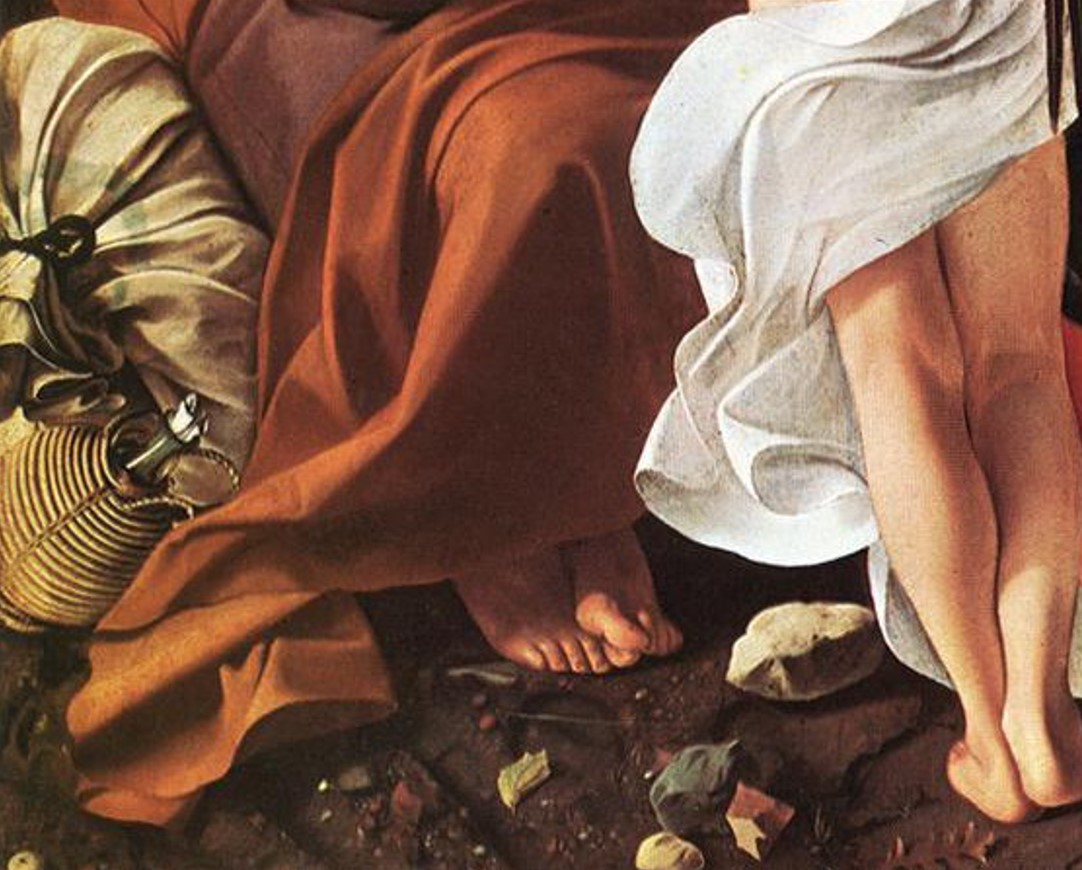
La Sacra Famiglia si ripara sotto le fronde degli alberi per recuperare energie durante il lungo viaggio. La scena è immersa in una luce dorata che contribuisce a ricreare un’atmosfera serena e contemplativa. La natura, con i suoi colori caldi e i suoi elementi rurali, offre rifugio e pace ai protagonisti.
La Vergine con il capo chino stringe il Figlio a sé mostra la sua stanchezza e un senso di vulnerabilità. San Giuseppe, alle sue spalle, ha invece il volto segnato da un’espressione protettiva e vigile.
L’angelo caratterizzato da un aspetto androgino suona il violino per allietarli. Le figure sono rappresentate a grandezza naturale, con dettagli anatomici precisi e una resa realistica dei tessuti e degli oggetti.
Le simbologie
La tela di Caravaggio è intrisa di simbologie che rimandano a temi religiosi e filosofici.
L’asino per esempio raffigura la pazienza e l’umiltà mentre i frutti e l’acqua alludono alla vita e alla rinascita. La presenza dell’angelo, con la sua musica celestiale, sottolinea la dimensione divina della Sacra Famiglia.
Vi faccio notare una cosa singolare: guardate la natura rappresentata ai piedi di San Giuseppe e quella vicino alla Vergine. Mentre attorno ai piedi di San Giuseppe è brulla, piena di sassi e con la terra a vista, la natura raffigurata ai piedi della Madonna è molto più rigogliosa. A fare da spartiacque fra le due ambientazioni c’è l’angelo.
E’ una raffigurazione dell’era pagana e di quella divina: pagana ancora quella di San Giuseppe e divina quella della Vergine.

La musica
Giuseppe sorregge fra le mani lo spartito che l’angelo musicante segue. Sono state riconosciute fra quelle note il motetto dedicato alla Vergine che fu composto nel 1519 dal musicista Noel Baulduin sul Cantico dei cantici dal titolo Quan pulchra es.
Secondo Calvesi esistono altri rimandi al Cantico nell’opera come per esempio la chioma della Vergine color rosso citata nel testo biblico “Le chiome del tuo capo sono come la porpora del re” ma anche il Suo sonnecchiare che richiama il verso “Io dormo, ma il mio cuore veglia”.

Non è finita qua. Se aguzzate la vista noterete che il violino ha una corda spezzata che mostra allegoricamente quanto sia precaria la vita.
Per il momento il sempre vostro Michelangelo Buonarroti vi saluta dandovi appuntamento ai prossimi post e sui social.

Rest during Caravaggio’s Flight into Egypt: commission and allegories
The painting that I propose to you today on this 18th of July in which we remember the death of Caravaggio, which occurred in Porto Ercole in 1610, is the Rest during the Flight into Egypt, created in oil on canvas by the artist between 1595 and 1597.
An extraordinary and, unlike Caravaggio’s other creations, very luminous work, kept in the Doria Pamphilj Gallery in Rome.
The Commission
The identity of the client of the “Rest during the Flight into Egypt” is still the subject of debate and study.
According to Giulio Mancini, Caravaggio’s biographer, the work was commissioned by Monsignor Fantino Petrignani, with whom the painter stayed at the beginning of 1594, while according to recent research conducted by Lothar Sickel, it can be hypothesized that the painting was created for Girolamo Vittrici, brother-in-law of Prospero Orsi and friend of Caravaggio. According to this version, it was Girolamo’s sister, Caterina, who sold it to Camillo Pamphilj.
The setting and the characteristics of the protagonists
The Holy Family takes shelter under the branches of the trees to recover energy during the long journey. The scene is immersed in a golden light which helps to recreate a serene and contemplative atmosphere. Nature, with its warm colors and its rural elements, offers refuge and peace to the protagonists.
The Virgin with her head bowed holds her Son close to her, showing her tiredness and a sense of vulnerability. Saint Joseph, behind her, instead has a face marked by a protective and alert expression.
The angel characterized by an androgynous appearance plays the violin to cheer them up. The figures are represented in life size, with precise anatomical details and a realistic rendering of tissues and objects.
The symbols
Caravaggio’s canvas is full of symbols that refer to religious and philosophical themes.
The donkey, for example, represents patience and humility while the fruits and water allude to life and rebirth. The presence of the angel, with his celestial music, underlines the divine dimension of the Holy Family.
I would like to point out something singular to you: look at the nature represented at the feet of Saint Joseph and the one near the Virgin. While around the feet of Saint Joseph it is barren, full of stones and with exposed earth, the nature depicted at the feet of the Madonna is much more lush. The angel acts as a watershed between the two settings.
It is a depiction of the pagan and divine eras: that of Saint Joseph is still pagan and that of the Virgin is divine.
The music
Joseph holds in his hands the score that the musician angel follows. Among those notes, the motet dedicated to the Virgin was recognized, which was composed in 1519 by the musician Noel Baulduin on the Song of Songs entitled Quan pulchra es.
According to Calvesi there are other references to the Canticle in the work such as for example the red hair of the Virgin mentioned in the biblical text “The hair of your head is like the purple of the king” but also her dozing which recalls the verse “I sleep, but my heart watches.”
It didn’t end there. If you look closely you will notice that the violin has a broken string which allegorically shows how precarious life is.
For the moment, your always Michelangelo Buonarroti greets you and will meet you in the next posts and on social media.

Sostienici – Support Us
Se questo blog ti piace e ti appassiona, puoi aiutarci a farlo crescere sempre più sostenendoci in modo concreto condividendo i post, seguendo le pagine social e con un contributo che ci aiuta ad andare avanti con il nostro lavoro di divulgazione. . ENGLISH: If you like and are passionate about this blog, you can help us make it grow more and more by supporting us in a concrete way by sharing posts, following social pages and with a contribution that helps us to move forward with our dissemination work.
10,00 €
-
La Lavanda dei Piedi di Tintoretto: Il Capolavoro Veneziano al Prado
🇮🇹Tra i capolavori più affascinanti del Rinascimento veneziano, “La Lavanda dei Piedi” di Jacopo Tintoretto rappresenta un perfetto equilibrio tra spiritualità, innovazione compositiva e straordinaria forza narrativa… 🇬🇧Among the most fascinating masterpieces of the Venetian Renaissance, Jacopo Tintoretto’s “The Washing of the Feet” represents a perfect balance between spirituality, compositional innovation, and extraordinary narrative force…
-
Il Sacrificio di Isacco e quel momento tra la vita e la morte
🇮🇹Oggi voglio raccontarvi alcuni dettagli sul mio disegno del Sacrificio di Isacco, conservato oggi a Casa Buonarroti. Su quel foglio volli tracciare il momento preciso in cui la paura fa spazio al miracolo… 🇬🇧Today I want to tell you some details about my drawing of the Sacrifice of Isaac, now preserved at Casa Buonarroti. On…
-
Mercoledì Santo: il giorno del tradimento di Giuda affrescato da Giotto
🇮🇹Il Mercoledì Santo è il giorno del silenzio, della riflessione e del tradimento. È il momento in cui Giuda sceglie di vendere Gesù per trenta denari, segnando uno dei passaggi più dolorosi della Settimana Santa…. 🇬🇧Holy Wednesday is a day of silence, reflection, and betrayal. ✝It is the moment when Judas chooses to sell Jesus…
Condividi:


Questo sono io





sostienici

Sostienici - Support Us
Se questo blog ti piace e ti appassiona, puoi aiutarci a farlo crescere sempre più sostenendoci in modo concreto condividendo i post, seguendo le pagine social e con un contributo che ci aiuta ad andare avanti con il nostro lavoro di divulgazione. . ENGLISH: If you like and are passionate about this blog, you can help us make it grow more and more by supporting us in a concrete way by sharing posts, following social pages and with a contribution that helps us to move forward with our dissemination work.
€10,00


1 commento »