

L’angelo etereo e l’angelo terreno
Non esistono angeli più diversi fra loro al mondo, scolpiti per una sola opera. Uno esile e l’altro corpulento, uno etereo e l’altro più che terreno.
L’angelo che scolpii quando avevo diciannove anni è collocato nel registro inferiore dell’Arca di San Domenico, a Bologna, posto in pendant a quello che anni prima aveva realizzato Niccolò dell’Arca.
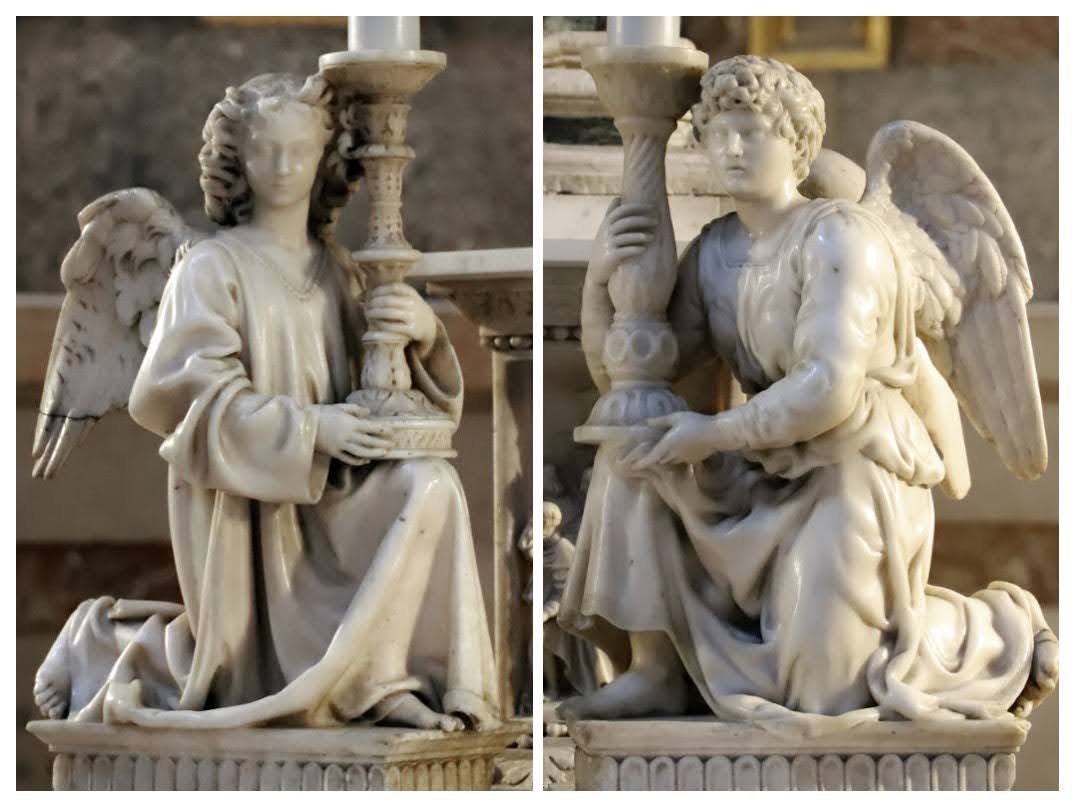
Etereo e distaccato dal mondo terreno quello di Niccolò dell’Arca, delicato e ispirato al gotico internazionale, si contrappone in modo netto al mio angelo, assai più terreno che celeste.
Con lo sguardo perso nel vuoto e un corpo da atleta è invece il mio angelo che accenna una rotazione del busto tenendo fra le mani il candelabro tipicamente fiorentino, sostenendone il peso sul ginocchio sinistro.
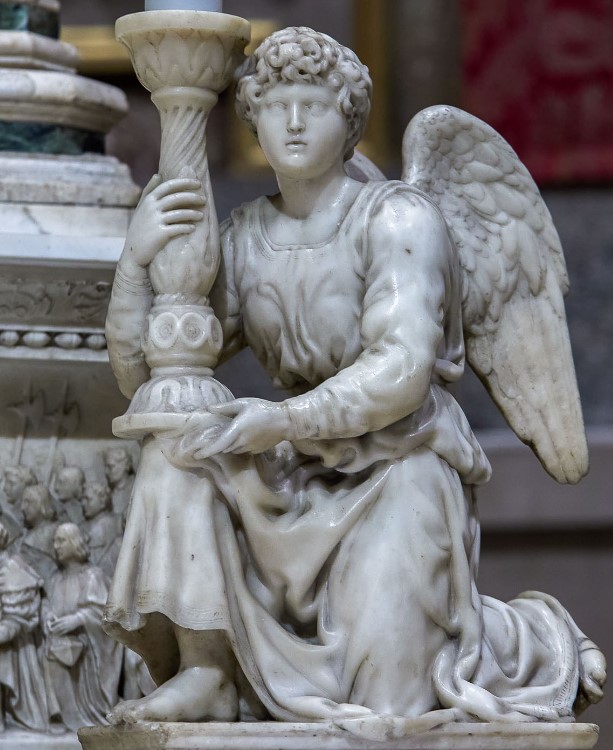
L’angelo reggicandelabro fu la prima scultura a cui misi mano per l’Arca di San Domenico e subito mi dovetti fronteggiare con quello che per me era un grande problema: le ali.
Come posizionarle? Dove attaccarle? Al corpo o alla veste?
In fondo un angelo in carne e piume mai l’avevo visto e la sua anatomia mi era sconosciuta. Riprodurre quegli orpelli era un ostacolo non di poco conto.

Talmente ritenevo improbabili quelle appendici che poi negli anni a seguire preferii eliminare il problema alla radice dando spazio piuttosto ad angeli privi di ali come quelli che potete apprezzare nel Giudizio Universale o in altri disegni miei.
Per il momento il vostro Michelangelo Buonarroti vi saluta dandovi appuntamento ai prossimi post e sui social.
The ethereal angel and the earthly angel
The ethereal angel and the earthly angel
There are no more different angels in the world, sculpted for a single work. One slender and the other corpulent, one ethereal and the other more than earthly.
The angel that I sculpted when I was nineteen is located in the lower register of the Arca di San Domenico, in Bologna, matching the one that Niccolò dell’Arca had created years earlier.
Ethereal and detached from the earthly world, that of Niccolò dell’Arca, delicate and inspired by international Gothic, contrasts clearly with my angel, much more earthly than celestial.
With his gaze lost in space and an athlete’s body, it is my angel who hints at a rotation of the torso, holding the typically Florentine candelabra in his hands, supporting its weight on his left knee.
The candlestick angel was the first sculpture I worked on for the Arca di San Domenico and I immediately had to face what was a big problem for me: the wings.
Where to attach them? to the body or to the dress? After all, I had never seen an angel in flesh and feathers and his anatomy was unknown to me. Reproducing those trappings was a significant obstacle.
I considered those appendages so unlikely that in the following years I preferred to eliminate the problem at its root, giving space instead to wingless angels like those you can appreciate in the Last Judgment or in my other drawings.
For the moment, your Michelangelo Buonarroti greets you and will meet you in future posts and on social media.

Sostienici – Support Us
Se questo blog ti piace e ti appassiona, puoi aiutarci a farlo crescere sempre più sostenendoci in modo concreto condividendo i post, seguendo le pagine social e con un contributo che ci aiuta ad andare avanti con il nostro lavoro di divulgazione. . ENGLISH: If you like and are passionate about this blog, you can help us make it grow more and more by supporting us in a concrete way by sharing posts, following social pages and with a contribution that helps us to move forward with our dissemination work.
8,00 €
-
La Pietà di Tincolini: a Pontedera l’arte torna a fare domande scomode
🇮🇹“Pietà”, la scultura di Filippo Tincolini, insieme alle parole di Federico Quaranta e Andrea Pezzi, non è stato solo uno spettacolo. È stata una domanda lanciata in faccia al pubblico, impossibile da evitare: siamo ancora capaci di provare pietà? 🇬🇧 “Pietà,” Filippo Tincolini’s sculpture, along with the words of Federico Quaranta and Andrea Pezzi, wasn’t…
-
Ai Musei Vaticani i fasti barocchi di Urbano VIII: in mostra gli arazzi della manifattura Barberini
🇮🇹A quattro secoli dalla consacrazione della Basilica di San Pietro, i Musei Vaticani dedicano una mostra all’Arazzeria Barberini, simbolo di una cultura visiva capace di fondere magnificenza estetica e affermazione politica… 🇬🇧Four centuries after the consecration of St. Peter’s Basilica, the Vatican Museums are dedicating an exhibition to the Barberini Tapestry Factory, a symbol of…
-
Le Opere della Pasqua: come la Resurrezione ha ispirato Arte e Cultura
🇮🇹La Pasqua, oltre ad essere una ricorrenza religiosa è un momento in cui la storia, l’arte e la spiritualità si intrecciano per raccontare il fulcro della fede cristiana: la resurrezione di Cristo. .. 🇬🇧Easter, beyond being a religious holiday, is a moment when history, art, and spirituality intertwine to recount the core of the Christian…
Condividi:


Questo sono io





sostienici

Sostienici – Support Us
Se questo blog ti piace e ti appassiona, puoi aiutarci a farlo crescere sempre più sostenendoci in modo concreto condividendo i post, seguendo le pagine social e con un contributo che ci aiuta ad andare avanti con il nostro lavoro di divulgazione. . ENGLISH: If you like and are passionate about this blog, you can help us make it grow more and more by supporting us in a concrete way by sharing posts, following social pages and with a contribution that helps us to move forward with our dissemination work.
€10,00


Sempre grazie per i tuoi articoli belli ed interessanti.
"Mi piace"Piace a 1 persona
grazie :-*
"Mi piace"Piace a 1 persona