

Cosimo il Vecchio torna a prendere il potere dopo l’esilio nell’opera del Vasari
Palazzo Vecchio a Firenze racconta tante storie della città e di chi l’ha dominata. La sua edificazione e decorazione è avvenuta in tempi diversi ma il grande rinnovamento fu voluto e portato avanti da Cosimo I de’ Medici, con la realizzazione dei cosiddetti ‘quartieri nuovi’.
La realizzazione dei quartieri dedicati a Leone X e a Eleonora di Toledo furono avviati da Battista del Tasso alla metà del Cinquecento e poi portati avanti tra il 1555 e il 1463 dal mio caro amico Giorgio Vasari con l’aiuto di vari collaboratori tra i quali Giovanni Stradano, Marco da Faenza e Cristofano Gherardi.
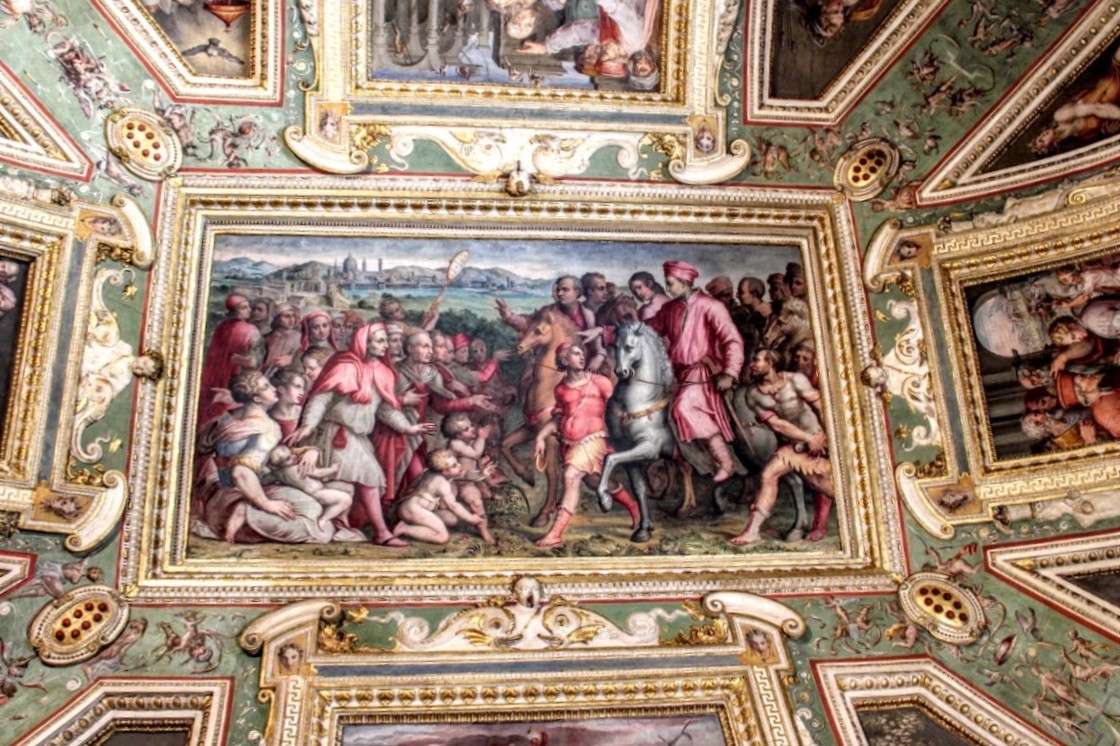
Ciascuna delle sale di Leone X è dedicata a un personaggio della famiglia Medici e ne racconta le imprese più significative.
Nella prima sala vengono raccontate le vicende di Cosimo il Vecchio al quale la casata deve l’affermazione del suo potere nel Quattrocento.
Sul soffitto Vasari volle dipingere a olio su intonaco l’incontro cha avvenne il 6 ottobre del 1434 tra Cosimo il Vecchio e un gruppo di autorevoli fiorentini, tra i quali erano presenti Niccolò da Uzzano e Tommaso Soderini.
Quell’incontro avvenne fuori dalla porta San Gallo durante il rientro dall’esilio da Cosimo da Padova.
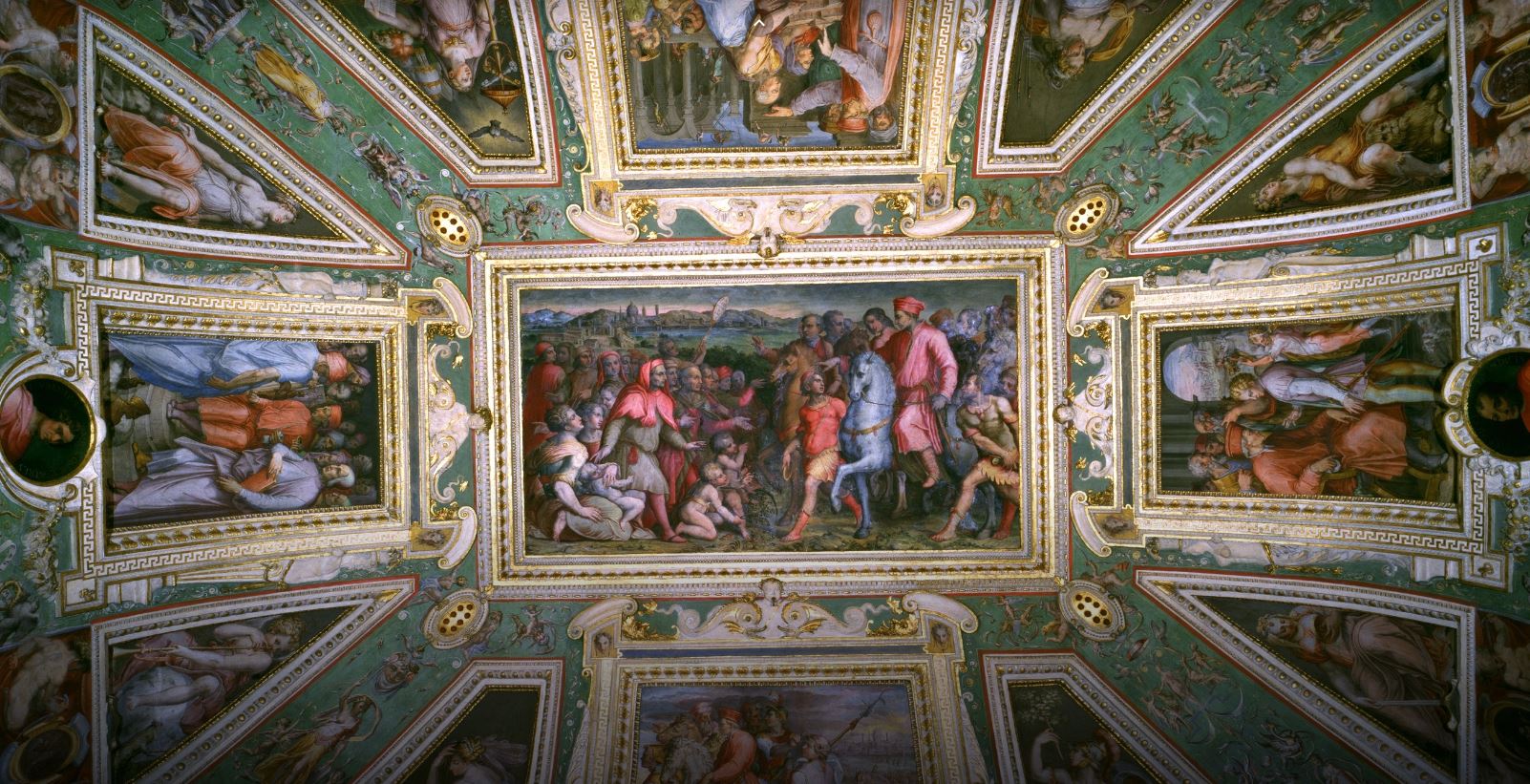
Il soggetto dell’opera fu suggerito all’artista da Cosimo Bartoli il quale in una lettera datata 1556, volle fargli dipingere quel momento.
Il Vasari poi descriverà quella scena in modo dettagliato nei suoi ‘Ragionamenti’. Proprio in virtù di quel testo, il Cecchi è riuscito a dare un’identità alla maggior parte dei personaggi che l’aretino inserì nell’opera.
Il prestigio e la forza politica di Cosimo il Vecchio lo rendeva di giorno in giorno più autorevole ma a contrastare il suo potere c’erano le famiglie nobiliari fiorentine degli Albizi e degli Strozzi.
In fondo i Medici non erano né una famiglia nobile e nemmeno fiorentina e già quando Giovanni de Medici, padre di Cosimo, era ancora in vita, le altre due famiglie rivali avevano avviato una grande campagna denigratoria contro di loro.

Il 5 settembre 1433 Cosimo dei Medici venne fatto andare a Palazzo Vecchio, con la scusa dello sbrigo di una pratica ma fu aggredito e incarcerato. Condannato a morte riuscì a salvarsi offrendo tanti danari ai suoi aguzzini.
Fu allora che gli fu risparmiata la vita ma imposto l’esilio a Padova e a Venezia per un periodo compreso tra i cinque e i dieci anni.
Vasari nell’affresco di Palazzo Vecchio raffigura il momento del rientro in città di Cosimo il Vecchio avvenuto a un anno di distanza dall’esilio, il 5 ottobre del 1434. Fu un ritorno trionfale che lo porterà a prendere il comando della città.
Per il momento il sempre vostro Michelangelo Buonarroti vi saluta dandovi appuntamento ai prossimi post e sui social.

Cosimo the Elder returns to power after exile in Vasari’s work
Palazzo Vecchio in Florence tells many stories of the city and of those who dominated it. Its construction and decoration took place at different times and a major renovation was desired and carried out by Cosimo I de’ Medici with the creation of the so-called ‘new districts’.
The construction of the districts dedicated to Leo X and Eleonora di Toledo were started by Battista del Tasso in the mid-16th century and then continued between 1555 and 1463 by my dear friend Giorgio Vasari with the help of various collaborators including Giovanni Stradano, Marco da Faenza and Cristofano Gherardi.
Each of the rooms of Leo X is dedicated to a figure of the Medici family and recounts their most significant exploits.
The first room tells the story of Cosimo the Elder to whom the family owes the affirmation of its power in the 15th century.
On the ceiling Vasari wanted to paint in oil on plaster the meeting that took place on October 6, 1434 between Cosimo the Elder and a group of authoritative Florentines, among whom were Niccolò da Uzzano and Tommaso Soderini.
That meeting took place outside the Porta San Gallo during Cosimo da Padova’s return from exile.
The subject of the work was suggested to the artist by Cosimo Bartoli who, in a letter dated 1556, wanted him to paint that moment.
Vasari later described that scene in detail in his ‘Ragionamenti’. Precisely by virtue of that text, Cecchi was able to give an identity to most of the characters that the Arezzo native inserted into the work.
The prestige and political strength of Cosimo the Elder made him more authoritative day by day but his power was opposed by the noble Florentine families of Albizi and Strozzi. After all, the Medici were neither a noble family nor even Florentine and already when Giovanni de Medici, Cosimo’s father, was still alive, the other two rival families had started a great smear campaign against them.
On September 5, 1433, Cosimo de’ Medici was sent to Palazzo Vecchio, with the excuse of taking care of a matter but he was attacked and imprisoned. Sentenced to death, he managed to save himself by offering a lot of money to his torturers.
It was then that his life was spared but he was forced into exile in Padua and Venice for a period of between five and ten years.
In the fresco in Palazzo Vecchio, Vasari depicts the moment of Cosimo the Elder’s return to the city, which took place a year after his exile, on October 5, 1434. It was a triumphal return that would lead him to take command of the city.
For the moment, yours truly Michelangelo Buonarroti bids you farewell and says goodbye, seeing you in the next posts and on social media.

Sostienici – Support Us
Se questo blog ti piace e ti appassiona, puoi aiutarci a farlo crescere sempre più sostenendoci in modo concreto condividendo i post, seguendo le pagine social e con un contributo che ci aiuta ad andare avanti con il nostro lavoro di divulgazione. . ENGLISH: If you like and are passionate about this blog, you can help us make it grow more and more by supporting us in a concrete way by sharing posts, following social pages and with a contribution that helps us to move forward with our dissemination work.
10,00 €
Condividi:


Questo sono io





sostienici

Sostienici – Support Us
Se questo blog ti piace e ti appassiona, puoi aiutarci a farlo crescere sempre più sostenendoci in modo concreto condividendo i post, seguendo le pagine social e con un contributo che ci aiuta ad andare avanti con il nostro lavoro di divulgazione. . ENGLISH: If you like and are passionate about this blog, you can help us make it grow more and more by supporting us in a concrete way by sharing posts, following social pages and with a contribution that helps us to move forward with our dissemination work.
€10,00


