

L’Afrodite di Capua: un capolavoro della statuaria antica
L’eleganza delle movenze abbinata alla grazia delle forme, fanno dell’Afrodite di Capua uno dei capolavori della statuaria antica più belli che il Museo Archeologico di Napoli custodisca.
La scultura è una copia romana in marmo di un originale in bronzo andato perduto risalente al Quarto secolo avanti Cristo. Ha dimensioni maggiori del normale già che ha un’altezza complessiva di 2,20 metri.

La scultura è stata datata alla prima metà Il secolo d.C e fu rinvenuta tra le rovine di Santa Maria Capua Vetere, durante gli degli scavi effettuati a metà del Settecento che coinvolsero tutta l’area del noti anfiteatro campano. Stando alla ricostruzione dell’architetto Alvino del 1833, l’opera in origine decorava i vani della summa cavea del secondo o del terzo ordine.
La Venere trionfante è scolpita a seno e busto scoperti, con un ricco panneggio che dall’altezza del pube che le scende fino ai piedi.

Le braccia levate verso l’alto e staccate dal corpo denotano la possibile presenza, in origine, di uno scudo: probabilmente era quello di Marte che Venere adoperò per specchiarsi. Mentre il piede destro scarica il peso a terra, l’altro è appoggiato sopra quello che sembrerebbe essere un elmo. Che sia quello di Minerva? Potrebbe essere più plausibilmente quello di Marte.
Scrisse il poeta ellenistico Leonida: “Perché, o Venere, indossi tu le armi di Marte? E’ vero che tu l’hai disarmato; ma un dio è stato vinto, come vuoi tu dunque far guerra agli uomini?”.

Osservando la Venere di Capua a distanza ravvicinata, si nota che sono presenti diverse integrazioni realizzate con marmo diverso da quello originale. Sono infatti frutto del restauro integrativo effettuato da Augusto Brunelli nel 1820 che coinvolse in modo particolare le braccia e alcuni dettagli del volto che erano totalmente assenti.
Vi faccio notare un particolare. Guardate le mani della dea: ancora hanno i ponticelli lasciati dal restauratore. I cosiddetti “ponticelli” sono quei piccoli collegamenti di marmo che il Brunelli ha lasciato tra le dita per fornire supporto strutturale durante la lavorazione.
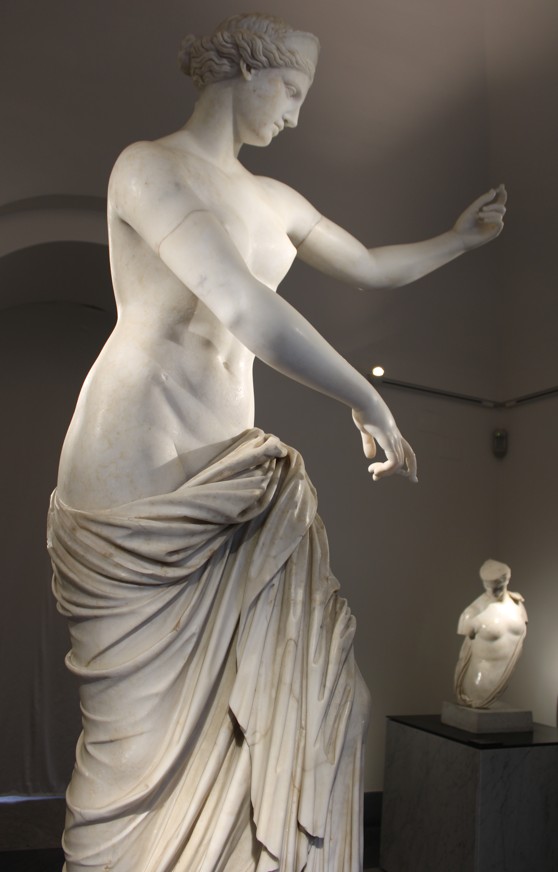
Di solito vengono lasciati in aree difficili da scolpire o sottili per evitare che le vibrazioni del martello e degli scalpelli, facciano saltar via le parti piccole.
In genere i ponticelli vengono poi eliminati a opera finita ma non è una regola. A volte infatti le dita o le altri parti sono talmente delicate che togliendoli si rischia di spezzarle e quindi, come in questo caso, sono stati lasciati.

Per il momento il sempre vostro Michelangelo Bonarroti vi saluta dandovi appuntameento ai prossimi post e sui social.

The Aphrodite of Capua: a masterpiece of ancient statuary
The elegance of the movements combined with the grace of the forms make the Aphrodite of Capua one of the most beautiful masterpieces of ancient statuary that the Archaeological Museum of Naples holds.
The sculpture is a Roman marble copy of a lost bronze original dating back to the fourth century BC. It has larger than normal dimensions since it has an overall height of 2.20 meters.
The sculpture has been dated to the first half of the second century AD and was found among the ruins of Santa Maria Capua Vetere, during the excavations carried out in the mid-eighteenth century that involved the entire area of the famous Campanian amphitheater. According to the reconstruction by the architect Alvino in 1833, the work originally decorated the rooms of the summa cavea of the second or third order.
The triumphant Venus is sculpted with her breasts and bust exposed, with a rich drapery that goes from the height of her pubis down to her feet.
The arms raised upwards and detached from the body denote the possible presence, originally, of a shield: it was probably that of Mars that Venus used to look at herself in the mirror. While the right foot unloads its weight on the ground, the other is resting on what appears to be a helmet. Could it be that of Minerva? It could more plausibly be that of Mars.
The Hellenistic poet Leonidas wrote: “Why, O Venus, do you wear the weapons of Mars? It is true that you have disarmed him; but a god has been defeated, so how do you want to make war on men?”.
Observing the Venus of Capua at close range, you notice that there are several integrations made with marble other than the original. They are in fact the result of the integrative restoration carried out by Augusto Brunelli in 1820 which involved in particular the arms and some details of the face that were totally absent.
I would like to point out a detail. Look at the hands of the goddess: they still have the bridges left by the restorer. The so-called “bridges” are those small marble connections that Brunelli left between the fingers to provide structural support during the work.
Usually they are left in areas that are difficult to sculpt or thin to prevent the vibrations of the hammer and chisels from causing the small parts to pop off. Generally the bridges are then removed once the work is finished but this is not a rule. Sometimes in fact the fingers or other parts are so delicate that removing them risks breaking them and therefore, as in this case, they were left.
For the moment, your always Michelangelo Bonarroti says goodbye to you, giving you an appointment for the next posts and on social media.

Sostienici – Support Us
Se questo blog ti piace e ti appassiona, puoi aiutarci a farlo crescere sempre più sostenendoci in modo concreto condividendo i post, seguendo le pagine social e con un contributo che ci aiuta ad andare avanti con il nostro lavoro di divulgazione. . ENGLISH: If you like and are passionate about this blog, you can help us make it grow more and more by supporting us in a concrete way by sharing posts, following social pages and with a contribution that helps us to move forward with our dissemination work.
10,00 €
Condividi:


Questo sono io





sostienici

Sostienici – Support Us
Se questo blog ti piace e ti appassiona, puoi aiutarci a farlo crescere sempre più sostenendoci in modo concreto condividendo i post, seguendo le pagine social e con un contributo che ci aiuta ad andare avanti con il nostro lavoro di divulgazione. . ENGLISH: If you like and are passionate about this blog, you can help us make it grow more and more by supporting us in a concrete way by sharing posts, following social pages and with a contribution that helps us to move forward with our dissemination work.
€10,00


