

Le ultime Crocifissioni disegnate per un gruppo scultoreo
Fra i molti disegni che sono arrivati fino a voi, e chissà quanti n’ho bruciati, c’è un gruppo particolarmente numeroso: è quello delle Crocifissioni.
Ne disegnai molte a partire dal 1530 e fra quelle più celebri c’è sicuramente la Crocifissione con il Cristo sulla croce ancora vivo che pensai per Vittoria Colonna.
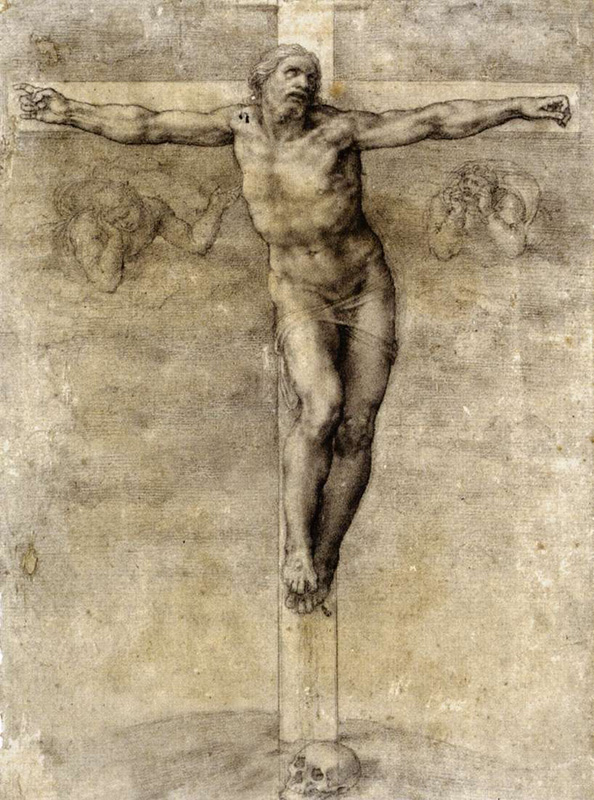
Il gruppo delle ultime Crocifissioni però, quello che culmina nel 1545, ha una particolarità che in pochi conoscono.
Con molta probabilità stavo studiando la giusta composizione per un gruppo scultoreo avente come soggetto proprio la Crocifissione. Le figure hanno una forma slanciata verso l’alto ma creano comunque un insieme compatto. Già anni prima avevo pensato di scolpire una Crocifissione e nell’ultimo periodo della vita, quell’idea mi tornò di nuovo ad accarezzare la mente.

Negli archivi di Casa Buonarroti è conservato un foglio nel quale avevo tracciato a mano libera gli schizzi di tre blocchi. Quei marmi mi sarebbero serviti per concretizzare il mio pensiero con tanto di misure ben dettagliate. Dal blocco di sinistra avrei cavato la Madonna, da quello al centro Cristo sulla Croce e dal blocco sulla destra la figura del San Giovanni.
Chissà quale Crocifissione poi avrei voluto scolpire delle tante che tracciai a carboncino. Forse questa che vi propongo a seguire è la più probabile, attualmente conservata presso il British Museum.
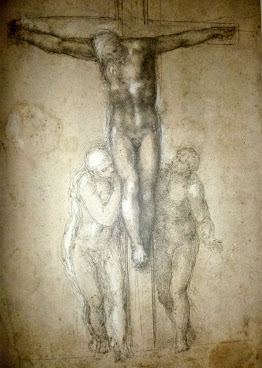
Nel foglio son presenti parecchie modifiche e pentimenti leggibili se si aguzza la vista.
San Giovanni, patrono dei fiorentini, si avvicina alla Croce abbracciandola e con la mano sfiora il capo della Madonna addolorata per la morte del Figlio. La Vergine si stringe a Cristo e sembra baciargli le gambe mentre ci si appoggia con il braccio destro. Una composizione commovente, capace di arrivare dritta al cuore di chi la osserva.
Il sempre vostro Michelangelo Buonarroti e i suoi racconti
The last Crucifixions designed for a sculptural group
Among the many drawings that have come down to you, and who knows how many I burned, there is a particularly large group: it is that of the Crucifixions. I drew many from 1530 and among the most famous ones there is certainly the Crucifixion with the Christ on the cross still alive that I thought for Vittoria Colonna.
The group of the last Crucifixions, however, the one that culminates in 1545, has a peculiarity that few know. Most probably I was studying the right composition for a sculptural group having the Crucifixion as its subject. The figures have a slender shape upwards but still create a compact whole. Already years before I had thought of sculpting a Crucifixion and in the last period of life, that idea came back to caress my mind again.

In the Casa Buonarroti archives there is a sheet in which I sketched three sketches freehand. Those marbles would have served me to realize my thoughts with a lot of well detailed measures. From the block on the left I would have carved out the Madonna, from the one in the center Christ on the Cross and from the block on the right the figure of Saint John.

Who knows what Crucifixion then I would have liked to sculpt so many charcoal traces. Perhaps the one I propose to follow is the most probable, currently kept at the British Museum.
The sheet contains several modifications and legible repentances if the view is sharpened. Saint John, patron saint of the Florentines, approaches the Cross embracing it and with his hand grazes the head of Our Lady of Sorrows for the death of the Son. The Virgin hugs Christ and seems to kiss his legs while leaning on his right arm. A moving composition, able to get straight to the heart of the viewer.
Your always Michelangelo Buonarroti and his stories

Sostienici – Support Us
Se questo blog ti piace e ti appassiona, puoi aiutarci a farlo crescere sempre più sostenendoci in modo concreto condividendo i post, seguendo le pagine social e con un contributo che ci aiuta ad andare avanti con il nostro lavoro di divulgazione. . ENGLISH: If you like and are passionate about this blog, you can help us make it grow more and more by supporting us in a concrete way by sharing posts, following social pages and with a contribution that helps us to move forward with our dissemination work.
10,00 €
-
Il mio primo soggiorno a Bologna e l’incontro con Giovan Francesco Aldrovandi
🇮🇹Fuggii da Firenze a soli 19 anni. Senza certezze, senza protezioni. Solo con il mio talento. A Bologna trovai rifugio nella casa di Giovan Francesco Aldrovandi… 🇬🇧I fled Florence at just 19. Without certainties, without protection. Only with my talent. In Bologna, I found refuge in the home of Giovan Francesco Aldrovandi…
-
11 aprile 1514: muore Donato Bramante, il genio della scala elicoidale
🇮🇹Era l’11 aprile 1514 quando Donato Bramante morì a Roma. La sua scomparsa non cancellò però le tensioni, le rivalità e i giudizi contrastanti che avevano accompagnato tutta la sua carriera… 🇬🇧It was April 11, 1514, when Donato Bramante died in Rome. His passing, however, did not erase the tensions, rivalries, and conflicting opinions that…
-
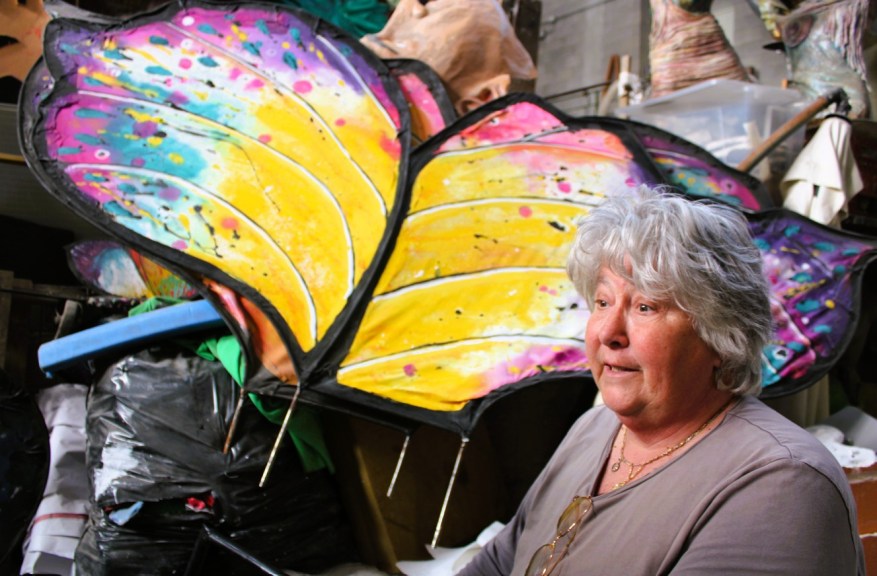
Dentro l’hangar 12 del Carnevale di Viareggio: dove la cartapesta prende vita con Marzia Etna
🇮🇹Ho incontrato Marzia Etna, maestra carrista da 40 anni: mentre racconta, le brillano gli occhi. E capisci subito una cosa: questo non è solo un lavoro, è vita tra carta a calco, ferro e sogni… 🇬🇧I met Marzia Etna, a master float builder for 40 years: her eyes sparkle as she talks. And you immediately…
Condividi:


Questo sono io





sostienici

Sostienici – Support Us
Se questo blog ti piace e ti appassiona, puoi aiutarci a farlo crescere sempre più sostenendoci in modo concreto condividendo i post, seguendo le pagine social e con un contributo che ci aiuta ad andare avanti con il nostro lavoro di divulgazione. . ENGLISH: If you like and are passionate about this blog, you can help us make it grow more and more by supporting us in a concrete way by sharing posts, following social pages and with a contribution that helps us to move forward with our dissemination work.
€10,00


1 commento »