

Sarah Bernhardt: nota attrice e straordinaria scultrice
La celebre Sarah Bernhardt, iconica attrice teatrale e cinematografica francese, considerata una delle più grandi donne di teatro del XIX secolo e musa ispiratrice di Mucha, era anche una straordinaria scultrice.
Realizzò diverse opere in marmo come Ofelia, Hermione e il Busto di Donna del quale voglio parlarvi oggi. La Bernhardt ebbe modo di cominciare la sua attività artistica all’inizio del 1870 sotto l’attenta guida di Roland Mathieu-Meusnier e Jules Franceschi.

Dopo aver aperto un proprio studio nel 1873, cominciò a dar forma a diverse opere che riscossero un grande successo, esponendo anche al Salon.
Sebbene abbia esposto per molti anni, fino ai primi anni del Novecento, il suo periodo più prolifico di attività scultorea fu negli anni Settanta dell’Ottocento, quando il suo impiego alla Comédie-Française le permise di dedicare tempo al lavoro in studio.
La Bernhardt era apprezzata in particolar modo per il modellato dei busti, per i quali ricevette elogi dalla critica.

Nelle sue memorie del 1907, scrisse con grande orgoglio di amici e conoscenti che posarono per i suoi busti ritratto nel 1874.
Alla mostra londinese della Bernhardt del 1879, furono due i suoi busti che si distinsero dagli altri. Un recensore scrisse: “La “stella” della Comédie-Française è preferibile nei busti. Tutti questi sono espressivi e caratteristici […]”.
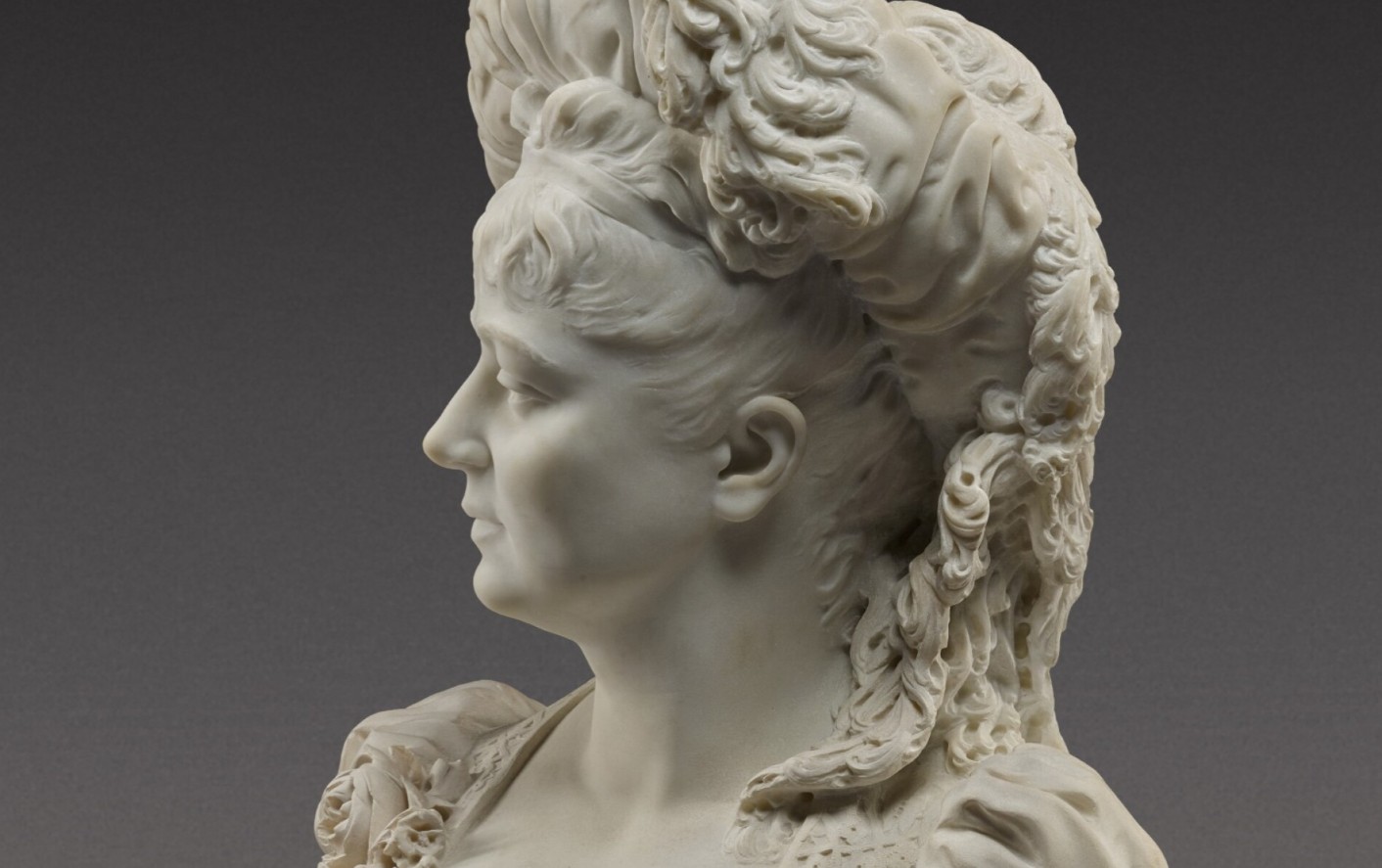
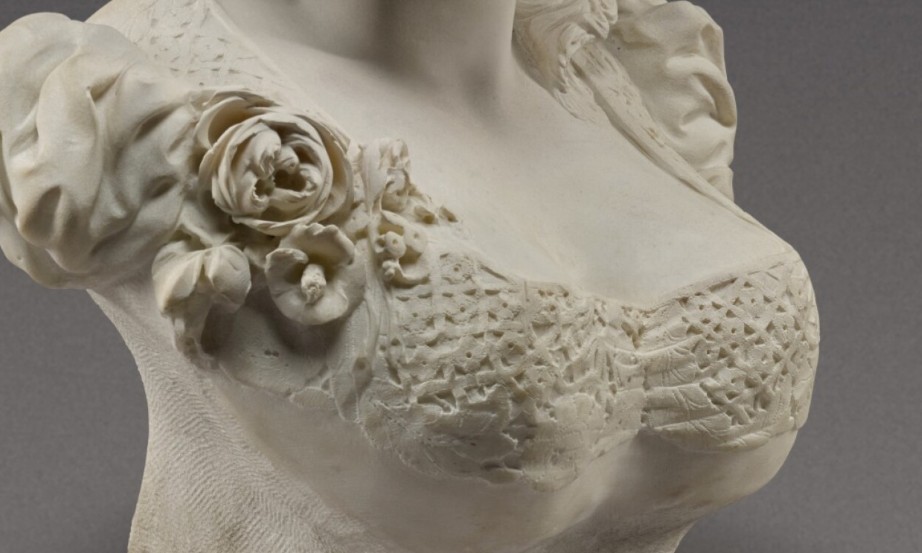
Il Busto di Donna in questione riferibile a una persona non ancora identificata, porta uno stravagante copricapo con tanto di piume e probabilmente venne scolpito dal Sarah Bernhardt verso il finire degli anni ’70 dell’Ottocento.

L’opera reca la firma dell’artista sulla base: SARAH BERNHARDT. Delle opere dell’artista mi piacciono in modo particolare i dettagli curati quasi all’estremo e la resa dell’animo delle sue protagoniste attraverso volti espressivi e mai banali.
Sarah Bernhardt era nata a Parigi da una cortigiana e padre ignoto. Aveva ricevuto la sua prima formazione come attrice alla Comédie-Française e, dal 1866, cominciò a calcare i palcoscenici dei più prestigiosi teatri di Parigi.
Raggiunse una fama senza precedenti in Europa e oltre, avendo modo di prendere parte a diverse tournée in tutto il mondo durante gli anni ’80 e ’90 dell’Ottocento. Apprezzata e nota per le sue interpretazioni dei personaggi più tragici, agli inizi del Ventesimo Secolo cominciò a recitare anche nei primi film muti fino a quando passò a miglior vita, nel 1923.
Nota in particolare per le sue magistrali interpretazioni di personaggi tragici, la leggenda di Sarah Bernhardt continuò a esistere fino all’inizio del XX secolo, quando recitò in film muti e rimase attiva sul palcoscenico fino alla sua morte nel 1923.
Non solo.
Sarah Bernhardt fu la figura più influente nella vita artistica di Alphonse Mucha. La loro collaborazione lanciò la carriera di Mucha e contribuì anche a definire lo stile iconico dell’Art Nouveau consolidando la stessa immagine dell’attrice nell’immaginario collettivo.
I due si incontrarono casualmente nel 1894 quando Mucha, all’epoca, era un illustratore poco noto a Parigi. Stava mettendo mano a delle bozze in una tipografia quando Sarah Bernhardt si rivolse alla stessa tipografia per avere urgentemente per un nuovo manifesto per la sua produzione teatrale Gismonda.
Fu quello il momento dell’inizio di due leggende: Bernhardt e Mucha.

Per il momento il sempre vostro Michelangelo Buonarroti vi saluta dandovi appuntamento ai prossimi post e sui social.
Sarah Bernhardt: renowned actress and extraordinary sculptor
The celebrated Sarah Bernhardt, an iconic French stage and film actress, considered one of the greatest women of the 19th century and Mucha’s muse, was also an extraordinary sculptor.
She created several marble works, such as Ophelia, Hermione, and the Bust of a Woman, which I want to discuss today. Bernhardt began her artistic career in the early 1870s under the watchful guidance of Roland Mathieu-Meusnier and Jules Franceschi.
After opening her own studio in 1873, she began creating several works that met with great success, including exhibiting at the Salon.
Although she exhibited for many years, until the early 1900s, her most prolific period of sculptural activity was in the 1870s, when her employment at the Comédie-Française allowed her to dedicate time to studio work.
Bernhardt was particularly renowned for her busts, for which she received critical acclaim.
In her 1907 memoirs, she wrote with great pride about friends and acquaintances who posed for her portrait busts in 1874.
At Bernhardt’s 1879 London exhibition, two of her busts stood out. One reviewer wrote: “The ‘star’ of the Comédie-Française is preferable in busts. All these are expressive and characteristic […].”
The Bust of a Woman in question, attributed to an as yet unidentified person, wears an extravagant headdress complete with feathers and was likely sculpted by Sarah Bernhardt in the late 1870s.
The work bears the artist’s signature on the base: SARAH BERNHARDT. What I particularly appreciate about the artist’s works is the meticulous attention to detail and the portrayal of the souls of her protagonists through expressive, never banal faces.
Sarah Bernhardt was born in Paris to a courtesan and an unknown father. She received her initial training as an actress at the Comédie-Française and, starting in 1866, began appearing on the stages of Paris’s most prestigious theaters.
She achieved unprecedented fame in Europe and beyond, taking part in several tours around the world during the 1880s and 1890s. Appreciated and renowned for her portrayals of tragic characters, at the beginning of the 20th century she also began acting in the first silent films until her passing in 1923.
Particularly known for her masterful portrayals of tragic characters, the legend of Sarah Bernhardt continued to thrive until the early 20th century, when she acted in silent films and remained active on stage until her death in 1923.
Moreover, Sarah Bernhardt was the most influential figure in Alphonse Mucha’s artistic life. Their collaboration launched Mucha’s career and also helped define the iconic Art Nouveau style, cementing the actress’s image in the collective imagination.
The two met by chance in 1894 when Mucha, at the time, was a little-known illustrator in Paris. He was working on some proofs at a printing press when Sarah Bernhardt urgently needed a new poster for her theatrical production of Gismonda.
That was the birth of two legends: Bernhardt and Mucha.
For now, yours truly, Michelangelo Buonarroti bids you farewell and says he’ll see you in future posts and on social media.

Sostienici – Support Us
Se questo blog ti piace e ti appassiona, puoi aiutarci a farlo crescere sempre più sostenendoci in modo concreto condividendo i post, seguendo le pagine social e con un contributo che ci aiuta ad andare avanti con il nostro lavoro di divulgazione. . ENGLISH: If you like and are passionate about this blog, you can help us make it grow more and more by supporting us in a concrete way by sharing posts, following social pages and with a contribution that helps us to move forward with our dissemination work.
10,00 €
Condividi:


Questo sono io





sostienici

Sostienici – Support Us
Se questo blog ti piace e ti appassiona, puoi aiutarci a farlo crescere sempre più sostenendoci in modo concreto condividendo i post, seguendo le pagine social e con un contributo che ci aiuta ad andare avanti con il nostro lavoro di divulgazione. . ENGLISH: If you like and are passionate about this blog, you can help us make it grow more and more by supporting us in a concrete way by sharing posts, following social pages and with a contribution that helps us to move forward with our dissemination work.
€10,00


Grazie! Non avrei mai immaginato che la Bernhardt fosse anche scultrice. buon pomeriggio.
"Mi piace"Piace a 1 persona
eh si ed era pure brava
"Mi piace"Piace a 1 persona