

Beato Angelico: restaurata la grande Crocifissione rovinata da un’azzardata descialbatura
È giunto a termine il restauro condotto sullo straordinario affresco del Crocifissione del Beato Angelico, capolavoro custodito nel Convento di San Domenico a Fiesole.
L’intervento è stato reso possibile grazie all’importante contributo economico di Friends of Florence ed è stato effettuato materialmente dalle restauratrici Cristiana Conti e Alessandra Popple della ditta S.A.R. snc, sotto l’Alta Sorveglianza della Soprintendenza Archeologia Belle arti e Paesaggio per la Città Metropolitana di Firenze e le province di Pistoia e Prato.
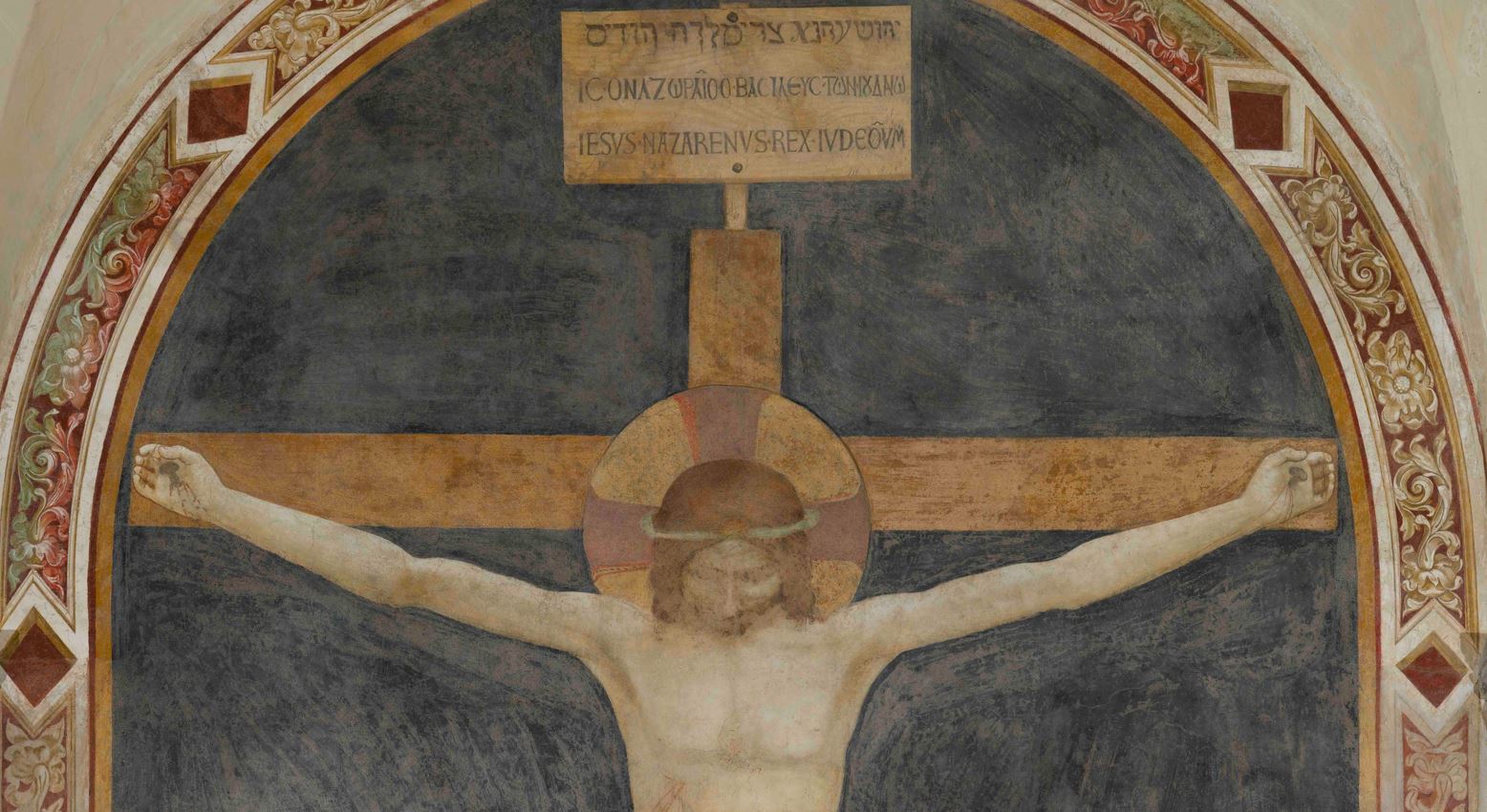
La Crocifissione del Beato Angelico
Il Beato Angelico volle raffigurare Gesù crocifisso realizzando un’opera monumentale viste le sue dimensioni.
L’immagine essenziale è tipica dell’Angelico. La croce innalzata sul Golgota assai stilizzato emerge da un fondo blu scuro che tende quasi al nero: una preparazione tipica realizzata per l’applicazione successiva a secco dell’azzurrite.
La figura del Cristo è insolita: il capo è reclinato verso il basso in modo prospettico. Una caratteristica non tipica della pittura dell’Angelico, ritrovata solo in questo caso e in una delle celle di San Marco.
L’affresco è contenuto in una cornice decorata con volute vegetali ed elementi quadrangolari. La scritta nel cartiglio sopra la croce è la stessa che si ritrova nel grande affresco dell’ex Capitolo di San Marco ed è rappresentata in greco, latino ed ebraico: ‘Gesù Nazareno Re dei Giudei’, recita.

Questo Crocifisso è un’opera giovanile del Beato Angelico ma di ammirevole fattura. La sua collocazione all’interno del Convento di S. Domenico, nella zona che un tempo era di clausura, ha fatto sì che fino al momento rimanesse pressoché sconosciuta ai più.
Risale alla prima metà del Quattrocento e molto probabilmente venne occultato nel 1566, quando l’intero muro della Sala Capitolare fu imbiancato completamente, come racconta la Cronica Ottocentesca del convento che riferisce inoltre che l’affresco fu riscoperto nel 1880 da Padre Raimondo Magrini.
Nel 1881 fu effettuato un restauro che però ritoccò in modo importante il volto e il fregio del contorno che erano stati fortemente compromessi.

Il primo intervento di restauro sulla Crocifissione, dopo quello ottocentesco, fu realizzato da Dino
Dini nel 1955. Sempre Dino Dini, molto attento alla conservazione di quest’opera, nel 1984, dopo averla
nuovamente revisionata, eseguì inoltre un secondo intervento, applicando un impacco di idrossido di bario sulle superfici, all’epoca ritenuta una metodologia innovativa, a cui fece seguire un attento ritocco pittorico. Da allora, fino ad oggi, l’affresco non fu più interessato da altri restauri.
Tecnica pittorica e stato di conservazione
Le indagini diagnostiche condotte sull’opera hanno permesso di capire meglio la tecnica pittorica adoperata dal Beato Angelico.
L’affresco fu realizzato in nove giornate e in origine erano presenti dorature fatte a ‘conchiglia’ come quelle presenti sull’aureola.
Le indagini effettuate sulla superficie pittorica hanno rilevato l’assenza di azzurrite, un pigmento che forse non era stato previsto dall’artista. Sono inoltre presenti tracce del disegno preparatorio realizzato a sanguigna nella parte bassa della cornice e altre tracce di spolvero nella partitura decorativa.
Dalle analisi fatte, sono emersi segni di matita, testimonianza di alcuni rifacimenti ottocenteschi sulla cornice.
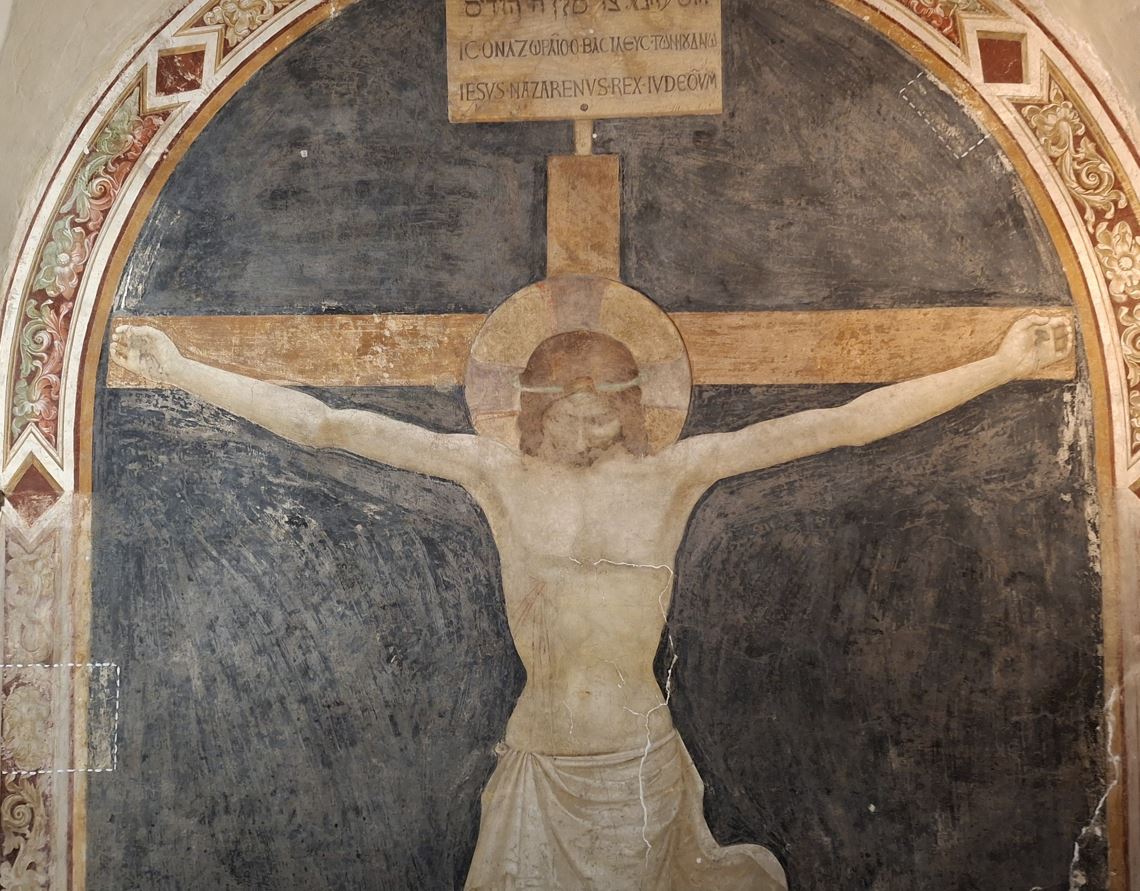
Lo stato di conservazione dell’opera prima dell’intervento era molto compromesso. La parte più danneggiata era proprio la figura di Cristo che nel corso dei secoli aveva subito la perdita di tutta la materia cromatica.
Come accennato prima, l’affresco era stato scialbato, ovvero occultato con una stesura di calce, in un
periodo non definito e successivamente descialbato. A causa di queste operazioni il colore appariva molto delicato, di spessore piuttosto sottile, conseguenza di un intervento di descialbo poco accurato che ha probabilmente determinato la perdita di parte dello strato pittorico.
In modo particolare il capo di Cristo era assai lacunoso, con evidenti mancanze di numerosi dettagli morfologici.
Tutta la superficie dell’affresco presentava tracce evidenti della martellinatura della superficie adottata per staccare lo scialbo dalla pellicola pittorica e asportarlo.
Tutta la superficie dell’opera era coperta da uno strato consistente di polvere e nero fumo, provenienti
probabilmente dal sistema di riscaldamento dell’ambiente. Il fondo blu scuro appariva caratterizzato da evidenti macchie di umidità più scure, alternate a zone chiare, quasi come se il colore avesse subito un’alterazione.

Sul corpo del Cristo, sull’intonaco di fondo e lungo la cornice nella parte alta erano presenti alcune fessurazioni della superficie. Inoltre, in corrispondenza dei bordi delle giornate di esecuzione nella parte inferiore del dipinto, si trovavano mancanze di intonaco, segno di una probabile decoesione della superficie pittorica circostante.
Anche la cornice decorata che delimita l’affresco appariva in più punti mancante del colore originale,
con abrasioni e cadute diffuse.
Il basamento della croce era in parte ridipinto e privo del colore originale, come testimoniavano i rifacimenti in ampie zone dell’affresco, nella parte bassa e sulla cornice perimetrale.
Buona parte del fondo blu scuro, la continuazione della croce oltre i piedi del Cristo, il Golgota e
buona parte della cornice erano stati rifatti, usufruendo dell’intonaco antico di supporto, probabilmente a causa di infiltrazioni di umidità dall’esterno.
Il restauro
Dopo la campagna diagnostica e una prima spolveratura, l’intervento di manutenzione ha riguardato il
consolidamento degli intonaci e della pellicola pittorica, la pulitura delle superfici, il recupero
cromatico dell’opera, alterato da tempo e da vecchi interventi, la stuccatura di cretti e lacune presenti
sul dipinto e il relativo ritocco pittorico.
Per il momento il sempre vostro Michelangelo Buonarroti vi saluta dandovi appuntamento ai prossimi post e sui social.

Beato Angelico: the great Crucifixion ruined by a risky whitewashing has been restored
The restoration of the extraordinary fresco of the Crucifixion by Beato Angelico, a masterpiece kept in the Convent of San Domenico in Fiesole, has been completed.
The intervention was made possible thanks to the significant financial contribution of Friends of Florence and was physically carried out by the restorers Cristiana Conti and Alessandra Popple of the company S.A.R. snc, under the High Supervision of the Superintendence of Archaeology, Fine Arts and Landscape for the Metropolitan City of Florence and the provinces of Pistoia and Prato.
The Crucifixion by Beato Angelico
Beato Angelico wanted to depict Jesus crucified by creating a monumental work given its dimensions.
The essential image is typical of Angelico. The cross raised on the highly stylised Golgotha emerges from a dark blue background that almost tends to black: a typical preparation made for the subsequent dry application of azurite.
The figure of Christ is unusual: the head is tilted downwards in a perspective manner. A characteristic not typical of Angelico’s painting, found only in this case and in one of the cells of San Marco.
The fresco is contained in a frame decorated with vegetal scrolls and quadrangular elements. The writing in the scroll above the cross is the same as that found in the large fresco of the former Chapter of San Marco and is represented in Greek, Latin and Hebrew: ‘Jesus of Nazareth King of the Jews’, it reads.
This Crucifix is an early work by Beato Angelico but of admirable workmanship. Its location inside the Convent of San Domenico, in the area that was once cloistered, has meant that until now it has remained almost unknown to most.
It dates back to the first half of the fifteenth century and was most likely hidden in 1566, when the entire wall of the Chapter House was completely whitewashed, as reported in the Cronica Ottocentesca of the convent, which also reports that the fresco was rediscovered in 1880 by Father Raimondo Magrini.
In 1881, a restoration was carried out which however significantly retouched the face and the frieze of the outline which had been severely compromised.
The first restoration intervention on the Crucifixion, after the nineteenth-century one, was carried out by Dino
Dini in 1955. Again Dino Dini, very attentive to the conservation of this work, in 1984, after having revised it again, also carried out a second intervention, applying a poultice of barium hydroxide on the surfaces, at the time considered an innovative methodology, which was followed by careful pictorial retouching. From then until today, the fresco has not been affected by other restorations.
Painting technique and state of conservation
The diagnostic tests conducted on the work have allowed us to better understand the painting technique used by Beato Angelico.
The fresco was created in nine days and originally featured gilding done in a ‘shell’ like those on the halo.
The tests carried out on the painted surface revealed the absence of azurite, a pigment that perhaps had not been foreseen by the artist. There are also traces of the preparatory drawing made in sanguine in the lower part of the frame and other traces of dusting in the decorative score.
From the analyses carried out, pencil marks emerged, evidence of some nineteenth-century remakes on the frame.
The state of conservation of the work before the intervention was very compromised. The most damaged part was the figure of Christ which over the centuries had suffered the loss of all the chromatic material.
As mentioned above, the fresco had been whitewashed, or hidden with a layer of lime, in an
unspecified period and subsequently dewhitewashed. Because of these operations, the color appeared very delicate, rather thin in thickness, the result of an inaccurate desciabo intervention that probably caused the loss of part of the pictorial layer.
In particular, the head of Christ was very patchy, with evident lacks of numerous morphological details.
The entire surface of the fresco showed clear traces of the hammering of the surface used to detach the scialo from the pictorial film and remove it.
The entire surface of the work was covered by a consistent layer of dust and black smoke, probably coming from the heating system of the room. The dark blue background appeared characterized by evident darker humidity stains, alternating with light areas, almost as if the color had undergone an alteration.
On the body of Christ, on the background plaster and along the frame in the upper part there were some cracks in the surface. Furthermore, in correspondence with the edges of the days of execution in the lower part of the painting, there were missing plaster, a sign of a probable decohesion of the surrounding pictorial surface.
The decorated frame that delimits the fresco also appeared to be missing its original color in several places,
with widespread abrasions and falls.
The base of the cross was partly repainted and lacking the original color, as evidenced by the repainting in large areas of the fresco, in the lower part and on the perimeter frame.
A good part of the dark blue background, the continuation of the cross beyond the feet of Christ, Golgotha and a good part of the frame had been redone, using the ancient supporting plaster, probably due to humidity infiltrations from the outside.
The restoration
After the diagnostic campaign and an initial dusting, the maintenance intervention involved the
consolidation of the plaster and the pictorial film, the cleaning of the surfaces, the
chromatic recovery of the work, altered by time and old interventions, the filling of cracks and gaps present
on the painting and the relative pictorial retouching.
For the moment, your ever Michelangelo Buonarroti bids you farewell, making an appointment with you in the next posts and on social media.

Sostienici – Support Us
Se questo blog ti piace e ti appassiona, puoi aiutarci a farlo crescere sempre più sostenendoci in modo concreto condividendo i post, seguendo le pagine social e con un contributo che ci aiuta ad andare avanti con il nostro lavoro di divulgazione. . ENGLISH: If you like and are passionate about this blog, you can help us make it grow more and more by supporting us in a concrete way by sharing posts, following social pages and with a contribution that helps us to move forward with our dissemination work.
10,00 €
Condividi:


Questo sono io





sostienici

Sostienici – Support Us
Se questo blog ti piace e ti appassiona, puoi aiutarci a farlo crescere sempre più sostenendoci in modo concreto condividendo i post, seguendo le pagine social e con un contributo che ci aiuta ad andare avanti con il nostro lavoro di divulgazione. . ENGLISH: If you like and are passionate about this blog, you can help us make it grow more and more by supporting us in a concrete way by sharing posts, following social pages and with a contribution that helps us to move forward with our dissemination work.
€10,00


