
Il fragile gonfalone dipinto a olio su seta rossa torna a l’Aquila dopo il restauro
A 16 anni di distanza dal terribile terremoto nel 2009 colpì L’Aquila e l’Abruzzo, il grande Gonfalone con i Santi protettori della città realizzato nel Cinquecento da Giovanni Paolo Cardone torna a l’Aquila.
E’ stato infatti portato a termine il complesso intervento di restauro eseguito dai professionistidell’Opificio delle Pietre Dure di Firenze.
Il delicato intervento è stato finanziato dall’Associazione Bancaria Italiana – ABI e le banche del Gruppo di lavoro Relazioni culturali dell’Associazione, nell’ottica del contributo alla cultura che il mondo bancario porta avanti anche con il progetto “è cultura!”

La commissione del Gonfalone
Opera dai molteplici significati civili e religiosi, il grandioso Gonfalone, in seta rossa dipinta a olio, venne realizzato fra il 1578 e il 1579 per rimpiazzare un precedente esemplare donato dalla città dell’Aquila alla Basilica di San Pietro a Roma in occasione del Giubileo del 1575.
Della prestigiosa commissione fu incaricato il pittore aquilano Giovan Paolo Cardone, una delle personalità artistiche più rilevanti del tardo manierismo abruzzese.
L’artista, seguendo le dettagliate indicazioni delle Magistrature cittadine intorno ad una fedele rappresentazione prospettica della città, rappresentò la Vergine prostrata davanti al Cristo e i Santi Massimo, Pietro Celestino, Bernardino ed Equizio, protettori dell’Aquila.
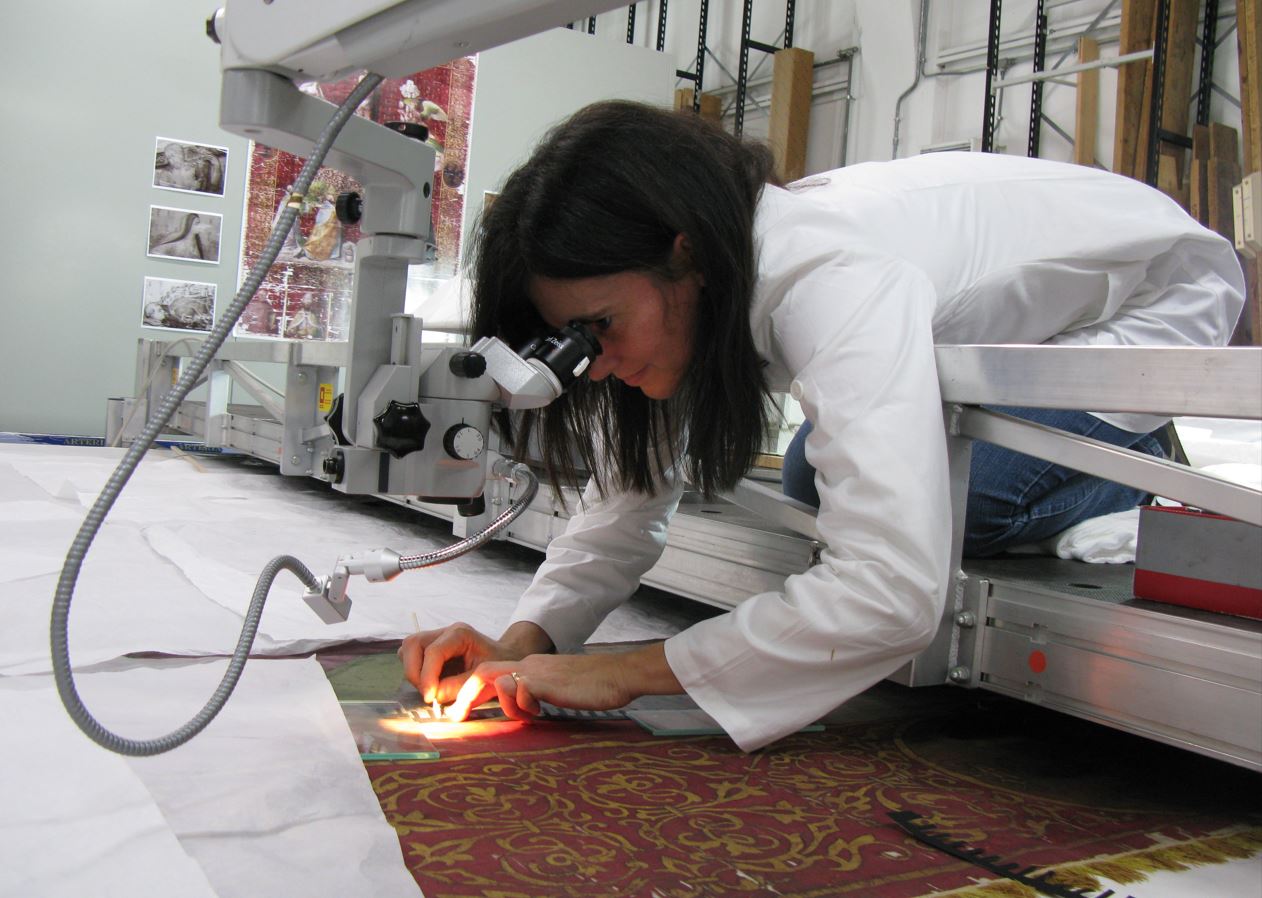
Speculare rispetto alla figura della Vergine Maria è un angelo con un’ampolla per il crisma, affiancato dalla colonna della flagellazione. Ai piedi di Cristo, due angioletti sostengono una pisside, chiaro riferimento all’ostia consacrata.
Tutto il fondo rosso appare disseminato di piccole fiammelle d’oro, allusive allo Spirito Santo, che cadono con ritmo ordinato sulla città. Racchiude la scena centrale una ricca cornice a fregi dorati, interrotta in corrispondenza dei lati maggiori da medaglioni con l’aquila nera dello stemma civico e di quelli minori dal trigramma bernardiniano entro un sole sfavillante di raggi.
Completano l’opera, in basso, cinque pendenti o “drappelle” di forma rettangolare in cui si alternano Sant’Antonio da Padova, San Francesco d’Assisi, San Giovanni da Capestrano e Santi vescovi.

L’opera colpisce, oltre che per la qualità artistica, per le dimensioni: circa 15 mq (460×323 cm). Per secoli è stata conservata nella Basilica di San Bernardino e sino al 1815, il 10 agosto, era portata in processione lungo le vie dell’Aquila per implorare “la serenità dell’aria”.
Dalla Basilica passò poi al Castello Cinquecentesco ed è qui che a colpirla fu il sisma del 2009. Recuperata, venne accolta dal Museo Paludi di Celano fino al 2013 quando, grazie al finanziamento garantito dall’ABI, venne affidato all’Opificio delle Pietre Dure di Firenze per esservi sottoposta a restauro.
Il restauro
Le principali sfide nell’intervento su quest’opera, concluso nel dicembre 2015, riguardano l’intrinseca fragilità dei materiali costitutivi e le sue grandi dimensioni, che rendono ogni movimentazione estremamente delicata e dunque da progettare nei minimi dettagli.

Lo stato di conservazione del Gonfalone si fonda su un fragile equilibrio dettato dall’intervento degli anni Ottanta, che ne ha permesso l’esposizione in verticale consolidando tutta la seta rossa, fragile e lacunosa, con un nuovo supporto leggero e trasparente in fibra sintetica facendolo aderire al tessuto originario con una resina vinilica attivata a caldo.
Per attenuare il disturbo costituito dalle numerose lacune è stata inoltre applicata sotto l’intera superficie una fodera dello stesso colore del tessuto di fondo, imparentata nella parte alta del Gonfalone con una cucitura visibile solo sul retro.
All’arrivo nei laboratori dell’Opificio l’opera presentava un consistente deposito di materiale incoerente su tutta la superficie e numerose deformazioni delle fibre del supporto originario e delle aree dipinte con colore a olio. Inoltre, sono stati riscontrati numerosi e fragili sollevamenti del tessuto originario da quello del restauro, in particolare in corrispondenza delle innumerevoli e articolate lacune tessili.
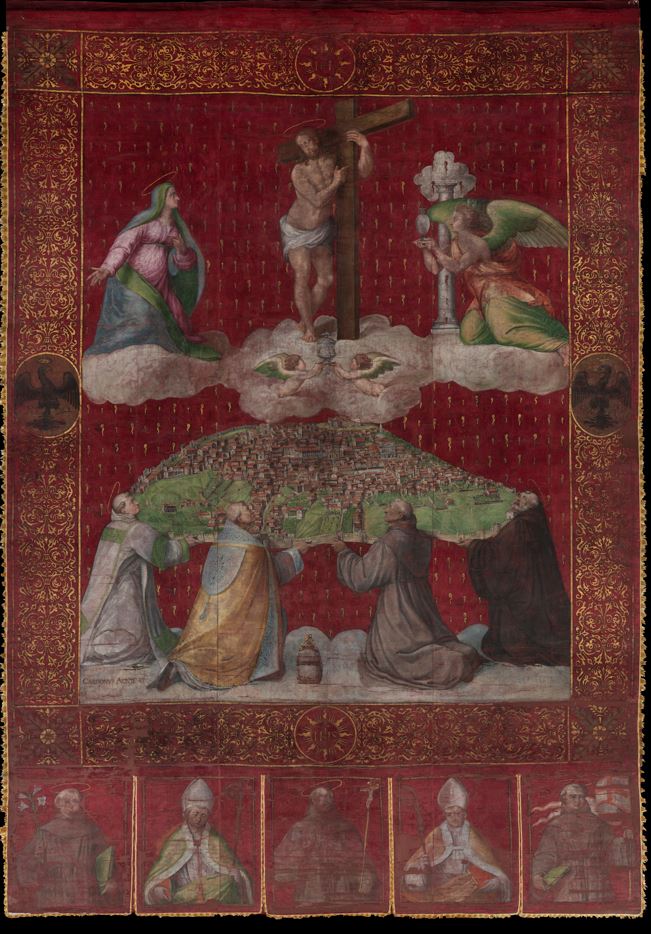
L’opera è stata documentata, studiata e mappata nei dettagli. L’accurata campagna diagnostica ha confermato l’intrinseca interazione e fragilità dei materiali costitutivi e la necessità di un intervento conservativo.
Come prima fase è stata approntata la pulitura, consistita nell’aspirazione graduale e controllata dei depositi incoerenti su tutta la superficie e, a seguito di test, e la pulitura della policromia.
La seconda fase dell’intervento si prefiggeva il consolidamento e la riadesione dei sollevamenti tessili. L’operazione, complessa e articolata, è stata preceduta da una serie di test preliminari che hanno dimostrato l’impossibilità di riattivare nuovamente l’adesivo utilizzato nel precedente restauro dell’ICR, e si è arricchita della sperimentazione di nuovi materiali adesivi, testati con prove di resistenza a trazione.
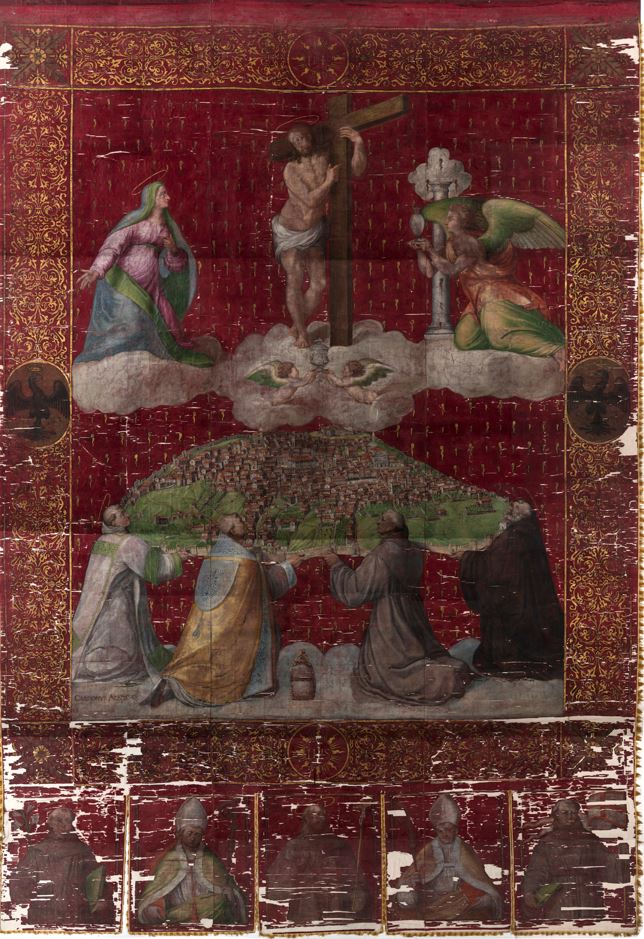
I buoni risultati della sperimentazione hanno permesso di utilizzare materiali per la conservazione in linea con quelli adoperati nel 1980, e in grado di non causare ulteriori stress alla fragile seta del supporto e degli strati pittorici.
La fodera esistente è stata rimossa dalla cucitura del Gonfalone per non causare ulteriori aggravi alla struttura originaria, trattata per la pulitura e preparata per un nuovo sistema di connessione alla testata dell’opera attraverso nastri in velcro, mantenendo così la sua funzione di chiusura ottica delle lacune, in previsione di una futura esposizione del Gonfalone, che dovrà però prevedere una collocazione non più in verticale ma su di un piano inclinato appositamente studiato per non causare ulteriori accelerazioni al degrado dei materiali costitutivi.
Per il momento il sempre vostro Michelangelo Buonarroti vi saluta dandovi appuntamento ai prossimi post e sui social.
The fragile gonfalon painted in oil on red silk returns to L’Aquila after restoration
16 years after the terrible earthquake in 2009 that struck L’Aquila and Abruzzo, the large Gonfalon with the patron saints of the city created in the sixteenth century by Giovanni Paolo Cardone returns to L’Aquila.
The complex restoration work carried out by the professionals of the Opificio delle Pietre Dure in Florence has in fact been completed.
The delicate work was financed by the Italian Banking Association – ABI and the banks of the Cultural Relations Working Group of the Association, in view of the contribution to culture that the banking world also carries out with the project “è cultura!”
The Gonfalone Commission
A work with multiple civil and religious meanings, the grandiose Gonfalone, in red silk painted in oil, was created between 1578 and 1579 to replace a previous example donated by the city of L’Aquila to the Basilica of St. Peter in Rome on the occasion of the Jubilee of 1575.
The prestigious commission was entrusted to the painter from L’Aquila Giovan Paolo Cardone, one of the most important artistic personalities of the late Mannerism of Abruzzo.
The artist, following the detailed indications of the city magistrates around a faithful perspective representation of the city, represented the Virgin prostrate before Christ and the Saints Massimo, Pietro Celestino, Bernardino and Equizio, protectors of L’Aquila.
Mirroring the figure of the Virgin Mary is an angel with a vial for the chrism, flanked by the column of the flagellation. At the feet of Christ, two little angels hold a pyx, a clear reference to the consecrated host.
The entire red background appears dotted with small golden flames, alluding to the Holy Spirit, which fall in an orderly rhythm over the city. The central scene is surrounded by a rich frame with golden friezes, interrupted on the longer sides by medallions with the black eagle of the civic coat of arms and on the smaller sides by the Bernardine trigram within a sun sparkling with rays.
The work is completed at the bottom by five rectangular pendants or “drappelle” in which Saint Anthony of Padua, Saint Francis of Assisi, Saint John of Capestrano and Holy Bishops alternate.
The work is striking not only for its artistic quality, but also for its size: approximately 15 m2 (460×323 cm). For centuries it was kept in the Basilica of San Bernardino and until 1815, on August 10, it was carried in procession along the streets of L’Aquila to implore “the serenity of the air”.
From the Basilica it then moved to the Castello Cinquecentesco and it was here that it was hit by the earthquake of 2009. Recovered, it was welcomed by the Museo Paludi di Celano until 2013 when, thanks to the funding guaranteed by the ABI, it was entrusted to the Opificio delle Pietre Dure of Florence for restoration.
The restoration
The main challenges in the intervention on this work, concluded in December 2015, concern the intrinsic fragility of the constituent materials and its large size, which make every movement extremely delicate and therefore must be planned down to the smallest details.
The state of conservation of the Gonfalone is based on a fragile balance dictated by the intervention of the 1980s, which allowed its vertical display by consolidating all the fragile and gaping red silk with a new light and transparent support in synthetic fiber by adhering it to the original fabric with a heat-activated vinyl resin.
To attenuate the disturbance caused by the numerous gaps, a lining of the same color as the background fabric was also applied under the entire surface, related in the upper part of the Gonfalone with a seam visible only on the back.
Upon arrival at the Opificio laboratories, the work presented a substantial deposit of incoherent material over the entire surface and numerous deformations of the fibers of the original support and the areas painted with oil paint. Furthermore, numerous and fragile liftings of the original fabric from that of the restoration were found, in particular in correspondence with the innumerable and complex textile gaps.
The work has been documented, studied and mapped in detail. The accurate diagnostic campaign confirmed the intrinsic interaction and fragility of the constituent materials and the need for a conservative intervention.
As a first phase, cleaning was prepared, consisting of the gradual and controlled aspiration of incoherent deposits on the entire surface and, following tests, the cleaning of the polychromy.
The good results of the experimentation have allowed us to use conservation materials in line with those used in 1980, and capable of not causing further stress to the fragile silk of the support and the pictorial layers. The existing lining was removed from the Gonfalone’s stitching so as not to cause further burdens to the original structure, treated for cleaning and prepared for a new connection system to the head of the work through Velcro strips, thus maintaining its function of optically closing the gaps, in anticipation of a future exhibition of the Gonfalone, which will however have to provide for a placement no longer vertical but on an inclined plane specifically designed to not cause further accelerations to the degradation of the constituent materials.
For the moment, your ever Michelangelo Buonarroti bids you farewell, making an appointment with you in the next posts and on social media.

Sostienici – Support Us
Se questo blog ti piace e ti appassiona, puoi aiutarci a farlo crescere sempre più sostenendoci in modo concreto condividendo i post, seguendo le pagine social e con un contributo che ci aiuta ad andare avanti con il nostro lavoro di divulgazione. . ENGLISH: If you like and are passionate about this blog, you can help us make it grow more and more by supporting us in a concrete way by sharing posts, following social pages and with a contribution that helps us to move forward with our dissemination work.
10,00 €
Condividi:


Questo sono io





sostienici

Sostienici – Support Us
Se questo blog ti piace e ti appassiona, puoi aiutarci a farlo crescere sempre più sostenendoci in modo concreto condividendo i post, seguendo le pagine social e con un contributo che ci aiuta ad andare avanti con il nostro lavoro di divulgazione. . ENGLISH: If you like and are passionate about this blog, you can help us make it grow more and more by supporting us in a concrete way by sharing posts, following social pages and with a contribution that helps us to move forward with our dissemination work.
€10,00


