

La Scultura del giorno: l’Ebbrezza di Noè che il Bandinelli copiò da me
La scultura del giorno che vi propongo oggi è l’Ebbrezza di Noè, un rilievo scolpito nel marmo di Carrara di Baccio Bandinelli, realizzato attorno al 1530.
Può sembrare strano ma di quest’opera non è noto né il committente né la sua destinazione.
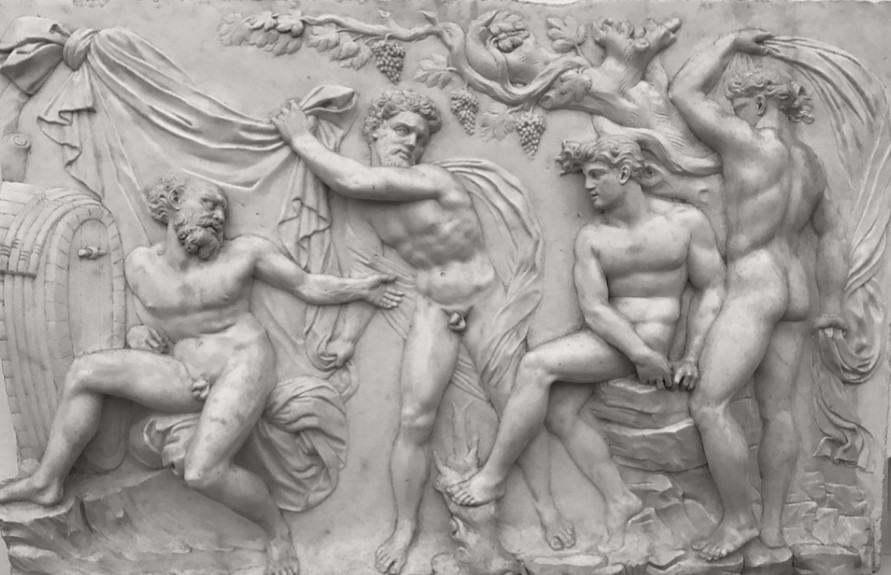
La compiutezza del lavoro e la sua complessa lavorazione fanno pensare all’inserimento in un ciclo biblico di decorazioni marmoree ma potrebbe essere stata un’opera a se stante, donata dal Bandinelli a qualche personalità dell’epoca come aveva fatto in precedenza per il rilievo della Flagellazione regalato a Clemente VII de’ Medici.
Mi preme dire che il Bandinelli, nelle sculture a tutto tondo, aveva dei seri problemi nella resa dei muscoli.
A parte il fatto che a volte ne inventava laddove il corpo non ne presenta ma nello sviluppo non riusciva a far cose degne di nota. Pensate che al tempo si ritrovava a fare i conti con titani della scultura, tipo me e i giudizi non erano certo clementi verso il suo operato.

Le cose però cambiano con i rilievi e i disegni dove riusciva a migliorare notevolmente la resa.
Osservate per esempio i differenti piani di lavorazione, quei drappi che sembrano impalpabili, il corpo di Noè fortemente aggettante e il trattamento dei panneggi così come la resa dei corpi.
Vi faccio notare un’altra cosa. Osservate la scena per intero. Non vi sembra di averla già vista altrove?

Ebbene sì, per realizzare la sua Ebbrezza di Noè, più che ispirarsi a quella che avevo affrescato anni prima nella volta della Cappella Sistina, la copiò deliberatamente.
La composizione è la medesima con Noè a terra, Cam quasi al centro della scena visto di fronte che si accinge a coprire il padre e gli altri due fratelli a distanza ravvicinata, in piedi.

Il Bandinelli volle aggiungere al rilievo scultoreo un’allegoria significativa.
Osservate il giovane all’estrema destra con il panneggio che il vento rigonfia come fosse una vela e i capelli mossi. Orbene, quelle due caratteristiche dipinte sono a tutti gli effetti la raffigurazione iconografica della fortuna.
Il rilievo in questione appartiene al Museo Nazionale del Bargello ed è esposto nella Sala mia, la Sala di Michelangelo, al pian terreno.
Per il momento il vostro Michelangelo Buonarroti vi saluta dandovi appuntamento ai prossimi post e sui social.
©Tutti i diritti sono riservati
Sculpture of the day: The Drunkenness of Noah that Bandinelli copied from me
The sculpture of the day that I propose to you today is The Drunkenness of Noah, a relief carved in Carrara marble by Baccio Bandinelli, made around 1530.
It may seem strange but neither the commissioner nor its destination are known for this work.
The completeness of the work and its complex manufacturing suggest its inclusion in a biblical cycle of marble decorations but it could have been a work in itself, donated by Bandinelli to some personality of the time as he had previously done for the relief of the Flagellation given to Clement VII de’ Medici.
I would like to say that Bandinelli, in his sculptures in the round, had serious problems in rendering muscles. Apart from the fact that sometimes he invented them where the body does not have any but in the development he was unable to do anything worthy of note. You might think that at the time he had to deal with titans of sculpture, like me.
Things change with the reliefs and drawings, however, where he managed to significantly improve the rendering. Observe for example the different working planes, those drapes that seem impalpable, the strongly protruding body of Noah and the treatment of the draperies as well as the rendering of the bodies.
I would like to point out another thing. Observe the entire scene. Doesn’t it seem like you’ve already seen it elsewhere?
Well yes, to create his Drunkenness of Noah, rather than being inspired by the one I had frescoed years before in the vault of the Sistine Chapel, he deliberately copied it.
The composition is the same with Noah on the ground, Ham almost at the center of the scene seen from the front preparing to cover his father and the other two standing at close range.
Bandinelli wanted to add a significant allegory to the sculptural relief. Look at the young man on the far right with the drapery that the wind swells like a sail and the hair blowing in the wind. Well, those two painted features are in all respects the iconographic representation of fortune.
This relief by Bandinelli belongs to the Museo Nazionale del Bargello and is exhibited in my room, the Hall of Michelangelo, on the ground floor.
For the moment, your Michelangelo Buonarroti bids you farewell, making an appointment with you in the next posts and on social media.
©All rights reserved

Sostienici – Support Us
Se questo blog ti piace e ti appassiona, puoi aiutarci a farlo crescere sempre più sostenendoci in modo concreto condividendo i post, seguendo le pagine social e con un contributo che ci aiuta ad andare avanti con il nostro lavoro di divulgazione. . ENGLISH: If you like and are passionate about this blog, you can help us make it grow more and more by supporting us in a concrete way by sharing posts, following social pages and with a contribution that helps us to move forward with our dissemination work.
10,00 €
-
La Pietà di Tincolini: a Pontedera l’arte torna a fare domande scomode
🇮🇹“Pietà”, la scultura di Filippo Tincolini, insieme alle parole di Federico Quaranta e Andrea Pezzi, non è stato solo uno spettacolo. È stata una domanda lanciata in faccia al pubblico, impossibile da evitare: siamo ancora capaci di provare pietà? 🇬🇧 “Pietà,” Filippo Tincolini’s sculpture, along with the words of Federico Quaranta and Andrea Pezzi, wasn’t…
-
Ai Musei Vaticani i fasti barocchi di Urbano VIII: in mostra gli arazzi della manifattura Barberini
🇮🇹A quattro secoli dalla consacrazione della Basilica di San Pietro, i Musei Vaticani dedicano una mostra all’Arazzeria Barberini, simbolo di una cultura visiva capace di fondere magnificenza estetica e affermazione politica… 🇬🇧Four centuries after the consecration of St. Peter’s Basilica, the Vatican Museums are dedicating an exhibition to the Barberini Tapestry Factory, a symbol of…
-
Le Opere della Pasqua: come la Resurrezione ha ispirato Arte e Cultura
🇮🇹La Pasqua, oltre ad essere una ricorrenza religiosa è un momento in cui la storia, l’arte e la spiritualità si intrecciano per raccontare il fulcro della fede cristiana: la resurrezione di Cristo. .. 🇬🇧Easter, beyond being a religious holiday, is a moment when history, art, and spirituality intertwine to recount the core of the Christian…
Condividi:


Questo sono io





sostienici

Sostienici – Support Us
Se questo blog ti piace e ti appassiona, puoi aiutarci a farlo crescere sempre più sostenendoci in modo concreto condividendo i post, seguendo le pagine social e con un contributo che ci aiuta ad andare avanti con il nostro lavoro di divulgazione. . ENGLISH: If you like and are passionate about this blog, you can help us make it grow more and more by supporting us in a concrete way by sharing posts, following social pages and with a contribution that helps us to move forward with our dissemination work.
€10,00


