
25 marzo: l’Annunciazione di Jan van Eyck, capolavoro fiammingo
Nel giorno del 25 marzo, tradizionalmente legato al mistero dell’Annunciazione, lo sguardo si posa su uno dei capolavori più raffinati della pittura nordica: l’Annunciazione di Jan van Eyck.
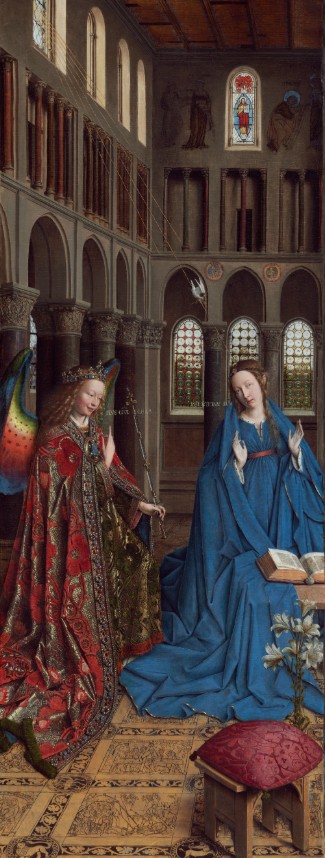
Realizzata tra il 1434 e il 1436, questa opera a olio su tavola, successivamente trasferita su tela, è oggi conservata presso la National Gallery of Art di Washington.
Si tratta con ogni probabilità di uno scomparto superstite di un trittico perduto vista anche l’insolito formato.
Dalla Borgogna a Washington: la storia avventurosa dell’opera
Le prime notizie documentate sull’opera risalgono al 1791, quando era conservata presso la Certosa di Champmol, luogo di sepoltura dei duchi di Borgogna, per i quali van Eyck lavorò come pittore di corte dal 1425 fino alla morte nel 1441. Il monastero fu devastato durante la Rivoluzione francese e molte opere andarono disperse.
Il dipinto riemerse nel 1817 in un’asta a Parigi, per poi passare nelle collezioni di Guglielmo II dei Paesi Bassi e successivamente dello zar Nicola I di Russia, entrando così all’Ermitage. Proprio in Russia, tra il 1864 e il 1870, il supporto ligneo venne trasferito su tela per ragioni conservative.
Nel 1929 l’opera tornò sul mercato occidentale e, dopo vari passaggi tra importanti mercanti, venne acquistata nel 1930 da Andrew Mellon. La sua collezione costituì il nucleo originario della National Gallery di Washington, dove il dipinto è tuttora custodito.
L’Annunciazione secondo van Eyck: un dialogo sospeso nel sacro
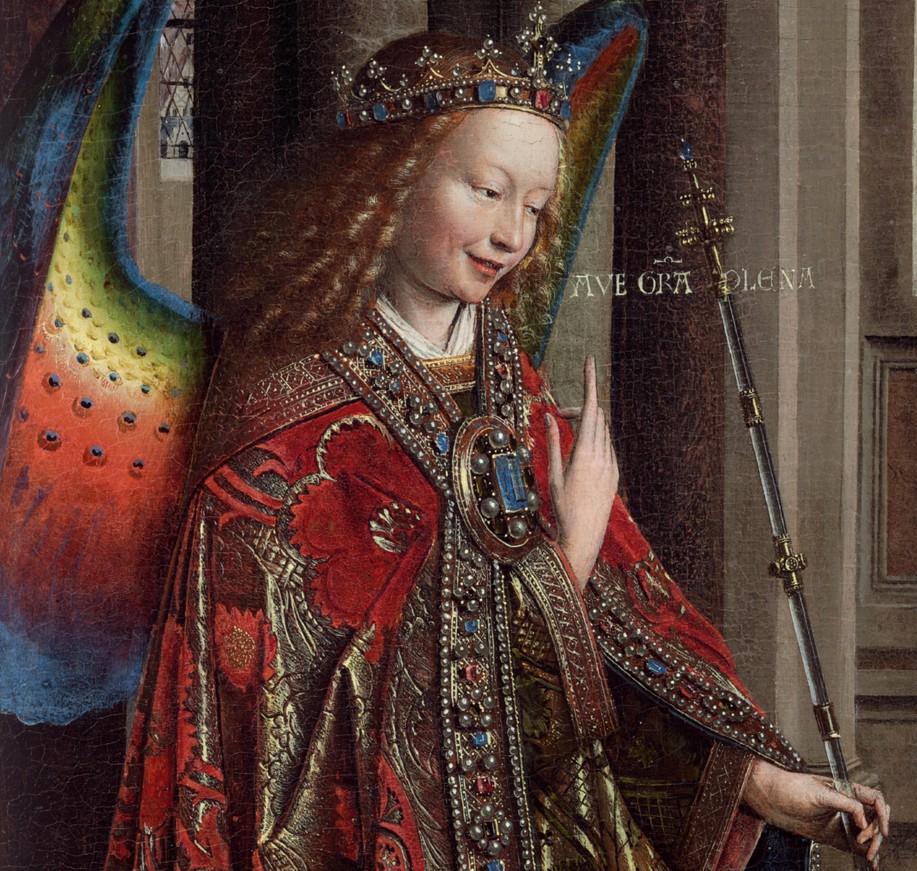
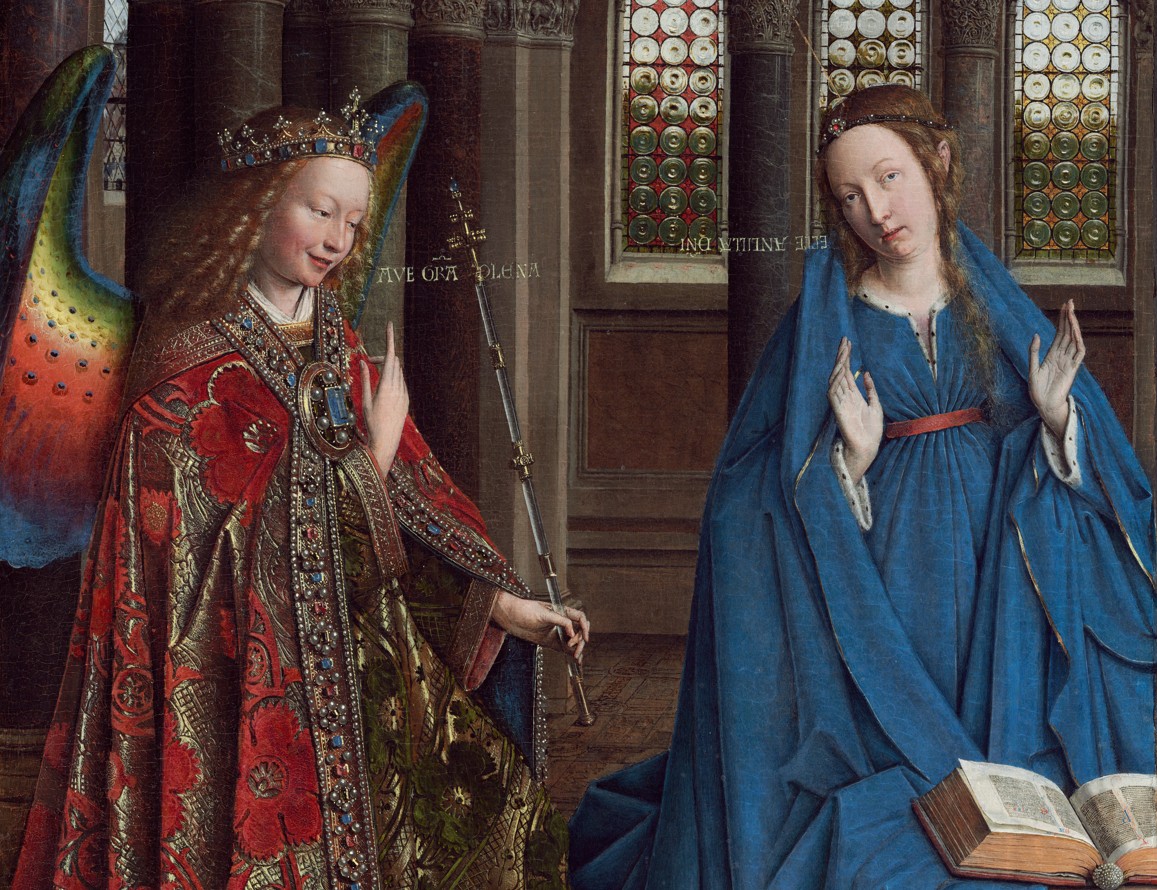
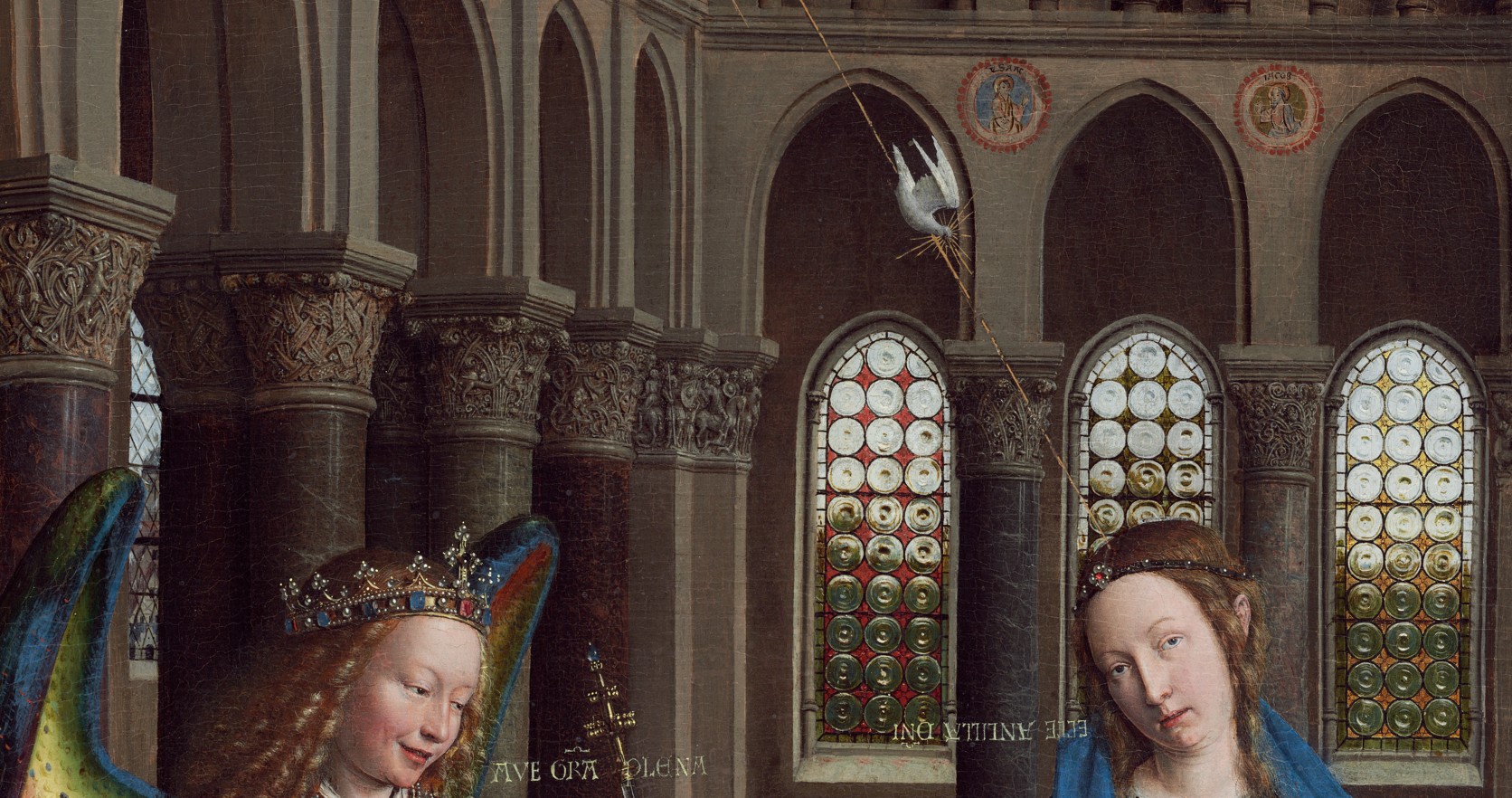
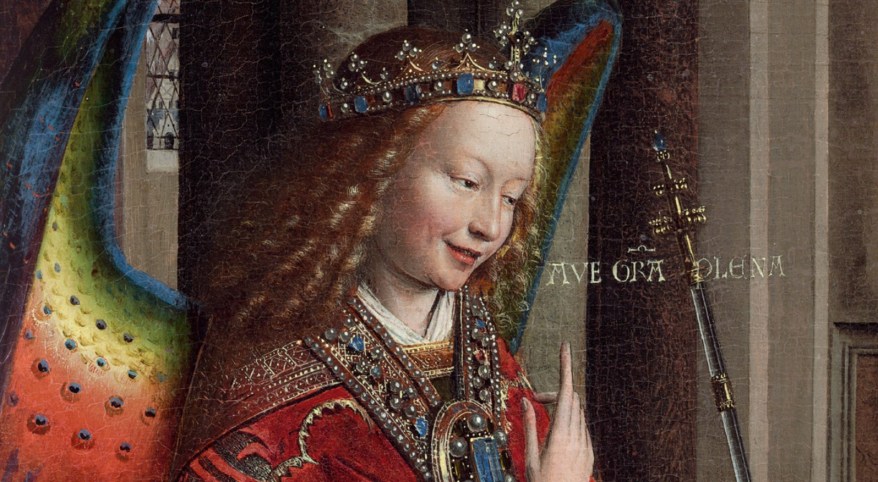
La scena raffigura il momento evangelico narrato nel Vangelo di Luca, con l’Arcangelo Gabriele che annuncia a Maria la nascita di Cristo. Il dialogo tra i due protagonisti prende forma visiva attraverso eleganti iscrizioni dorate che sembrano uscire dalle loro bocche: “AVE GRÃ[TIA] PLENA” e “ECCE ANCILLA D[OMI]ÑI”, quest’ultima scritta al contrario per rispettare la direzione della voce.
La Colomba dello Spirito Santo discende dall’alto, accompagnata da sette raggi luminosi, simbolo dei sette doni spirituali. La scena è immersa in un’atmosfera solenne e silenziosa, dove ogni dettaglio contribuisce a costruire una narrazione teologica e visiva di straordinaria profondità.
La ricchezza cromatica e il virtuosismo tecnico
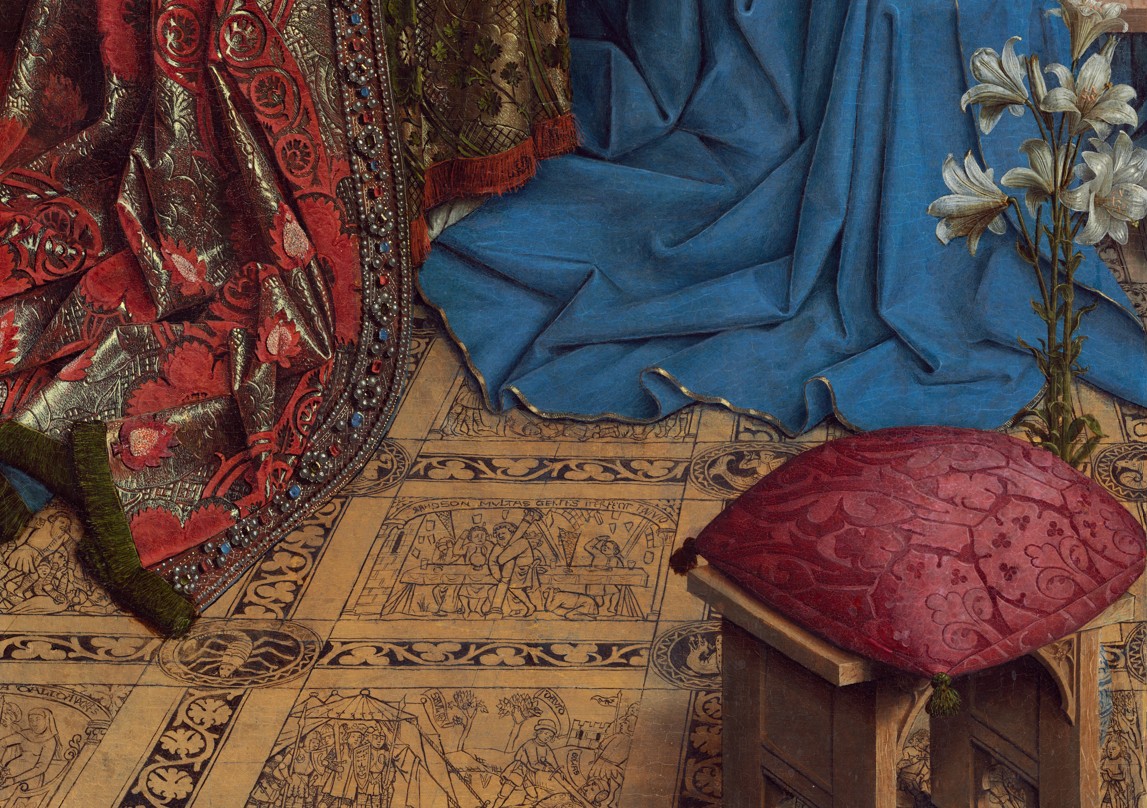
Uno degli aspetti più sorprendenti dell’opera è la resa delle stoffe. L’angelo indossa una veste sontuosa, decorata con broccati che mutano aspetto al variare della luce e delle pieghe, dimostrando l’eccezionale abilità tecnica di van Eyck. Maria, invece, è raffigurata con un abito più sobrio, di un intenso blu, bordato di ermellino, simbolo della sua purezza e nobiltà.
L’assenza dell’aureola, scelta innovativa per l’epoca, accentua il realismo della scena, avvicinando lo spettatore al sacro in modo diretto e coinvolgente.
Architettura e simbolismo: un universo da decifrare
L’ambientazione è una chiesa dalle forme romaniche con accenni gotici, una scelta non casuale che richiama simbolicamente il contesto ebraico dell’evento. La profondità è costruita attraverso raffinati giochi di luce, che guidano l’occhio verso le zone più in ombra.
Il pavimento è decorato con scene dell’Antico Testamento, tra cui Davide e Golia e Sansone, mentre sulle pareti si trovano raffigurazioni di Mosè e dei patriarchi. La grande vetrata centrale mostra Dio Padre, mentre una triplice apertura sottostante allude alla Trinità.
Ogni elemento, dai capitelli scolpiti alla trasparenza dei vetri, fino ai tessuti e agli oggetti, è reso con una precisione quasi microscopica, tipica della pittura fiamminga.
Simboli e significati: gigli, libri e luce divina
Tra gli oggetti simbolici spiccano i gigli, emblema di purezza, e il libro, che rappresenta il compimento delle Scritture. La luce, elemento centrale nella composizione, non è solo un fenomeno fisico ma anche una manifestazione del divino.
La linea dell’orizzonte alta e la prospettiva avvolgente fanno sì che lo spettatore si senta immerso nella scena, come se partecipasse direttamente al mistero rappresentato.
Per il momento il sempre vostro Michelangelo Buonarroti vi saluta dandovi appuntamento ai prossimi post e sui social.
March 25: The Annunciation by Jan van Eyck, a Flemish masterpiece
On March 25, traditionally associated with the mystery of the Annunciation, our gaze falls on one of the finest masterpieces of Northern European painting: The Annunciation by Jan van Eyck. Created between 1434 and 1436, this oil on panel work, later transferred to canvas, is now housed at the National Gallery of Art in Washington.
It is most likely a surviving panel of a lost triptych, given its unusual format.
From Burgundy to Washington: The Work’s Adventurous History
The first documented references to the work date back to 1791, when it was kept at the Chartreuse de Champmol, the burial place of the Dukes of Burgundy, for whom van Eyck worked as court painter from 1425 until his death in 1441. The monastery was devastated during the French Revolution, and many works were lost.
The painting resurfaced in 1817 at an auction in Paris, later entering the collections of William II of the Netherlands and later Tsar Nicholas I of Russia, finally entering the Hermitage. It was in Russia, between 1864 and 1870, that the wooden support was transferred to canvas for conservation reasons.
In 1929, the work returned to the Western market and, after several exchanges between important dealers, was purchased in 1930 by Andrew Mellon. His collection formed the original core of the National Gallery in Washington, where the painting is still housed.
The Annunciation according to van Eyck: a dialogue suspended in the sacred
The scene depicts the evangelical moment narrated in the Gospel of Luke, with the Archangel Gabriel announcing the birth of Christ to Mary. The dialogue between the two protagonists takes visual form through elegant golden inscriptions that seem to come from their mouths: “AVE GRÃ[TIA] PLENA” and “ECCE ANCILLA D[OMI]ÑI,” the latter written backwards to reflect the direction of the voice.
The Dove of the Holy Spirit descends from above, accompanied by seven rays of light, symbolizing the seven spiritual gifts. The scene is immersed in a solemn and silent atmosphere, where every detail contributes to constructing a theological and visual narrative of extraordinary depth.
The richness of color and technical virtuosity
One of the most striking aspects of the work is the rendering of the fabrics. The angel wears a sumptuous robe, decorated with brocades that change appearance as the light and the folds change, demonstrating van Eyck’s exceptional technical skill. Mary, on the other hand, is depicted in a more sober dress, a deep blue, trimmed with ermine, a symbol of her purity and nobility.
The absence of a halo, an innovative choice for the time, accentuates the realism of the scene, drawing the viewer directly and engagingly closer to the sacred.
Architecture and Symbolism: A Universe to Decipher
The setting is a Romanesque church with Gothic accents, a significant choice that symbolically recalls the Jewish context of the event. Depth is created through refined plays of light, which guide the eye toward the more shadowed areas.
The floor is decorated with scenes from the Old Testament, including David and Goliath and Samson, while the walls feature depictions of Moses and the Patriarchs. The large central window depicts God the Father, while a triple opening below alludes to the Trinity.
Every element, from the sculpted capitals to the transparency of the glass, to the fabrics and objects, is rendered with an almost microscopic precision, typical of Flemish painting.
Symbols and Meanings: Lilies, Books, and Divine Light
Among the symbolic objects, the lilies, emblem of purity, and the book, representing the fulfillment of the Scriptures, stand out. Light, a central element in the composition, is not only a physical phenomenon but also a manifestation of the divine.
The high horizon line and enveloping perspective make the viewer feel immersed in the scene, as if directly participating in the mystery depicted.
For now, yours truly, Michelangelo Buonarroti bids you farewell and invites you to join him in future posts and on social media.

Sostienici – Support Us
Se questo blog ti piace e ti appassiona, puoi aiutarci a farlo crescere sempre più sostenendoci in modo concreto condividendo i post, seguendo le pagine social e con un contributo che ci aiuta ad andare avanti con il nostro lavoro di divulgazione. . ENGLISH: If you like and are passionate about this blog, you can help us make it grow more and more by supporting us in a concrete way by sharing posts, following social pages and with a contribution that helps us to move forward with our dissemination work.
10,00 €
Articoli
Condividi:


Questo sono io





sostienici

Sostienici – Support Us
Se questo blog ti piace e ti appassiona, puoi aiutarci a farlo crescere sempre più sostenendoci in modo concreto condividendo i post, seguendo le pagine social e con un contributo che ci aiuta ad andare avanti con il nostro lavoro di divulgazione. . ENGLISH: If you like and are passionate about this blog, you can help us make it grow more and more by supporting us in a concrete way by sharing posts, following social pages and with a contribution that helps us to move forward with our dissemination work.
€10,00


