

La scala impossibile della Biblioteca Medicea Laurenziana
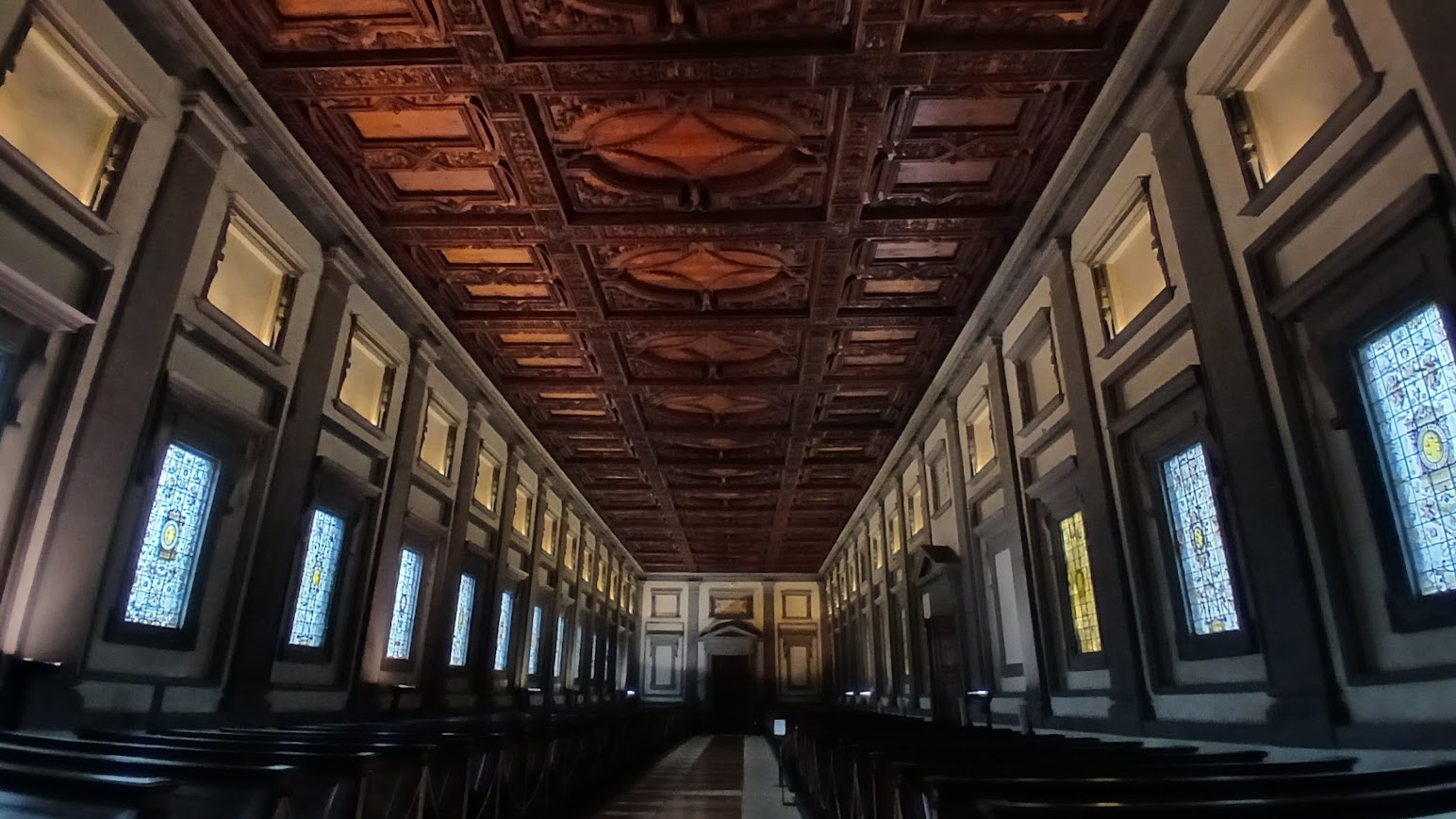
Quando mi fu affidata la realizzazione della Biblioteca Medicea Laurenziana, pensai subito a un’ingresso che non fosse solo un semplice passaggio. Volevo diventasse un luogo capace di inquietare, sorprendere, perfino turbare.
Nel vestibolo della Biblioteca Medicea Laurenziana dissi addio alle norme, all’antichità intesa come obbedienza cieca a “misura, ordine e regola”.
E lo feci consapevolmente.
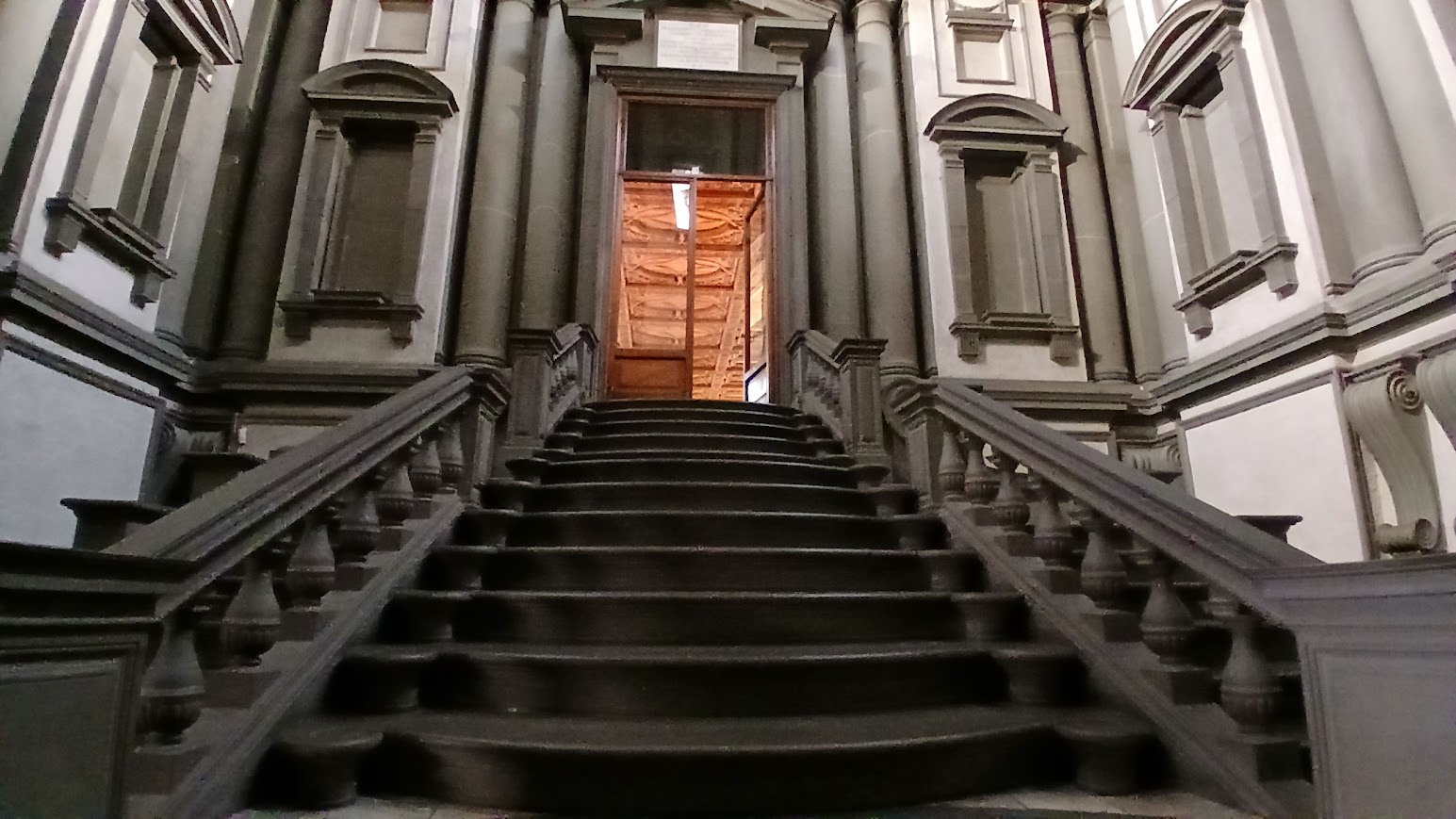
«Qualche fantasia nuova»: la sfida di Clemente VII de’ Medici
Nel marzo del 1524, il papa mi scrisse che si aspettava «qualche fantasia nuova». Non una replica dell’antico. Non un’imitazione. Una fantasia.
Accettai la sfida come si accetta un duello.
Dovevo inserire uno scalone capace di superare un dislivello di circa tre metri. Ma non mi interessava soltanto risolvere un problema tecnico: volevo trasformare la salita in un evento drammatico.
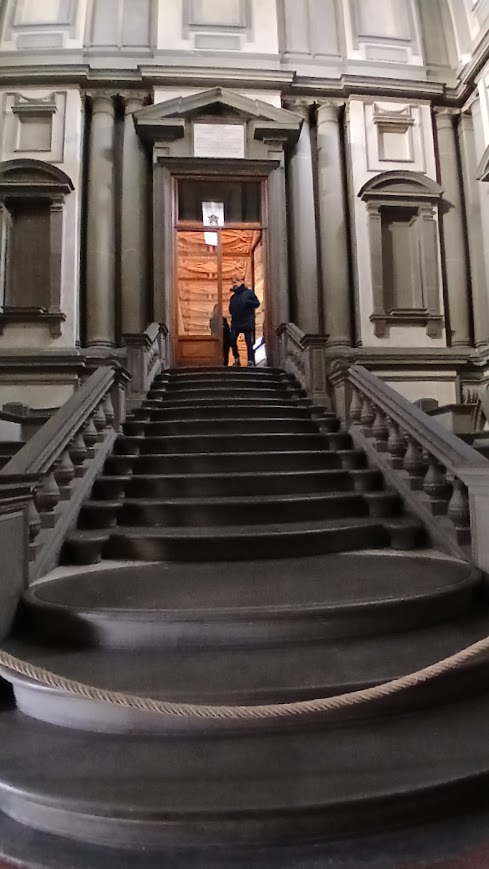
Lo scalone: un sogno che diventa marmo
Per anni lo scalone rimase con me in forma di sogno. Quando, ormai vecchio, mi sollecitarono di riprenderlo, quasi non lo riconoscevo più: era cresciuto dentro di me.
La parte centrale si solleva come un’onda. I primi gradini ovali sembrano sciogliersi nello spazio. Qualcuno vi ha visto un’eco delle scale di Donato Bramante nel Cortile del Belvedere in Vaticano, ma io non cercavo citazioni ma movimento.
Ai lati, le scale si avvolgono in volute senza precedenti. Non pura funzione, ma gesto. Energia che si torce nella pietra.
Immaginai persino che l’atrio potesse diventare un piccolo teatro. Secoli dopo, il regista Peter Greenaway intuì questa natura scenica nel suo film Prospero’s Books. Aveva compreso ciò che molti non avevano visto: quello spazio è azione, non solo architettura.
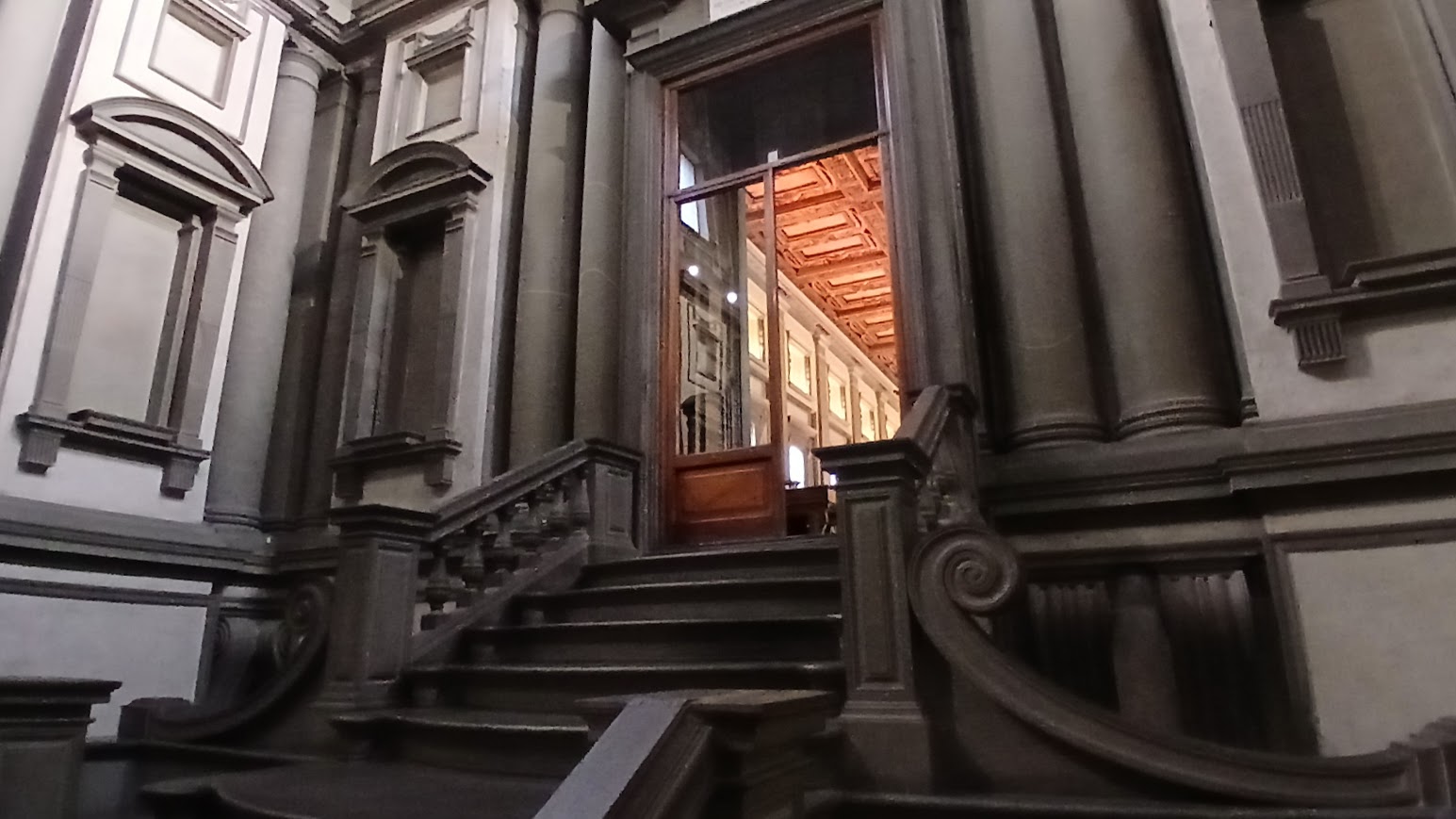
Colonne che non sostengono: l’architettura come ribellione
Le colonne del vestibolo non si offrono allo sguardo come la tradizione impone. Non stanno davanti alla parete. Restano incassate, quasi prigioniere del muro.
Non sostengono davvero. Sono simboli di sostegno, non sostegni.
Il cornicione si piega sopra di loro come un gesto teatrale. Le finestre sono cieche: sembrano tabernacoli, ma non custodiscono nulla. È un’architettura che nega la propria funzione per rivelare il proprio linguaggio.
Avevo studiato i trattati, conoscevo le regole: per questo potevo infrangerle.
Il mondo alla rovescia
Le paraste si assottigliano verso il basso, proprio dove dovrebbero essere più robuste. È un rovesciamento deliberato.
Nei capitelli compaiono piccole maschere mostruose. Creature che sembrano spuntare dalla materia stessa, come se la pietra fosse viva. Ricordano le figure inquietanti della mia Sagrestia Nuova in San Lorenzo.
Sopra di loro si apre un mondo capovolto. Cercavo tensione. L’idea che la forma non sia mai definitiva, che ogni struttura sia in metamorfosi.
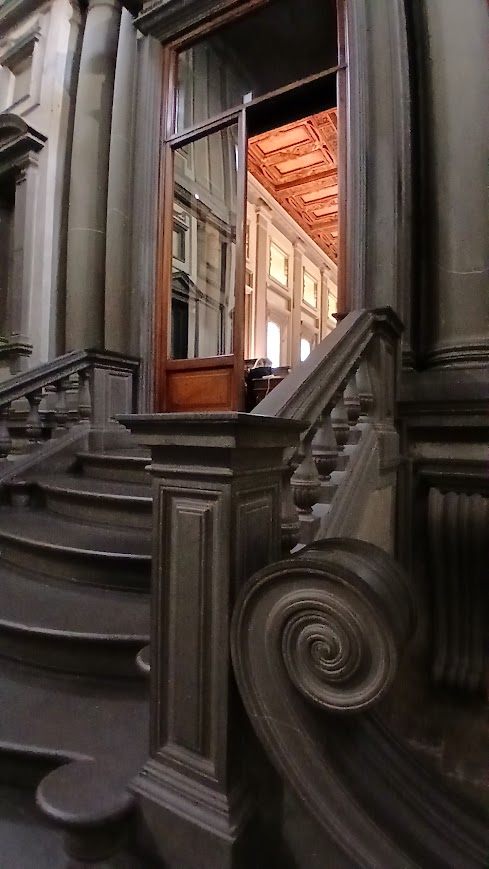
Eliminare il peso: quando l’architettura sembra volare
Nel vestibolo ho portato all’estremo un’idea che mi ossessionava da anni: eliminare l’opposizione tra sostegno e carico.
La pesantezza non è più in basso. Si sposta in alto.
Le colonne arretrate non sembrano reggere nulla. I livelli superiori paiono librarsi nell’aria. È un’architettura che sfida la gravità non con la tecnica, ma con il linguaggio.
Biblioteca o teatro?
Avevo immaginato nicchie con statue antiche. Lo scalone come palcoscenico. L’architettura come protagonista di uno spettacolo continuo.
Il vestibolo non doveva essere soltanto l’anticamera della sala di lettura. Doveva preparare lo spirito.
Chi saliva quei gradini non entrava semplicemente in una biblioteca. Entrava in uno stato mentale diverso.
Addio all’antichità
Si disse che con queste opere io avessi detto addio all’antichità. Non era un rifiuto della grandezza classica, ma della sua ripetizione meccanica.
Volevo restare libero. E nel vestibolo della Laurenziana ho cercato proprio questo: una libertà che inquieta, che destabilizza, che non offre appigli certi.
Perché l’arte, quando è viva, non consola. Trasforma.
Per il momento il sempre vostro Michelangelo Buonarroti vi saluta dandovi appuntamento ai prossimi post e sui social.
The Impossible Staircase of the Laurentian Library
When I was entrusted with the design of the Laurentian Library, I immediately envisioned an entrance that wasn’t just a simple passageway. I wanted it to become a place capable of disturbing, surprising, even unsettling.
In the vestibule of the Laurentian Library, I said goodbye to norms, to antiquity understood as blind obedience to “measure, order, and rule.”
And I did so consciously.
“Some New Fantasy”: Clement VII de’ Medici’s Challenge
In March 1524, the Pope wrote to me that he expected “some new fantasy.” Not a replica of the ancient. Not an imitation. A fantasy.
I accepted the challenge as one accepts a duel.
I had to install a staircase capable of overcoming a difference in height of about three meters. But I wasn’t just interested in solving a technical problem: I wanted to transform the ascent into a dramatic event.
The staircase: a dream that becomes marble
For years, the staircase remained with me in the form of a dream. When, now old, they urged me to take it up again, I almost no longer recognized it: it had grown inside me.
The central section rises like a wave. The first oval steps seem to dissolve into space. Some have seen an echo of Donato Bramante’s stairs in the Cortile del Belvedere in the Vatican, but I wasn’t looking for references, but rather movement.
At the sides, the stairs twist in unprecedented spirals. Not pure function, but gesture. Energy twisting in the stone.
I even imagined the atrium could become a small theater. Centuries later, director Peter Greenaway intuited this scenic nature in his film Prospero’s Books. He understood what many had not: that space is action, not just architecture.
Columns that do not support: architecture as rebellion
The columns of the vestibule do not open to the gaze as tradition dictates. They do not stand in front of the wall. They remain embedded, almost prisoners of the wall.
They don’t really support. They are symbols of support, not supports.
The cornice bends above them like a theatrical gesture. The windows are blind: they look like tabernacles, but they contain nothing. It is an architecture that denies its own function to reveal its own language.
I had studied the treatises, I knew the rules: that’s why I could break them.
The world turned upside down
The pilasters taper towards the bottom, precisely where they should be strongest. It’s a deliberate reversal.
Small monstrous masks appear in the capitals. Creatures that seem to emerge from the material itself, as if the stone were alive. They recall the disturbing figures in my New Sacristy in San Lorenzo.
A topsy-turvy world opens up above them. I was looking for tension. The idea that form is never definitive, that every structure is in metamorphosis.
Eliminating Weight: When Architecture Seems to Fly
In the vestibule, I took to the extreme an idea that had obsessed me for years: eliminating the opposition between support and load.
The heaviness is no longer below. It moves upward.
The recessed columns seem to support nothing. The upper levels seem to hover in the air. It is an architecture that defies gravity not with technique, but with language.
Library or theater?
I had imagined niches with ancient statues. The staircase as a stage. Architecture as the protagonist of a continuous spectacle.
The vestibule was not meant to be merely the antechamber to the reading room. It was meant to prepare the spirit.
Those who climbed those steps did not simply enter a library. They entered a different state of mind.
Farewell to Antiquity
It was said that with these works I had bid farewell to antiquity. It was not a rejection of classical grandeur, but of its mechanical repetition.
I wanted to remain free. And in the vestibule of the Laurenziana, I sought precisely this: a freedom that unsettles, that destabilizes, that offers no sure footing.
Because art, when alive, doesn’t console. It transforms.
For now, yours truly, Michelangelo Buonarroti bids you farewell, inviting you to see him in future posts and on social media.

Sostienici – Support Us
Se questo blog ti piace e ti appassiona, puoi aiutarci a farlo crescere sempre più sostenendoci in modo concreto condividendo i post, seguendo le pagine social e con un contributo che ci aiuta ad andare avanti con il nostro lavoro di divulgazione. . ENGLISH: If you like and are passionate about this blog, you can help us make it grow more and more by supporting us in a concrete way by sharing posts, following social pages and with a contribution that helps us to move forward with our dissemination work.
10,00 €
Condividi:


Questo sono io





sostienici

Sostienici – Support Us
Se questo blog ti piace e ti appassiona, puoi aiutarci a farlo crescere sempre più sostenendoci in modo concreto condividendo i post, seguendo le pagine social e con un contributo che ci aiuta ad andare avanti con il nostro lavoro di divulgazione. . ENGLISH: If you like and are passionate about this blog, you can help us make it grow more and more by supporting us in a concrete way by sharing posts, following social pages and with a contribution that helps us to move forward with our dissemination work.
€10,00


L’arte non conosce età e certe meraviglia ci lasciano tutt’oggi senza parole! 👍👍👍👍👍👏👏👏👏
"Mi piace"Piace a 1 persona