
Quando Daniele da Volterra mi trasformò in un apostolo
Quando questo ritratto fu tracciato su carta, avevo già superato i settant’anni. Le mie mani portavano i segni del marmo, degli affreschi, delle notti passate a disegnare alla luce tremolante di una candela.
Non ero più il giovane scultore del David né l’artista impetuoso della volta della Cappella Sistina: il tempo mi aveva inciso il volto come uno scalpello lento e inesorabile. E proprio così mi vide e mi ritrasse il mio caro amico Daniele da Volterra.

Daniele non fu soltanto un allievo o un collaboratore. Fu uno dei pochi che seppero starmi accanto negli anni più difficili, quando il peso delle commissioni e della fama diventava quasi insopportabile. Le cronache lo ricordano come il “Braghettone”, colui che coprì le nudità del mio Giudizio Universale nella Sistina. Ma prima di tutto fu un artista sensibile, un uomo leale e per me un amico sincero.
Un giorno, mentre il tempo mi piegava le spalle e i pensieri si facevano più severi, decise di ritrarmi. Non cercò di addolcire le rughe né di nascondere la malinconia che da sempre abitò il mio sguardo.

Tracciò il mio volto con rispetto, quasi con devozione, lasciando che il segno della matita raccontasse la verità degli anni.
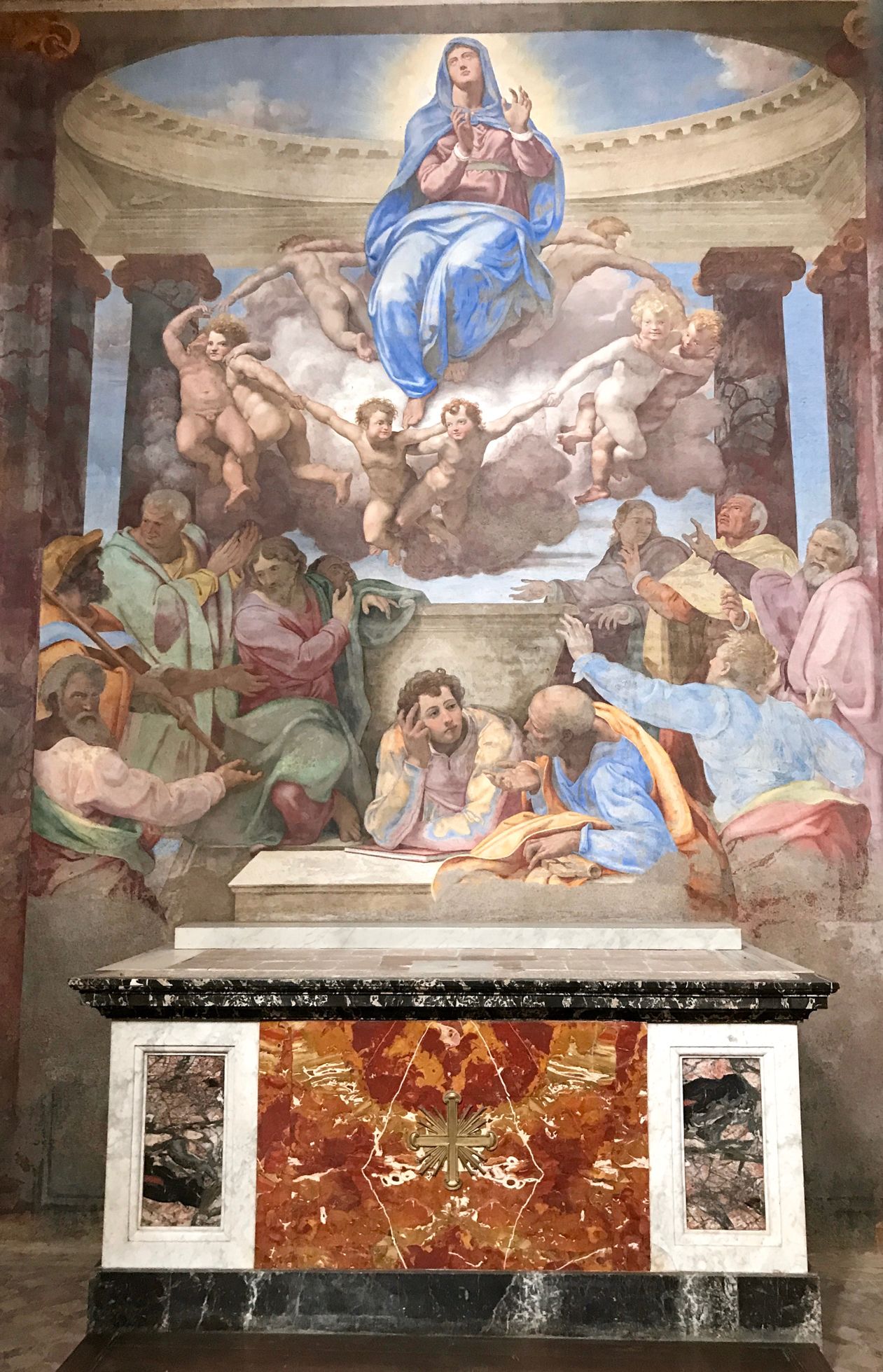
Quel foglio non rimase soltanto un ritratto. Daniele lo usò infatti come cartone per un’impresa più grande: l’affresco dell’Assunzione della Vergine nella cappella della famiglia Della Rovere, nella chiesa della Trinità dei Monti a Roma. Lì, tra gli apostoli raccolti attorno alla tomba vuota, volle darmi un posto.
Non come maestro, non come architetto di San Pietro, ma come un apostolo tra gli altri.
Se guardate bene l’affresco, mi troverete all’estrema destra. Indosso un manto rosato e con la mano indico la Vergine che sale al cielo. Ma il mio sguardo non segue il suo volo: guarda fuori, verso chi osserva la scena. È lo sguardo di un uomo che ha visto molto, forse troppo, e che ormai cerca altro.
Il disegno che Daniele fece di me porta ancora i segni del suo lavoro. Lungo il contorno del volto si notano i fori: sono le tracce della bucherellatura necessaria per lo spolvero, tecnica con cui trasferì il ritratto sulla parete. Lo appoggiò sull’intonaco fresco e, con lo spolvero, fece passare la polvere attraverso i fori, riportando così la mia immagine nell’affresco.
In quel modo, la mia testa dipinta risultò grande quanto quella del cartone: un passaggio diretto dalla carta al muro, dalla vita al colore.

Quando Daniele realizzò quel ritratto, avevo tra i settantatré e i settantotto anni. Non so se lo fece per omaggiarmi o per necessità di lavoro. Forse entrambe le cose. So soltanto che quel foglio conserva qualcosa di più di una somiglianza: custodisce l’affetto e la stima di lui nei miei confronti.
Dopo la mia morte, Daniele tornò ancora su quel volto, fondendolo in bronzo in alcuni busti che oggi testimoniano la sua memoria di me. E se quei ritratti hanno la stessa espressione severa e pensosa, è perché mi conobbe davvero.
Non cercò l’eroe. Non cercò il genio.
Disegnò semplicemente l’uomo che ero diventato.
E forse, tra tutte le opere della mia lunga vita, questo è il ritratto che più mi assomiglia.
Per il momento il sempre vostro Michelangelo vi saluta dandovi appuntamento ai prossimi post e sui social.
When Daniele da Volterra transformed me into an apostle
When this portrait was drawn on paper, I was already in my seventies. My hands bore the marks of marble, frescoes, and nights spent drawing by the flickering light of a candle.
I was no longer the young sculptor of David nor the impetuous artist of the Sistine Chapel ceiling: time had etched my face like a slow, inexorable chisel. And that’s exactly how my dear friend Daniele da Volterra saw me and portrayed me.
Daniele wasn’t just a student or a collaborator. He was one of the few who knew how to stand by me during the most difficult years, when the weight of commissions and fame became almost unbearable. The chronicles remember him as the “Braghettone,” the one who covered the nakedness of my Last Judgment in the Sistine Chapel. But above all, he was a sensitive artist, a loyal man, and a sincere friend to me.
One day, as time sagged and my thoughts grew more severe, he decided to paint me. He didn’t try to soften the wrinkles or hide the melancholy that had always inhabited my gaze.
He traced my face with respect, almost devotion, allowing the pencil mark to tell the truth of the years.
That sheet of paper didn’t remain just a portrait. Daniele used it as a cartoon for a greater undertaking: the fresco of the Assumption of the Virgin in the Della Rovere family chapel in the church of Trinità dei Monti in Rome. There, among the apostles gathered around the empty tomb, he wanted to give me a place.
Not as a master, not as the architect of St. Peter’s, but as an apostle among others.
If you look closely at the fresco, you’ll find me on the far right. I’m wearing a rosy cloak and with my hand I point to the Virgin ascending to heaven. But my gaze doesn’t follow her flight: it looks outside, toward those observing the scene. It’s the gaze of a man who has seen a lot, perhaps too much, and now seeks something else.
The drawing Daniele made of me still bears the marks of his work. Along the outline of my face, you can see the holes: they are the traces of the holes needed for the “spolvero” (dusting), the technique used to transfer the portrait to the wall. He placed it on the fresh plaster and, by dusting, forced the dust through the holes, thus transferring my image to the fresco.
In that way, my painted head was as large as the cardboard one: a direct transition from paper to wall, from life to color.
When Daniele created that portrait, I was between seventy-three and seventy-eight years old. I don’t know if he did it as a tribute to me or out of professional necessity. Perhaps both. I only know that that sheet of paper preserves something more than a likeness: it holds his affection and esteem for me.
After my death, Daniele returned to that face again, casting it in bronze in several busts that today bear witness to his memory of me. And if those portraits have the same stern and thoughtful expression, it’s because he truly knew me.
He didn’t seek the hero. He didn’t seek the genius.
He simply drew the man I had become.
And perhaps, of all the works of my long life, this is the portrait that most resembles me.
For now, yours truly, Michelangelo bids you farewell and says goodbye, looking forward to seeing you in future posts and on social media.

Sostienici – Support Us
Se questo blog ti piace e ti appassiona, puoi aiutarci a farlo crescere sempre più sostenendoci in modo concreto condividendo i post, seguendo le pagine social e con un contributo che ci aiuta ad andare avanti con il nostro lavoro di divulgazione. . ENGLISH: If you like and are passionate about this blog, you can help us make it grow more and more by supporting us in a concrete way by sharing posts, following social pages and with a contribution that helps us to move forward with our dissemination work.
10,00 €
Condividi:


Questo sono io





sostienici

Sostienici – Support Us
Se questo blog ti piace e ti appassiona, puoi aiutarci a farlo crescere sempre più sostenendoci in modo concreto condividendo i post, seguendo le pagine social e con un contributo che ci aiuta ad andare avanti con il nostro lavoro di divulgazione. . ENGLISH: If you like and are passionate about this blog, you can help us make it grow more and more by supporting us in a concrete way by sharing posts, following social pages and with a contribution that helps us to move forward with our dissemination work.
€10,00


