

Lo studio per il panneggio della Sibilla Eritrea
Questo che vi propongo è il disegno che realizzai per studiare il panneggio che scivola sulle gambe della Sibilla Eritrea.
Misi mano allo studio tra il 1508 e il 1512 adoperando acquerello marrone e penna con inchiostro marrone scuro su un disegno di base a gesso nero.

Probabilmente per realizzare questo studio adoperai un modello realizzato secondo la consueta tecnica tipica fiorentina descritta molto bene anche nella “Vita” di Leonardo scritta dal mio carissimo amico Giorgio Vasari.
In pratica un tessuto di lino o cotone veniva immerso nell’argilla bagnata e poi adagiato sopra un supporto.

Una pratica quattrocentesca che proseguì anche nella prima metà del Cinquecento e che usavo di tanto in tanto anch’io avendola imparata da ragazzetto a bottega dai Ghirlandaio.
Lo studio risale a un momento antecedente al cartone che realizzai per la Sibilla anche se poi, nell’affresco della volta della Sistina, il panneggio risulta più semplice.

Durante l’osservazione di questo foglio, Turner nel 1979 non fece a meno di notare che “la deliberata costruzione della forma scultorea mediante un complesso sistema di tratteggio e tratteggio incrociato può essere vista in embrione anche in disegni molto antichi come il Filosofo”.
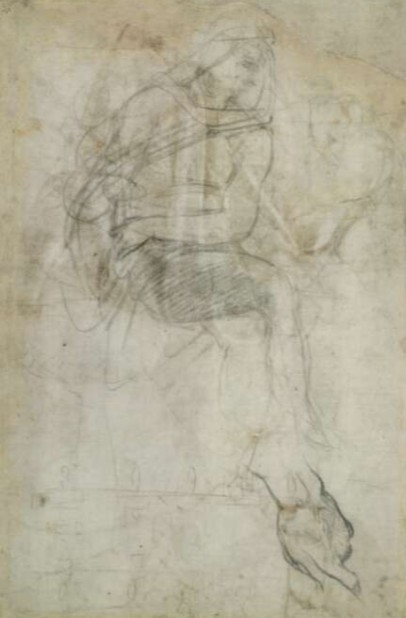
Sul verso del medesimo foglio invece tracciai una figura seduta in posizione serpentinata. Sembra uno studio precedente per la medesima sibilla con l’aggiunta dei putti appena percettibili ai lati.
Aguzzando la vista noterete lo schizzo riassuntivo del soffitto. E’ la divisione della volta della Sistina con la posizione dei profeti e delle sibille.
Il disegno appartiene alle collezioni del British Museum.
Per il momento il sempre vostro Michelangelo Buonarroti vi saluta dandovi appuntamento ai prossimi post e sui social.
The study for the drapery of the Erythraean Sibyl
This is the drawing I made to study the drapery that slides over the legs of the Erythraean Sibyl.
I began the study between 1508 and 1512, using brown watercolor and pen and dark brown ink over a black chalk base.
To create this study, I probably used a model made according to the traditional Florentine technique described very well in Vasari’s “Life” of Leonardo. In practice, a piece of fabric was dipped in wet clay and then placed on a support.
A fifteenth-century practice that continued into the first half of the sixteenth century and which I also used from time to time, having learned it as a boy in Ghirlandaio’s workshop. The study dates back to a period prior to the cartoon I made for the Sibyl, although the drapery in the fresco on the Sistine ceiling is simpler.
While examining this sheet, Turner observed in 1979 that “the deliberate construction of the sculptural form through a complex system of hatching and cross-hatching can be seen in embryo even in very early drawings such as the Philosopher.”
On the back of the same sheet, I drew a figure seated in a serpentine position. It appears to be an earlier study for the same sibyl, with the addition of the barely visible cherubs at the sides.
If you look closely, you’ll notice the summary sketch of the ceiling. It is the division of the Sistine Chapel vault with the positions of the prophets and sibyls.
The sheet belongs to the British Museum collections.
For now, yours truly, Michelangelo Buonarroti bids you farewell and invites you to join him in future posts and on social media.

Sostienici – Support Us
Se questo blog ti piace e ti appassiona, puoi aiutarci a farlo crescere sempre più sostenendoci in modo concreto condividendo i post, seguendo le pagine social e con un contributo che ci aiuta ad andare avanti con il nostro lavoro di divulgazione. . ENGLISH: If you like and are passionate about this blog, you can help us make it grow more and more by supporting us in a concrete way by sharing posts, following social pages and with a contribution that helps us to move forward with our dissemination work.
10,00 €
Condividi:


Questo sono io





sostienici

Sostienici – Support Us
Se questo blog ti piace e ti appassiona, puoi aiutarci a farlo crescere sempre più sostenendoci in modo concreto condividendo i post, seguendo le pagine social e con un contributo che ci aiuta ad andare avanti con il nostro lavoro di divulgazione. . ENGLISH: If you like and are passionate about this blog, you can help us make it grow more and more by supporting us in a concrete way by sharing posts, following social pages and with a contribution that helps us to move forward with our dissemination work.
€10,00


