
Trilogy: in scena la morte prima del cambiamento
Finisce qualcosa affinché qualcos’altro abbia spazio e tempo per iniziare. Tutto quello che termina ha bisogno di cambiare forma per tornare a nascere.
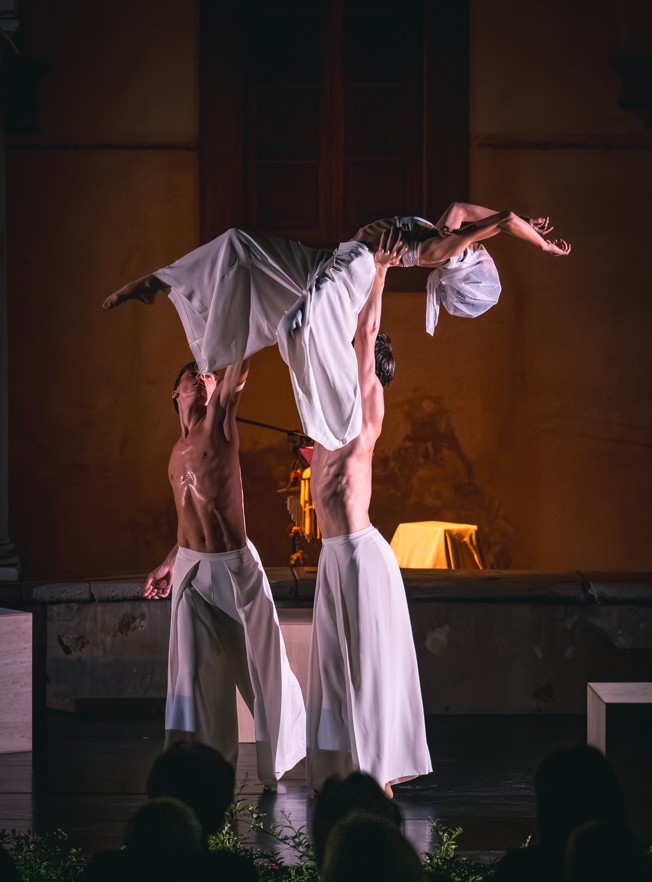
Prima di tornare alla luce però, c’è il baratro da affrontare. I corpi dei ballerini Daniele Iuliano, Thomas Piaggi e Chiara Ranca, giacciono dentro, sopra e attorno alle scatole di legno. Immobili han perduto la vita che fino a un istante prima li teneva in piedi.

Papiro compare eterea sulla scena, alla stregua di una figura angelica che vuol toccare con mano il momento esatto dell’abbandono. Cammina tra quelle figure spente e le guarda, una dopo l’altra.
Comincia così l’ultima parte dello spettacolo Trilogy dedicata alla morte che è stata portata ieri sera sul palco del Chiostro di Sant’Agostino a Pietrasanta, nell’ambito della 46^ edizione del Festival La Versiliana, promosso dalla Fondazione Versiliana con la direzione artistica di Marco Marchesi.
Non è la morte nera quella che viene messa in scena bensì il momento di passaggio tra il buio e la luce, tra la resa e la ripresa di una vita più consapevole, qui e ora.
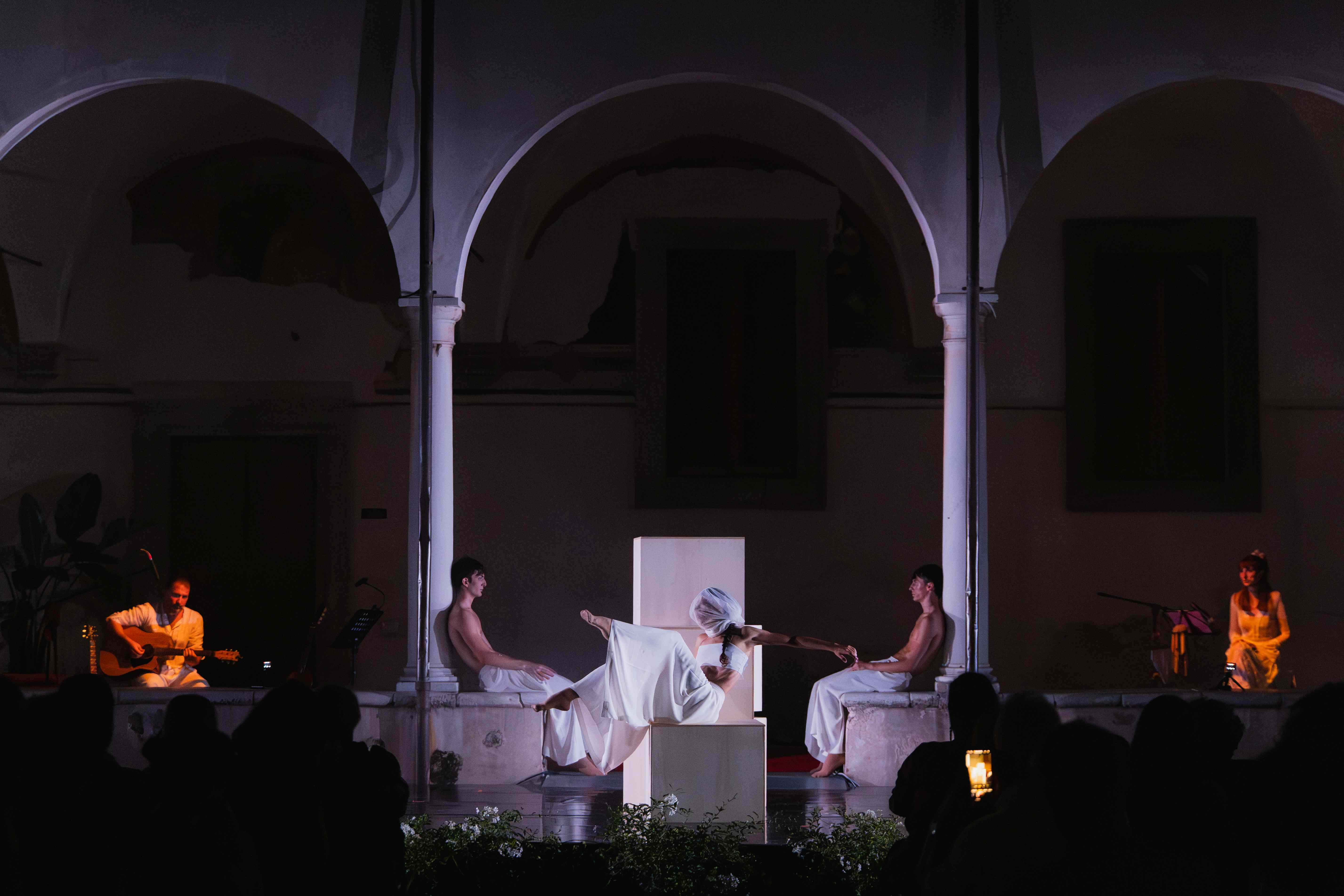
Mentre Matteo Carretto passa da uno strumento all’altro, Papiro canta e la sua voce melodiosa diventa parte integrante della narrazione messa in scena dai ballerini.
Nel limbo c’è spazio anche per le note e le coreografie di un tango appassionato nella sua versione originale, quando ancora era un ballo per soli uomini.
Per tornare a rinascere, è indispensabile togliere ciò che vela lo sguardo e la mente. Chiara Ranca alla stregua della Vergine Velata di Strazza, compare con il volto celato dall’organza che consente di vederne le forme ma impedisce a lei di essere totalmente libera. Lo è il suo corpo ma non la sua mente, imprigionata dall’insoddisfazione, dal voler essere come non si è, dalla frenetica corsa quotidiana che succhia costantemente energie.
Cadono i veli, cadono gli abiti e si rimane nudi dinanzi a sé stessi, al proprio essere, come dimostrano i tre ballerini. E’ solo allora che arriva la nuova forma di noi stessi, raffigurata da quel grande velo rosso che prima lascia intravedere i ballerini e poi avvolge la ballerina come se fosse una meravigliosa crisalide, pronta divenire farfalla.
Il pubblico estasiato applaude a ogni ripresa di fiato di chi è in scena fino al termine di Trilogy: uno spettacolo poetico che accompagna gli spettatori a porsi qualche interrogativo in più.

Regia e coreografia di ‘Trilogy amore – tempo – morte’ sono firmate da Greta Arditi assieme a Giulio Benvenuti, mentre la direzione musicale è affidata a Ivan Lazzara, che sigla le musiche insieme a Matteo Caretto, Papiro e Giulio Decembrini.
I testi dei monologhi portano la firma di Stefano Arditi mentre i costumi sono stati realizzati da MGS ed Elisa Leclè.
Per il momento il vostro sempre Michelangelo Buonarroti vi saluta dandovi appuntamento ai prossimi post e sui social.
Triogy: Death before Rebirth on Stage
Something ends so that something else has space and time to begin. Everything that ends needs to change shape to be reborn.
Before returning to the light, however, there is an abyss to be faced. The bodies of dancers Daniele Iuliano, Thomas Piaggi, and Chiara Ranca lie inside, on, and around the wooden boxes. Motionless, they have lost the life that just a moment before kept them upright.
Papiro appears ethereal on stage, like an angelic figure longing to experience the exact moment of abandonment. He walks among those lifeless figures and gazes at them, one after the other.
Thus begins the final part of the show Trilogy, dedicated to death, which was performed last night on the stage of the Chiostro di Sant’Agostino in Pietrasanta, as part of the 46th edition of the La Versiliana Festival, promoted by the Versiliana Foundation with the artistic direction of Marco Marchesi.
It’s not the Black Death that’s being staged, but rather the moment of transition between darkness and light, between surrender and the resumption of a more conscious life, here and now.
While Matteo Carretto switches from one instrument to another, Papiro sings, his melodious voice becoming an integral part of the narrative unfolded by the dancers.
In limbo, there’s also room for the notes and choreography of a passionate tango in its original version, when it was still a dance for men only.
To be reborn, it’s essential to remove what veils the gaze and the mind. Chiara Ranca, like Strazza’s Veiled Virgin, appears with her face hidden by organza, which allows her form to be seen but prevents her from being totally free. Her body is free, but not her mind, imprisoned by dissatisfaction, by wanting to be something other than herself, by the frenetic daily rush that constantly saps energy.
The veils fall, the clothes fall, and we are left naked before ourselves, before our very being, as the three dancers demonstrate. It is only then that our new self emerges, represented by that great red veil that first allows a glimpse of the dancers and then envelops the ballerina as if she were a marvelous chrysalis ready to become a butterfly.
The enraptured audience applauds with every breath taken by the dancers and the singer until the end of Trilogy: a poetic spectacle that leads spectators to ask themselves a few more questions.
The direction and choreography of “Trilogy Love – Time – Death” are by Greta Arditi together with Giulio Benvenuti, while the musical direction is entrusted to Ivan Lazzara, who composes the music together with Matteo Caretto, Papiro, and Giulio Decembrini.
The monologues’ lyrics are by Stefano Arditi, while the costumes were designed by MGS and Elisa Leclè.
For now, yours truly, Michelangelo Buonarroti bids farewell and says he’ll see you in future posts and on social media.

Sostienici – Support Us
Se questo blog ti piace e ti appassiona, puoi aiutarci a farlo crescere sempre più sostenendoci in modo concreto condividendo i post, seguendo le pagine social e con un contributo che ci aiuta ad andare avanti con il nostro lavoro di divulgazione. . ENGLISH: If you like and are passionate about this blog, you can help us make it grow more and more by supporting us in a concrete way by sharing posts, following social pages and with a contribution that helps us to move forward with our dissemination work.
10,00 €
Articoli
Condividi:


Questo sono io





sostienici

Sostienici – Support Us
Se questo blog ti piace e ti appassiona, puoi aiutarci a farlo crescere sempre più sostenendoci in modo concreto condividendo i post, seguendo le pagine social e con un contributo che ci aiuta ad andare avanti con il nostro lavoro di divulgazione. . ENGLISH: If you like and are passionate about this blog, you can help us make it grow more and more by supporting us in a concrete way by sharing posts, following social pages and with a contribution that helps us to move forward with our dissemination work.
€10,00


Dev’essere un vero spettacolo vedere dal vivo questa rappresentazione, già dalle immagini traspare le misteriosa bellezza di queste figure👏👏👏👍👍👍👍👍👍
"Mi piace"Piace a 1 persona
si, sono rimasto affascinato… e poi la voce di Papiro è quasi ipnotica, straordinaria
"Mi piace"Piace a 1 persona