

Boucher e Fragonard alla corte del re: da Palazzo Barberini a Casa Museo Zani
Se vi affascina la pittura francese del Settecento, in provincia di Brescia sta per aprire i battenti una mostra dedicata ai capolavori di Boucher e Fragonard.
I pittori che con la loro sensualità e malizia hanno conquistato la corte francese di Luigi XV e Luigi XVI, verranno esposti a Casa Museo Zani, in un percorso espositivo pensato dalla Fondazione Paolo e Carolina Zani in collaborazione con le Gallerie Nazionali d’Arte Antica Barberini Corsini.

Per la prima volta vengono esposte assieme le opere di François Boucher (Parigi 1703-1770) e il piccolo gioiello pittorico di Jean-Honoré Fragonard (Grasse 1732-Parigi 1806) delle collezioni romane con due capolavori di Boucher appartenenti alla collezione Zani.
François Boucher pittore di corte
Alla corte di Francia, Luigi XV nominò nel 1765 François Boucher primo pittore del re, coronando di fatto una carriera a dir poco leggendaria.
La fama di Boucher crebbe di anno in anno fin da quando, nel 1731, rientrò dal suo soggiorno romano. L’artista infatti nel 1723, grazie al suo talento, aveva conquistato il Prix de Rome ed ebbe così l’occasione di permanere a lungo nella Città Eterna.
Il suo rapporto privilegiato con Madame de Pompadour, favorita del re di Francia, assieme alla stretta amicizia che era riuscito a intessere con il marchese di Marigny, direttore del Bâtiments du Roi, gli permisero di divenire pittore alla corte del re a partire dal 1742 e, qualche anno dopo, nel 1761, fu scelto come rettore della medesima Académie.
Boucher deve molto alla pittura italiana. Le sue opere hanno echi riconducibili al Veronese, Guercino e al Tiepolo. Tutti artisti che il pittore di corte studiò a lungo in Italia e che definirono la tavolozza delle sue opere negli anni a seguire.
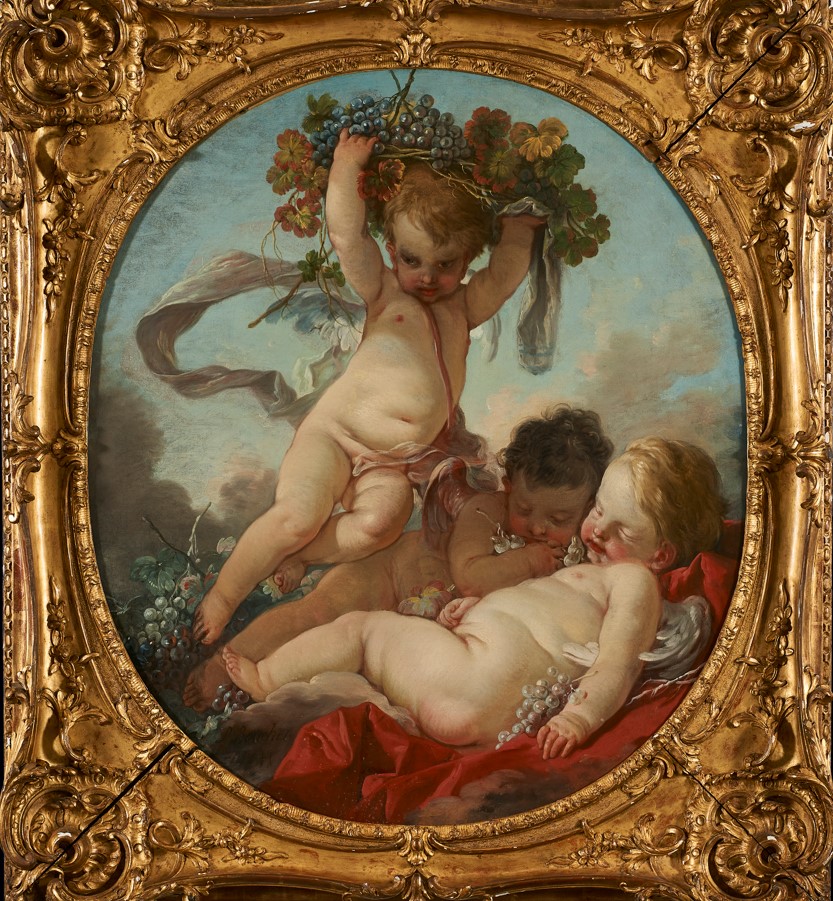
Casa Museo Zani conserva, tra gli altri, due dipinti di Boucher. Il primo, firmato e datato 1741, vanta una storia collezionistica che ci riporta proprio alla corte di Luigi XV quando l’opera apparteneva al castello reale di Choisy.
La tela ovale ha come soggetto due cupidi addormentati in primo piano e un terzo in alto con un intreccio di tralci di vite. L’opera è l’allegoria della Terra e faceva parte in origine di un gruppo di quattro pendants con i quattro elementi naturali: acqua, aria, terra e fuoco.

olio su tela 96 x 130 cm. Cellatica (Bs), Casa Museo Zani, Fondazione Paolo e Carolina Zani
La seconda tela della collezione Zani mostra Venere nella fucina di Vulcano ed è l’opera di Boucher più scenografico e imponente oggi conservato in una collezione italiana.
L’opera è strettamente connessa ad un altro dipinto di Boucher, oggi custodito al Louvre e originariamente destinato alla camera da letto del sovrano, firmato e datato 1747. Secondo gli studi più recenti, l’esemplare Zani, visti i numerosi pentimenti rivelati dalle indagini scientifiche, potrebbe essere addirittura precedente alla tela del Louvre, rimasto incompiuto e conservato nell’atelier dell’artista.
Accanto alla sublime tela raffigurante La piccola giardiniera (1767), un incanto compositivo tra l’incarnato perlaceo del volto, il vaporoso abito serico e la poetica natura morta con un cesto di rose, si collocano infatti due soggetti paesaggistici: Il mattino (1764) e La sera (1764).

L’opera in mostra di Jean Honoré Fragonard
In mostra sarà presente un vero gioiello della produzione pittorica di Jean Honoré Fragonard formatosi proprio sotto la guida di François Bouche.
A Roma, dove soggiornò per sei anni vincendo nel 1753 il Prix de Rome, Fragonard rimase incantato dai giardini che dominavano la scena urbana e, da quel momento, li trasferì in forme diverse all’interno delle proprie opere pittoriche.
Il grande riconoscimento, prima dell’oblio che segnò il finale della sua esistenza, lo raggiunse proprio con un genere di pittura “leggera”, con riferimenti maliziosi, in perfetto stile rococò, particolarmente apprezzati anche alla corte di Luigi XVI.

olio su tela cm 36 x 45. Roma, Gallerie Nazionali di Arte Antica, Palazzo Barberini e Galleria Corsini
Annette a vent’anni (1762 ca.) rientra perfettamente in questo genere pittorico e ha un soggetto tratto da uno dei Racconti morali di Jean-François Marmontel, noto illuminista collaboratore dell’Encyclopédie.
In un ampio paesaggio dal carattere bucolico, Fragonard colloca le due piccole figure in controluce di Annette e Lubin, due cugini belgi innamorati. Orfani dall’età di otto anni, i due cresceranno in una capanna allevando pecore, finché il loro amore non sarà contrastato perché considerato incestuoso, dopo la nascita di un figlio.
BOUCHER e FRAGONARD. Alla corte del re Da Palazzo Barberini a Casa Museo Zani
14 febbraio – 25 maggio 2025
Casa Museo Fondazione Paolo e Carolina Zani
via Fantasina 8, Cellatica (BS)
mar-ven (9-13), sab-dom (10-17)
La mostra è visitabile previa prenotazione: 0302520479 – info@fondazionezani.com
Per il momento il sempre vostro Michelangelo Buonarroti vi saluta dandovi appuntamento ai prossimi post e sui social.

Boucher and Fragonard at the King’s Court: from Palazzo Barberini to Casa Museo Zani
If you are fascinated by eighteenth-century French painting, an exhibition dedicated to the masterpieces of Boucher and Fragonard is about to open its doors in Rome.
The painters who conquered the French court of Louis XV and Louis XVI with their sensuality and malice will be exhibited at Casa Museo Zani, in an exhibition itinerary designed by the Paolo and Carolina Zani Foundation in collaboration with the Barberini Corsini National Galleries of Ancient Art.
For the first time, the works of François Boucher (Paris 1703-1770) and the small pictorial jewel of Jean-Honoré Fragonard (Grasse 1732-Paris 1806) from the Roman collections are exhibited together with two masterpieces by Boucher belonging to the Zani collection.
François Boucher court painter
At the court of France, Louis XV appointed François Boucher as the king’s first painter in 1765, effectively crowning a career that was nothing short of legendary.
Boucher’s fame grew year after year ever since he returned from his stay in Rome in 1731. In fact, in 1723, thanks to his talent, the artist had won the Prix de Rome and thus had the opportunity to remain in the Eternal City for a long time.
His privileged relationship with Madame de Pompadour, the king of France’s favorite, together with the close friendship he had managed to establish with the Marquis de Marigny, director of the Bâtiments du Roi, allowed him to become a painter at the king’s court starting in 1742 and, a few years later, in 1761, he was chosen as rector of the same Académie.
Boucher owes much to Italian painting. His works have echoes attributable to Veronese, Guercino and Tiepolo. All artists that the court painter studied for a long time in Italy and who defined the palette of his works in the years to follow.
Casa Museo Zani preserves, among others, two paintings by Boucher. The first, signed and dated 1741, boasts a collection history that takes us back to the court of Louis XV when the work belonged to the royal castle of Choisy.
The oval canvas has as its subject two sleeping cupids in the foreground and a third at the top with an intertwining of vine shoots. The work is the allegory of the Earth and was originally part of a group of four pendants with the four natural elements: water, air, earth and fire.
The second canvas of the Zani collection shows Venus in Vulcan’s forge and is the most scenographic and imposing work by Boucher today preserved in an Italian collection.
The work is closely connected to another painting by Boucher, now kept at the Louvre and originally intended for the sovereign’s bedroom, signed and dated 1747. According to the most recent studies, the Zani example, given the numerous pentimenti revealed by scientific investigations, could even be earlier than the Louvre canvas, which remained unfinished and preserved in the artist’s atelier.
Next to the sublime canvas depicting The Little Gardener (1767), a compositional enchantment between the pearly complexion of the face, the vaporous silk dress and the poetic still life with a basket of roses, there are in fact two landscape subjects: Morning (1764) and Evening (1764).
The work on display by Jean Honoré Fragonard
The exhibition will feature a true jewel of the pictorial production of Jean Honoré Fragonard who trained under the guidance of François Bouche.
In Rome, where he stayed for six years and won the Prix de Rome in 1753, Fragonard was enchanted by the gardens that dominated the urban scene and, from that moment, he transferred them in different forms into his pictorial works.
He achieved great recognition, before the oblivion that marked the end of his existence, precisely with a genre of “light” painting, with mischievous references, in perfect Rococo style, particularly appreciated also at the court of Louis XVI.
Annette at Twenty (ca. 1762) fits perfectly into this pictorial genre and has a subject taken from one of the Moral Tales by Jean-François Marmontel, a well-known Enlightenment contributor to the Encyclopédie.
In a large bucolic landscape, Fragonard places the two small backlit figures of Annette and Lubin, two Belgian cousins in love. Orphaned since the age of eight, the two will grow up in a hut raising sheep, until their love is thwarted because it is considered incestuous, after the birth of a son.
BOUCHER and FRAGONARD. At the king’s court From Palazzo Barberini to Casa Museo Zani
Casa Museo Fondazione Paolo e Carolina Zani
February 14 – May 25, 2025
The exhibition can be visited by reservation: 0302520479 – info@fondazionezani.com
For the moment, your ever Michelangelo Buonarroti bids you farewell, making an appointment for the next posts and on social media.

Sostienici – Support Us
Se questo blog ti piace e ti appassiona, puoi aiutarci a farlo crescere sempre più sostenendoci in modo concreto condividendo i post, seguendo le pagine social e con un contributo che ci aiuta ad andare avanti con il nostro lavoro di divulgazione. . ENGLISH: If you like and are passionate about this blog, you can help us make it grow more and more by supporting us in a concrete way by sharing posts, following social pages and with a contribution that helps us to move forward with our dissemination work.
10,00 €

Condividi:


Questo sono io





sostienici

Sostienici – Support Us
Se questo blog ti piace e ti appassiona, puoi aiutarci a farlo crescere sempre più sostenendoci in modo concreto condividendo i post, seguendo le pagine social e con un contributo che ci aiuta ad andare avanti con il nostro lavoro di divulgazione. . ENGLISH: If you like and are passionate about this blog, you can help us make it grow more and more by supporting us in a concrete way by sharing posts, following social pages and with a contribution that helps us to move forward with our dissemination work.
€10,00


