

Il dipinto del giorno: Venere e Marte di Botticelli
Il dipinto del giorno che vi propongo oggi è Marte e Venere di Sandro Botticelli, un’opera su tavola a tecnica mista realizzata fra il 1482 e il 1483, oggi appartenente alle collezioni della National Gallery di Londra.
Gli influssi classicheggianti presenti nel dipinto, inducono a pensare che Botticelli abbia messo mano alla tavola dopo il suo soggiorno romano. Nella Città Eterna ebbe sicuramente modo di studiare i sarcofagi romani e altre antichità che avrebbero influito sulla sua produzione successiva.
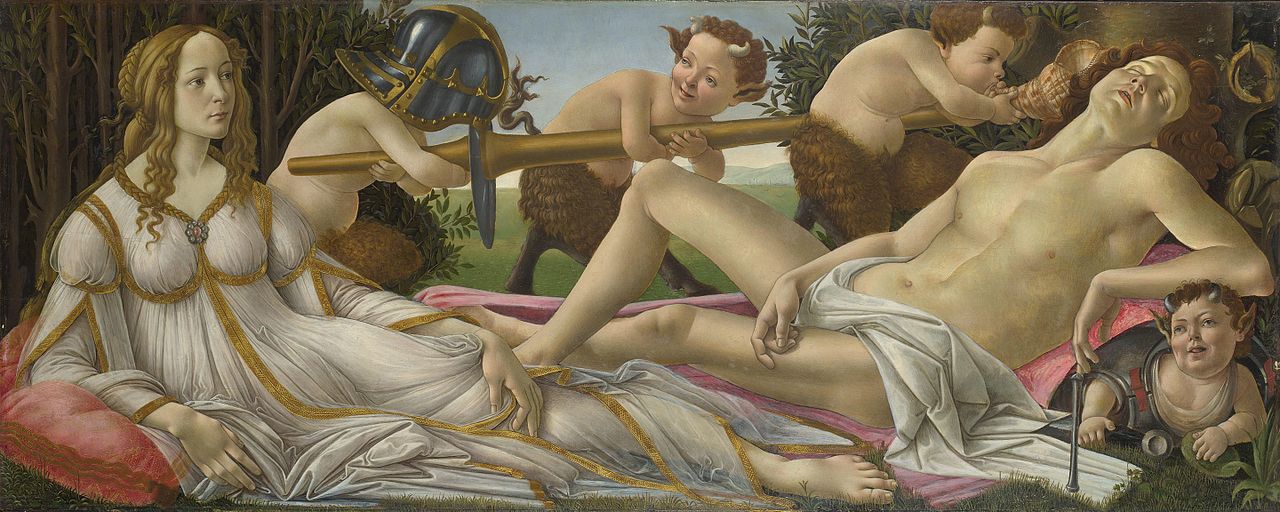
Osservando bene il dipinto, vi renderete conto che in alto a destra, all’altezza della testa di Marte, ci sono delle vespe in movimento il che ha fatto pensare agli studiosi che possa essere stata una commissione richiesta dalla famiglia Vespucci, forse in occasione di un matrimonio.
Il formato insolitamente orizzontale della tavola ha fatto supporre l’opera sia stata la decorazione di un cassone o una spalliera.
Nonostante l’atmosfera dell’opera immediatamente percepibile sia serena, guardando meglio ci si rende conto che la tranquillità sia interrotta bruscamente da uno sguardo malinconico di Venere che sembra impossibilitata a risvegliare dal sonno profondo Marte.

Venere, semi sdraiata, sostiene il busto appoggiando il gomito sopra un cuscino e rivolge il suo sguardo in direzione di Marte. E’ abbigliata con una veste bianca leggera e panneggiata, decorata con una passamaneria dorata. Sul petto porta un gioiello formato da un rubino centrale circondato da otto perle, simbolo di verginità.
Marte dorme profondamente ed completamente nudo, ad eccezion fatta di un panneggio che gli copre il pube.
In secondo piano non sfugge la presenza di tre satiri che giocano con la lancia di Marte. Uno di loro, soffia nel suo orecchio adoperando una conchiglia. Sotto il braccio sinistro di Marte si vede un altro satiro che indossa parte della sua corazza.

Secondo la narrazione contenuta nelle Metamorfosi di Ovidio, Venere è la dea dell’amore mentre Marte è il dio della guerra. Entrambi sono raffigurati da Botticelli con i rispettivi attributi iconografici. La conchiglia tenuta in mano da uno dei satiri fa riferimento alla nascita di Venere per esempio e le armi indossate da un altro satirino sono un palese attributo di Marte.
L’amore vince la guerra, sembrerebbe suggerire l’opera.
L’immagine rappresentata della dea rispetta i canoni di bellezza tipicamente rinascimentali con quell’incarnato pallido della giovane, le guance rosate e i capelli biondi fluenti che ricadono sulle spalle.

Fate caso a un dettaglio. Nel Rinascimento le dame nobili o comunque facoltose erano solite portare acconciature elaborate. Solo alle vergini come in questo caso e alle bambine era consentito portare i capelli sciolti.
Le donne adulte che avevano capelli privi di qualsiasi acconciatura e quindi che gli ricadevano liberi sulle spalle, erano prostitute. Pensate infatti a tutte le Maddalene raffigurate sempre con i capelli lunghi sciolti.
Per il momento il sempre vostro Michelangelo Buonarroti vi saluta dandovi appuntamento ai prossimi post e sui social.

Painting of the day: Botticelli’s Venus and Mars
The painting of the day that I propose to you today is Mars and Venus by Sandro Botticelli, a mixed media work on wood created between 1482 and 1483, now belonging to the collections of the National Gallery in London.
The classical influences present in the painting lead us to think that Botticelli put his hand to the painting after his stay in Rome. In the Eternal City he certainly had the opportunity to study Roman sarcophagi and other antiquities that would have influenced his subsequent production.
Looking closely at the painting, you will realize that at the top right, at the height of Mars’ head, there are moving wasps which made scholars think that it may have been a commission requested by the Vespucci family, perhaps on the occasion of a wedding.
The unusually horizontal format of the panel has led us to suppose that the work was the decoration of a chest or a wall panel.
Although the immediately perceivable atmosphere of the work is serene, looking closer one realizes that the tranquility is abruptly interrupted by a melancholic gaze from Venus who seems unable to awaken Mars from a deep sleep.
Venus, semi-reclining, supports her torso by resting her elbow on a pillow and directs her gaze in the direction of Mars. She is dressed in a light, draped white robe, decorated with golden trimmings. On her chest she wears a jewel consisting of a central ruby surrounded by eight pearls, a symbol of virginity.
Mars sleeps deeply and completely naked, except for a drapery that covers his pubis.
In the background the presence of three satyrs playing with Mars’ spear is not overlooked. One of them blows into his ear using a conch shell. Under Mars’ left arm we see another satyr wearing part of his armour.
According to the narrative contained in Ovid’s Metamorphoses, Venus is the goddess of love while Mars is the god of war. Both are depicted by Botticelli with their respective iconographic attributes. The shell held in the hand by one of the satyrs refers to the birth of Venus for example and the weapons worn by another satyr are a clear attribute of Mars.
Love wins war, the work would seem to suggest. The image represented of the goddess respects the typically Renaissance canons of beauty with the pale complexion of the young woman, the rosy cheeks and the flowing blonde hair that falls on her shoulders.
Pay attention to a detail. In the Renaissance, noble or wealthy ladies used to wear elaborate hairstyles. Only virgins as in this case and little girls were allowed to wear their hair loose. Adult women who had hair without any style and therefore falling freely over their shoulders were prostitutes. In fact, think of all the Magdalenes always depicted with their long hair loose.
For the moment, your always Michelangelo Buonarroti greets you and will meet you in the next posts and on social media.

Sostienici – Support Us
Se questo blog ti piace e ti appassiona, puoi aiutarci a farlo crescere sempre più sostenendoci in modo concreto condividendo i post, seguendo le pagine social e con un contributo che ci aiuta ad andare avanti con il nostro lavoro di divulgazione. . ENGLISH: If you like and are passionate about this blog, you can help us make it grow more and more by supporting us in a concrete way by sharing posts, following social pages and with a contribution that helps us to move forward with our dissemination work.
8,00 €
-
6 aprile 1520: la morte di Raffaello Sanzio e la nascita di un mito immortale
🇮🇹“Qui giace Raffaello: da lui, quando visse, la natura temette d’essere vinta, ora che egli è morto, teme di morire”. Il 6 aprile 1520 Raffaello morì a soli 37 anni… 🇬🇧“Here lies Raphael: when he lived, nature feared to be conquered by him, now that he is dead, she fears to die.” On April 6,…
-
Pasquetta, tra spiritualità e arte: il significato del Lunedì dell’Angelo e i capolavori del “Noli me tangere”
🇮🇹Il Lunedì dell’Angelo racchiude uno dei momenti più intensi del Vangelo: l’incontro tra Gesù risorto e Maria Maddalena, raccontato nel celebre “Noli me tangere”. Un episodio che nei secoli ha ispirato artisti straordinari, dando vita a opere cariche di emozione, spiritualità e bellezza. .. 🇬🇧Easter Monday encompasses one of the most intense moments in the…
-
La Pietà di Tincolini: a Pontedera l’arte torna a fare domande scomode
🇮🇹“Pietà”, la scultura di Filippo Tincolini, insieme alle parole di Federico Quaranta e Andrea Pezzi, non è stato solo uno spettacolo. È stata una domanda lanciata in faccia al pubblico, impossibile da evitare: siamo ancora capaci di provare pietà? 🇬🇧 “Pietà,” Filippo Tincolini’s sculpture, along with the words of Federico Quaranta and Andrea Pezzi, wasn’t…
Condividi:


Questo sono io





sostienici

Sostienici – Support Us
Se questo blog ti piace e ti appassiona, puoi aiutarci a farlo crescere sempre più sostenendoci in modo concreto condividendo i post, seguendo le pagine social e con un contributo che ci aiuta ad andare avanti con il nostro lavoro di divulgazione. . ENGLISH: If you like and are passionate about this blog, you can help us make it grow more and more by supporting us in a concrete way by sharing posts, following social pages and with a contribution that helps us to move forward with our dissemination work.
€10,00


