
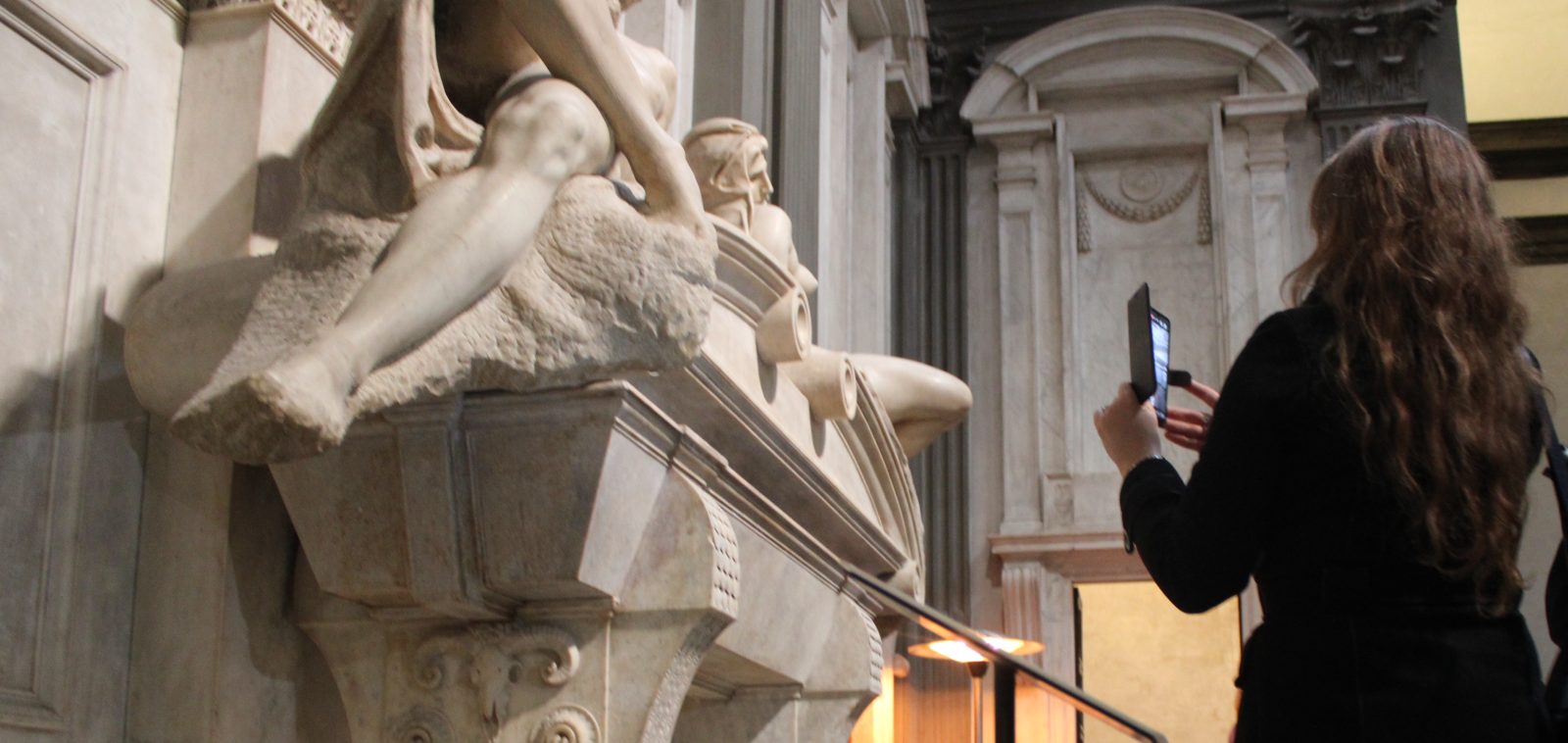
Galleria dell’Accademia di Firenze: aggiunge alle collezioni il Crocifisso Corsi
Questa mattina è stata presentata la nuova opera acquistata dalla Galleria dell’Accademia di Firenze durante l’ultima Biennale Internazionale dell’Antiquariato BIAF, che ha avuto luogo a Palazzo Corsini nel 2022.
Si tratta di un crocifisso dipinto risalente al primo quarto del secolo XIV, noto come Crocifisso Corsi, che i visitatori potranno da domani in poi ammirare all’interno del percorso espositivo delle sale al piano terra, accanto alle opere pittoriche dei massimi artisti fiorentini attivi tra Duecento e Trecento.

Il Crocifisso Corsi è un dipinto a tempera su tavola arrivato alla Galleria dell’Accademia in un buono stato di conservazione nonostante sia mancante di alcune parti come per esempio i terminali laterali e il braccio superiore con la relativa cimasa, dove si probabilmente era dipinto Pellicano mistico mentre nutriva i piccoli col suo sangue, palese allegoria di Cristo morto per la redenzione dell’umanità.
Il terminale sinistro, con l’effigie della Vergine dolente, è stato identificato, negli anni ’80, da Milan Boskovits in una raccolta privata: anche se in cattive condizioni, questo elemento ha consentito una parziale ricostruzione dell’opera.
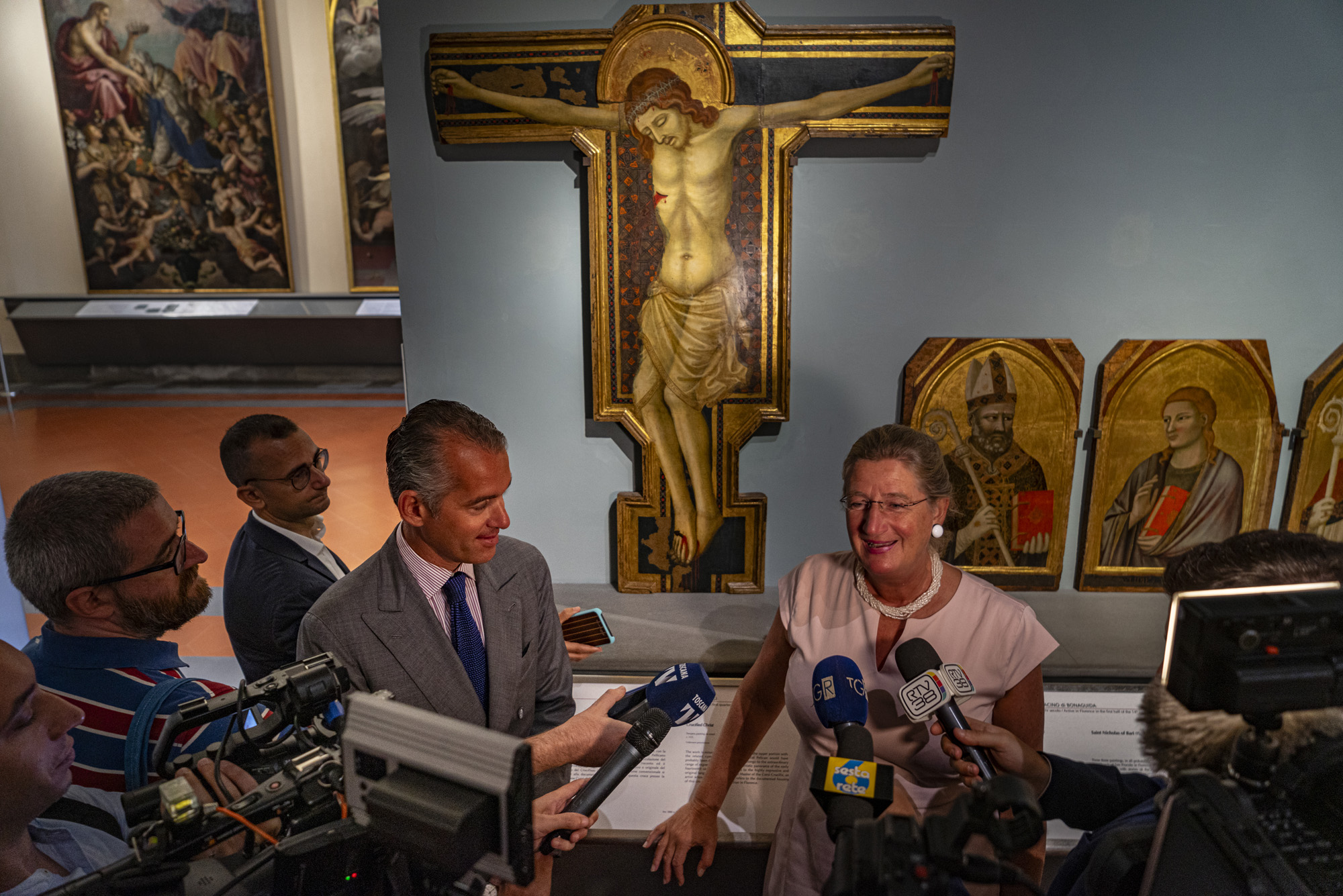
L’attribuzione al Maestro del Crocifisso Corsi è stata fatta da Richard Offner, nel 1931, che lo definì come «un pittore dal talento drammatico». Corsi si formò a stretto contatto con il Maestro della Santa Cecilia e il Crocifisso in questione proveniva dalla ricca raccolta che l’ingegnere Arnaldo Corsi lasciò al Comune di Firenze nel 1938.
Dal 1952 è presente sul mercato antiquario e da allora passò nelle mani di diverse proprietà e fu annesso a varie collezioni private tra Firenze, Milano e Venezia, prima di arrivare oggi nella collocazione alla Galleria dell’Accademia di Firenze mediante l’antiquario Fabrizio Moretti.
Grazie a questa attribuzione, venne identificata come dello stesso autore, un’altra croce dipinta, conservata sempre alla Galleria dell’Accademia di Firenze, molto affine a questa sotto tanti punti. Un’opera di dimensioni più grandi fino al 1782 nella Chiesa di San Pier Scheraggio a Firenze.
Questa seconda opera era collocata nelle sale al piano terra, dedicate al Duecento e al Trecento, pubblicata nei cataloghi scientifici delle raccolte del museo. Nel 2019 fu trasferita nelle Gallerie degli Uffizi, per una rimozione dal percorso decisa dall’allora direttore.

La Galleria dell’Accademia ha sottoposto il dipinto a un intervento di anossia, operazione necessaria per tutelare ed evitare attacchi di tarli.
La buona condizione degli strati pittorici ha permesso di documentare i peculiari dettagli tecnici, come la rara qualità del cinabro velato a lacca rossa in rilievo, le raffinate bordure del perizoma in oro, il decoro del tabellone in lamina d’argento.
La pittura è stesa a velature su un disegno ombreggiato e la tempera all’uovo è talmente sottile e delicata da far emergere lungo il corpo di Cristo le lamine argentee sottostanti.
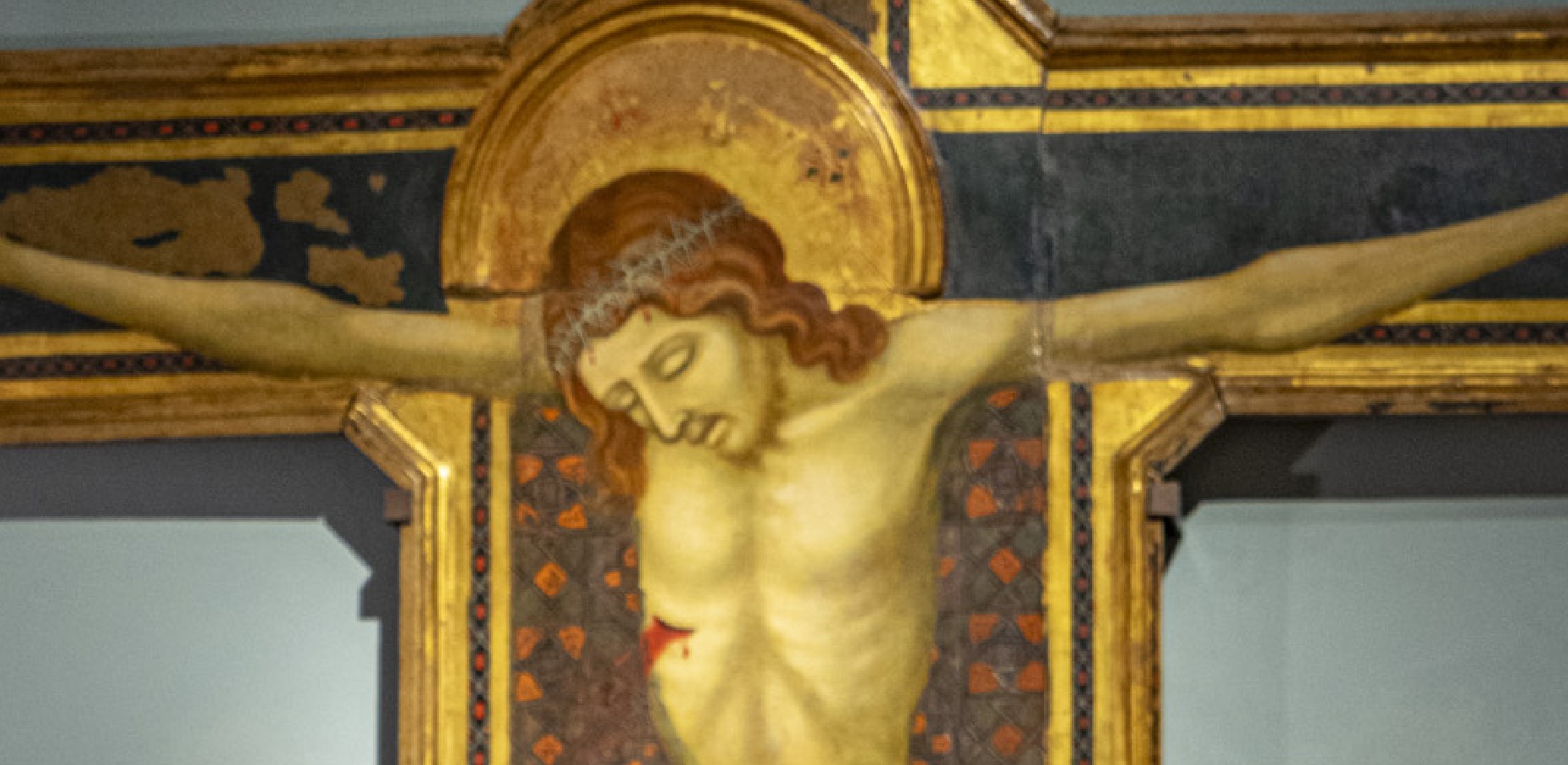
Il tabellone è decorato con un motivo con elementi ad intreccio, piuttosto diffuso in ambito fiorentino nel primo Trecento, che appare di ispirazione giottesca.
Il Crocifisso Corsi costituisce un documento ulteriore della straordinaria articolazione e vitalità creativa del panorama fiorentino degli inizi del Trecento.
Per i l momento il vostro Michelangelo Buonarroti vi saluta dandovi appuntamento ai prossimi post e sui socia.
Accademia Gallery of Florence: adds the Corsi Crucifix to the collections
This morning the new work purchased by the Galleria dell’Accademia of Florence during the last BIAF International Antiques Biennial, which took place at Palazzo Corsini in 2022, was presented.
It is a painted crucifix dating back to the first quarter of the 14th century, known as the Corsi Crucifix, which from tomorrow onwards visitors will be able to admire within the exhibition itinerary of the rooms on the ground floor, alongside the pictorial works of the greatest Florentine artists active between thirteenth and fourteenth centuries.
The Corsi Crucifix is a tempera painting on wood that arrived at the Accademia Gallery in a good state of conservation despite the fact that some parts are missing, such as the side terminals and the upper arm with the relative cymatium, where the Mystic Pelican was probably painted while he fed the little ones with his blood, a clear allegory of Christ who died for the redemption of humanity.
The left terminal, with the effigy of the Sorrowful Virgin, was identified in the 1980s by Milan Boskovits in a private collection: even if in poor condition, this element has allowed a partial reconstruction of the work.
The attribution to the Master of the Corsi Crucifix was made by Richard Offner, in 1931, who defined him as «a painter with dramatic talent». Corsi trained in close contact with the Master of the Santa Cecilia and the Crucifix in question came from the rich collection that the engineer Arnaldo Corsi left to the Municipality of Florence in 1938.
Since 1952 it has been present on the antiques market and since then it passed into the hands of various owners and was annexed to various private collections between Florence, Milan and Venice, before arriving today in the Galleria dell’Accademia in Florence through the antiques dealer Fabrizio Moretti.
Thanks to this attribution, another painted cross, also kept in the Galleria dell’Accademia in Florence, was identified as being by the same author, very similar to this one in many respects. A larger work until 1782 in the Church of San Pier Scheraggio in Florence.
This second work was located in the rooms on the ground floor, dedicated to the thirteenth and fourteenth centuries, published in the scientific catalogs of the museum’s collections. In 2019 it was transferred to the Uffizi Galleries, due to a removal from the itinerary decided by the then director.
The Accademia Gallery subjected the painting to an anoxia treatment, a necessary operation to protect and avoid woodworm attacks.
The good condition of the pictorial layers has allowed us to document the peculiar technical details, such as the rare quality of the veiled red lacquer cinnabar in relief, the refined borders of the gold loincloth, the decoration of the silver foil board.
The painting is spread in glazes over a shaded drawing and the egg tempera is so thin and delicate that it makes the underlying silver sheets emerge along the body of Christ.
The board is decorated with a motif with intertwined elements, quite widespread in the Florentine context in the early fourteenth century, which appears to be inspired by Giotto.
The Corsi Crucifix constitutes a further document of the extraordinary articulation and creative vitality of the Florentine panorama of the early fourteenth century.
For the moment, your Michelangelo Buonarroti greets you and will meet you in the next posts and on members.
-
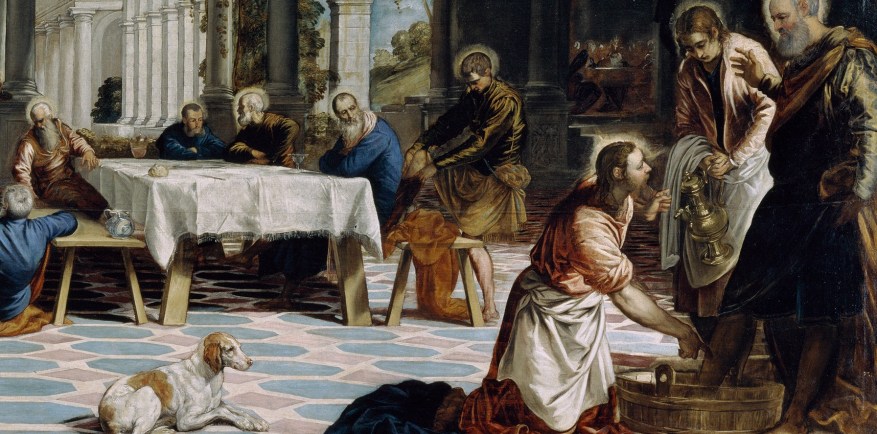
La Lavanda dei Piedi di Tintoretto: Il Capolavoro Veneziano al Prado
🇮🇹Tra i capolavori più affascinanti del Rinascimento veneziano, “La Lavanda dei Piedi” di Jacopo Tintoretto rappresenta un perfetto equilibrio tra spiritualità, innovazione compositiva e straordinaria forza narrativa… 🇬🇧Among the most fascinating masterpieces of the Venetian Renaissance, Jacopo Tintoretto’s “The Washing of the Feet” represents a perfect balance between spirituality, compositional innovation, and extraordinary narrative force…
-
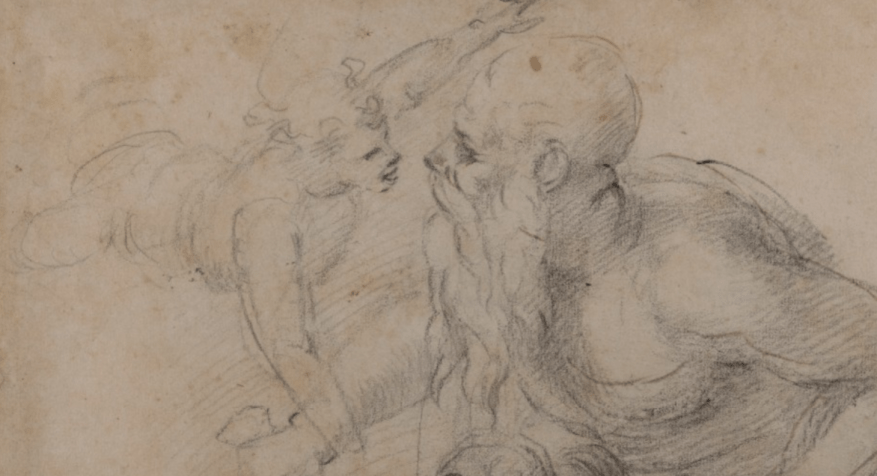
Il Sacrificio di Isacco e quel momento tra la vita e la morte
🇮🇹Oggi voglio raccontarvi alcuni dettagli sul mio disegno del Sacrificio di Isacco, conservato oggi a Casa Buonarroti. Su quel foglio volli tracciare il momento preciso in cui la paura fa spazio al miracolo… 🇬🇧Today I want to tell you some details about my drawing of the Sacrifice of Isaac, now preserved at Casa Buonarroti. On…
-
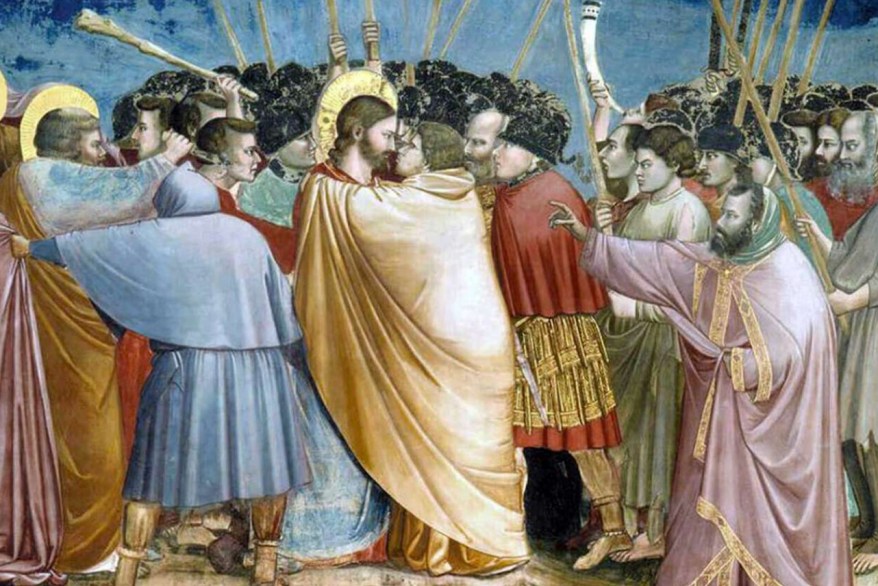
Mercoledì Santo: il giorno del tradimento di Giuda affrescato da Giotto
🇮🇹Il Mercoledì Santo è il giorno del silenzio, della riflessione e del tradimento. È il momento in cui Giuda sceglie di vendere Gesù per trenta denari, segnando uno dei passaggi più dolorosi della Settimana Santa…. 🇬🇧Holy Wednesday is a day of silence, reflection, and betrayal. ✝It is the moment when Judas chooses to sell Jesus…
Condividi:


Questo sono io





sostienici

Sostienici – Support Us
Se questo blog ti piace e ti appassiona, puoi aiutarci a farlo crescere sempre più sostenendoci in modo concreto condividendo i post, seguendo le pagine social e con un contributo che ci aiuta ad andare avanti con il nostro lavoro di divulgazione. . ENGLISH: If you like and are passionate about this blog, you can help us make it grow more and more by supporting us in a concrete way by sharing posts, following social pages and with a contribution that helps us to move forward with our dissemination work.
€10,00


