
Pigmalione e Galatea di Jean-Léon Gérôme: quando l’arte prende vita
Nel 1890 Jean-Léon Gérôme, uno dei massimi esponenti della pittura accademica francese, volle mettersi alla prova affrontando artisticamente uno dei miti più affascinanti della tradizione classica: quello di Pigmalione e Galatea.
Il risultato fu un dipinto intenso e teatrale ma al contempo emozionante, oggi appartenente alle prestigiose collezioni del Metropolitan Museum of Art di New York. L’opera racconta visivamente il momento esatto in cui l’arte supera i propri confini e diventa vita.
Pigmalione e Galatea offre allo spettatore lo spunto per una riflessione profonda sul ruolo dell’artista, sul desiderio creativo e sul potere illusionistico della pittura.

Il mito di Ovidio e il sogno dell’artista
Il soggetto deriva dalle Metamorfosi di Ovidio, dove Pigmalione, scultore cipriota, crea una scultura femminile così perfetta da innamorarsene. Disgustato dalle donne reali, Pigmalione riversa tutto il suo ideale di bellezza in una figura di marmo, pregando poi Afrodite affinché le dia vita. La dea ascolta la sua supplica e trasforma la statua in una donna viva: Galatea.
Gérôme sceglie di rappresentare l’istante più carico di tensione emotiva dell’intera storia, quello del primo bacio. Non il prima, dominato dalla solitudine dell’artista, né il dopo, segnato dalla felicità, ma l’attimo sospeso della metamorfosi.
La scena: un bacio tra marmo e carne
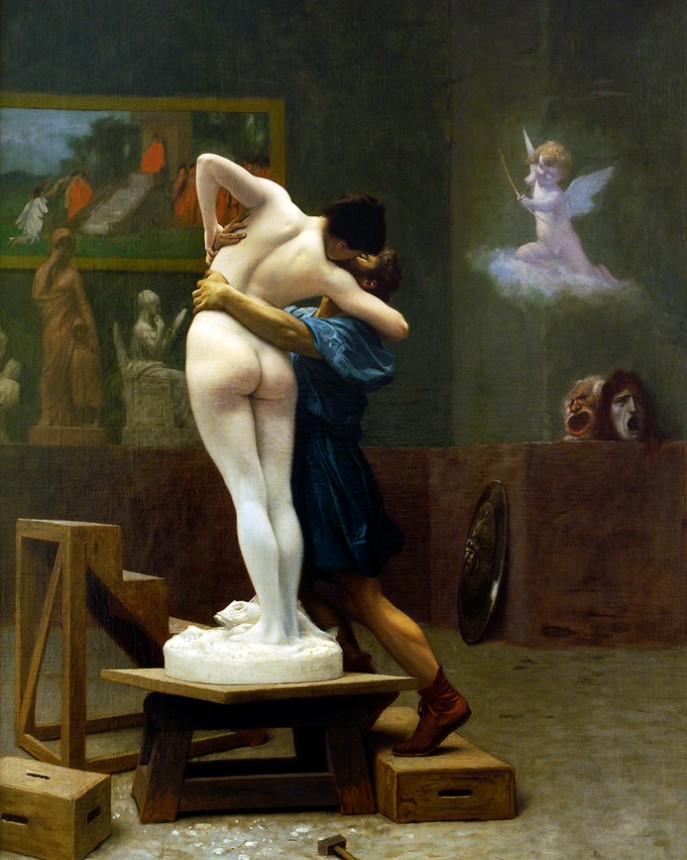
La scena si svolge dentro lo uno studio d’artista che richiama idealmente l’antichità classica. Pigmalione, avvolto in una tunica azzurra, sale su un piccolo piedistallo per raggiungere il volto della statua e baciarla. Galatea è ancora parzialmente marmorea: i piedi e parte del corpo sembrano appartenere alla scultura, mentre il busto e il volto rivelano già il calore della carne viva.
Questo passaggio graduale dalla pietra alla pelle è uno degli elementi più affascinanti del dipinto. Gérôme utilizza una pittura levigata, quasi smaltata, per rendere impercettibile il confine tra materia inanimata e corpo vivente. La luce accarezza Galatea e la fa emergere dallo sfondo, mentre Pigmalione appare colto in un gesto quasi disperato, come se temesse che il miracolo possa svanire da un momento all’altro.
Lo studio come spazio simbolico
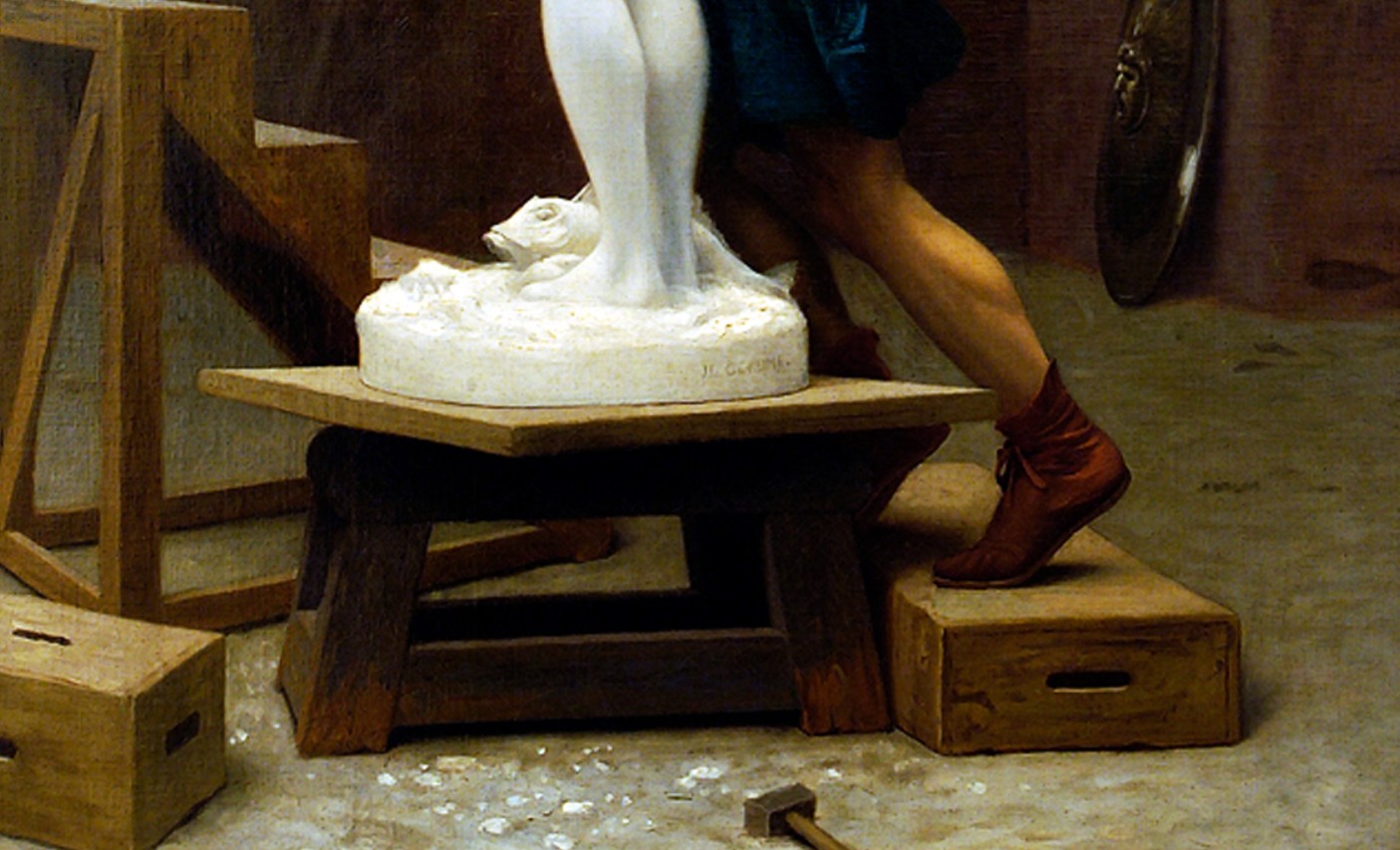
Intorno ai protagonisti si intravedono strumenti da scultore, piccole statue, bassorilievi e riferimenti all’arte antica. Lo studio diventa così il luogo della creazione per eccellenza, uno spazio in cui il tempo sembra sospeso e dove l’artista dialoga con le proprie opere come fossero esseri viventi.
In questo contesto, Pigmalione diviene così l’alter ego dello stesso Gérôme. Il pittore sembra interrogarsi sul proprio ruolo e sui limiti dell’arte: fino a che punto l’artista può spingersi nel tentativo di imitare la vita? E cosa accade quando l’illusione diventa così perfetta da sembrare reale?
Tecnica e stile: la perfezione accademica
Dal punto di vista tecnico, Pigmalione e Galatea rappresenta uno dei vertici della pittura accademica di fine Ottocento. Gérôme è celebre per la sua precisione quasi archeologica e per la cura maniacale del dettaglio, qualità che emergono con forza in quest’opera. Ogni superficie è trattata in modo diverso: la freddezza del marmo, la morbidezza della pelle, la fluidità dei tessuti sono resi con una maestria che sfiora l’iperrealismo.
La fortuna dell’opera
Il dipinto fu realizzato nel 1890, in un momento di grande successo per Gérôme, ormai artista affermato e collezionato a livello internazionale. Il dipinto era destinato al mercato collezionistico, come molte delle tele mitologiche dell’artista in questi anni. Dopo la sua realizzazione, Pigmalione e Galatea passò attraverso importanti collezioni private prima di essere donato nel 1927 al Metropolitan Museum of Art, dove ancora oggi è esposto.
È interessante notare che Gérôme realizzò più versioni dello stesso soggetto, cambiando l’angolazione della scena. In alcune, lo spettatore osserva il miracolo frontalmente; in altre, come se fosse alle spalle della statua. Questa moltiplicazione dei punti di vista suggerisce un’ossessione per il tema e una riflessione quasi cinematografica sull’atto creativo.
Un’opera sul potere dell’arte
Pigmalione e Galatea è una dichiarazione poetica sul potere dell’arte e sul desiderio umano di superare i limiti della realtà. Gérôme mette in scena il sogno eterno di ogni artista: creare qualcosa di così perfetto da sembrare vivo, da rispondere allo sguardo e all’amore di chi l’ha generato.
In un’epoca in cui l’arte stava iniziando a confrontarsi con la modernità e con le prime avanguardie, Gérôme risponde riaffermando la forza della tradizione e della tecnica. E lo fa scegliendo un mito che, ancora oggi, continua a parlare al presente, ricordandoci che l’arte nasce sempre da un desiderio profondo: quello di dare forma all’invisibile e di trasformare la materia in emozione.
Per il momento il sempre vostro Michelangelo Buonarroti vi saluta dandovi appuntamento ai prossimi post e sui social.
Pygmalion and Galatea by Jean-Léon Gérôme: When Art Comes to Life
In 1890, Jean-Léon Gérôme, one of the greatest exponents of French academic painting, wanted to challenge himself by artistically addressing one of the most fascinating myths of classical tradition: that of Pygmalion and Galatea.
The result was an intense and theatrical yet moving painting, now part of the prestigious collections of the Metropolitan Museum of Art in New York. The work visually narrates the exact moment when art transcends its boundaries and becomes life.
Pygmalion and Galatea offers the viewer the opportunity for profound reflection on the role of the artist, creative desire, and the illusionistic power of painting.
The Myth of Ovid and the Artist’s Dream
The subject is drawn from Ovid’s Metamorphoses, in which Pygmalion, a Cypriot sculptor, creates a female sculpture so perfect that he falls in love with it. Disgusted by real women, Pygmalion pours his entire ideal of beauty into a marble figure, then prays to Aphrodite to bring it to life. The goddess hears his plea and transforms the statue into a living woman: Galatea.
Gérôme chooses to depict the most emotionally charged moment of the entire story: the first kiss. Not the before, dominated by the artist’s solitude, nor the after, marked by happiness, but the suspended moment of metamorphosis.
The scene: a kiss between marble and flesh
The scene takes place in an artist’s studio ideally reminiscent of classical antiquity. Pygmalion, wrapped in a blue tunic, climbs onto a small pedestal to reach the statue’s face and kiss it. Galatea is still partially marble: her feet and part of her body seem to belong to the sculpture, while her torso and face already reveal the warmth of living flesh.
This gradual transition from stone to skin is one of the most fascinating elements of the painting. Gérôme uses a smooth, almost enameled paint to blur the line between inanimate matter and living matter. The light caresses Galatea and makes her emerge from the background, while Pygmalion appears caught in an almost desperate gesture, as if fearing the miracle might vanish at any moment.
The Studio as a Symbolic Space
Around the protagonists, we glimpse sculptor’s tools, small statues, bas-reliefs, and references to ancient art. The studio thus becomes the quintessential place of creation, a space where time seems suspended and where the artist engages with his works as if they were living beings.
In this context, Pygmalion thus becomes Gérôme’s alter ego. The painter seems to question his own role and the limits of art: how far can the artist go in his attempt to imitate life? And what happens when the illusion becomes so perfect that it seems real?
Technique and Style: Academic Perfection
From a technical standpoint, Pygmalion and Galatea represents one of the pinnacles of late-nineteenth-century academic painting. Gérôme is renowned for his almost archaeological precision and obsessive attention to detail, qualities that emerge forcefully in this work. Each surface is treated differently: the coldness of the marble, the softness of the skin, the fluidity of the fabrics are rendered with a mastery bordering on hyperrealism.
The Commission and the Work’s Success
The painting was created in 1890, at a time of great success for Gérôme, by then an established and internationally collected artist. The painting was intended for the collector’s market, like many of the artist’s mythological paintings of this period. After its completion, Pygmalion and Galatea passed through important private collections before being donated in 1927 to the Metropolitan Museum of Art, where it remains on display today.
Interestingly, Gérôme painted multiple versions of the same subject, varying the angles of the scene. In some, the viewer observes the miracle from the front; in others, as if from behind the statue. This multiplication of viewpoints suggests an obsession with the theme and an almost cinematic reflection on the creative act.
A work on the power of art
Pygmalion and Galatea is a poetic statement on the power of art and the human desire to transcend the limits of reality. Gérôme stages the eternal dream of every artist: to create something so perfect that it seems alive, responding to the gaze and love of its creator.
At a time when art was beginning to confront modernity and the first avant-garde movements, Gérôme responded by reaffirming the strength of tradition and technique. And he does so by choosing a myth that, even today, continues to speak to the present, reminding us that art always arises from a profound desire: to give form to the invisible and to transform matter into emotion.
For now, yours truly, Michelangelo Buonarroti.

Sostienici – Support Us
Se questo blog ti piace e ti appassiona, puoi aiutarci a farlo crescere sempre più sostenendoci in modo concreto condividendo i post, seguendo le pagine social e con un contributo che ci aiuta ad andare avanti con il nostro lavoro di divulgazione. . ENGLISH: If you like and are passionate about this blog, you can help us make it grow more and more by supporting us in a concrete way by sharing posts, following social pages and with a contribution that helps us to move forward with our dissemination work.
10,00 €
Condividi:


Questo sono io





sostienici

Sostienici – Support Us
Se questo blog ti piace e ti appassiona, puoi aiutarci a farlo crescere sempre più sostenendoci in modo concreto condividendo i post, seguendo le pagine social e con un contributo che ci aiuta ad andare avanti con il nostro lavoro di divulgazione. . ENGLISH: If you like and are passionate about this blog, you can help us make it grow more and more by supporting us in a concrete way by sharing posts, following social pages and with a contribution that helps us to move forward with our dissemination work.
€10,00


