
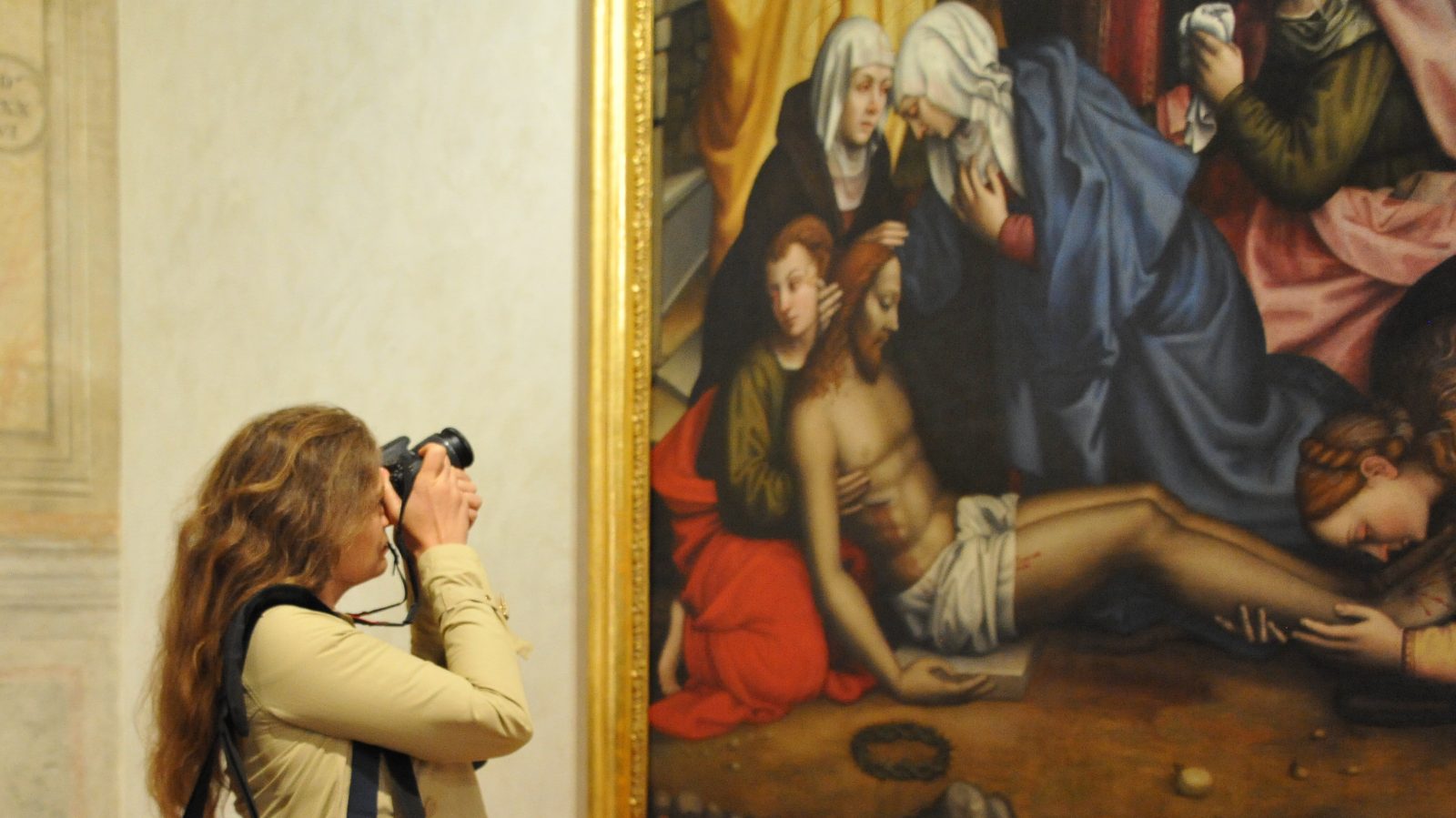
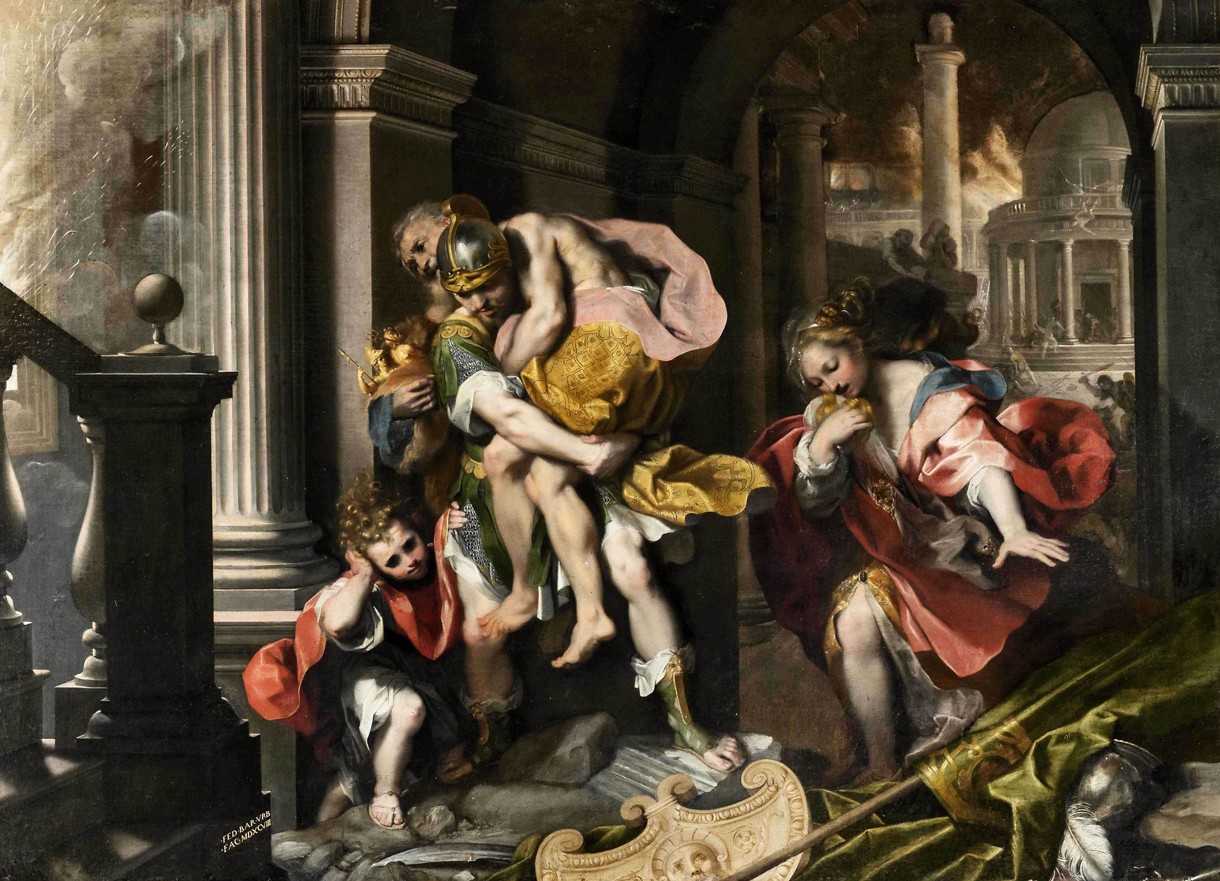
La Fuga di Enea da Troia del Barocci
L’opera di cui voglio parlarvi oggi è uno dei massimi capolavori di Federico Barocci che si trova a Galleria Borghese: la Fuga di Enea da Troia, realizzata nel 1598.
Dovete sapere che si tratta di una seconda versione del dipinto dell’unico soggetto profano che il Barocci dipinse in tutta la sua vita, se si escludono i ritratti.
La prima versione della Fuga di Enea da Troia è andata perduta. Era stata commissionata dall’imperatore Rodolfo II d’Asburgo e venne realizzata dall’artista tra il 1586 e il 1589.
L’opera di cui oggi s’è perduta ogni traccia, fu esposta a Praga fino al 1648 quando entrò a far parte dei possedimenti di Cristina di Svezia.

A seguire tornò in Italia tra le pertinenze degli Odescalchi a Bracciano poi varcò i confini alla volta della Francia e infine raggiunse l’Inghilterra dove scomparì nel nulla.
A circa dieci anni dalla prima commissione dell’opera, il Barocci volle realizzare la seconda versione commissionata da Giuliano della Rovere, firmandola e datandola in basso a sinistra con la dicitura “FED.BAR.URB. / FAC. MDXCVIII”.

Probabilmente il dipinto confluì nelle collezioni del cardinale Scipione Borghese nel 1613, regalata dallo stesso committente Giuliano Della Rovere.
A distanza di così tanti anni, non è dato sapere quanto differisca la seconda versione dell’opera dalla prima ma, mediante lo studio di un cartone preparatorio custodito al Louvre riferito alla prima stesura dell’opera, si nota un’architettura più indefinita.

Sullo sfondo di questo capolavoro del Barocci si nota un tempietto che il pittore realizzò ispirandosi a quello di San Pietro in Montorio sebbene lo rielaborò in chiave più antica.
Per il momento il sempre vostro Michelangelo Buonarroti vi saluta dandovi appuntamento ai prossimi post e sui social.

Barocci’s Flight of Aeneas from Troy
The work I want to discuss today is one of Federico Barocci’s greatest masterpieces, located in the Galleria Borghese: the Flight of Aeneas from Troy, painted in 1598.
You should know that this is a second version of the only secular subject Barocci painted in his entire life, excluding portraits.
The first version of the Flight of Aeneas from Troy has been lost. It was commissioned by Emperor Rudolf II of Habsburg and was painted by the artist between 1586 and 1589. The work, of which all trace is now lost, was exhibited in Prague until 1648, when it became part of the possessions of Christina of Sweden.
It subsequently returned to Italy, to the possessions of the Odescalchi family in Bracciano, then crossed the border into France and finally reached England, where it disappeared into thin air.
About ten years after the work’s initial commission, Barocci commissioned the second version, signed and dated at the bottom left with the inscription “FED.BAR.URB. / FAC. MDXCVIII.”
The painting likely entered the collections of Cardinal Scipione Borghese in 1613, a gift from the patron, Giuliano Della Rovere himself.
After so many years, it is unknown how much the second version of the work differs from the first, but a study of a preparatory cartoon from the first draft held at the Louvre reveals a more undefined architecture.
In the background of this masterpiece by Barocci, you can see a small temple that the painter created, inspired by the one in San Pietro in Montorio, although he reworked it in a more ancient style.
For now, yours truly, Michelangelo Buonarroti bids you farewell and invites you to join him in future posts and on social media.

Sostienici – Support Us
Se questo blog ti piace e ti appassiona, puoi aiutarci a farlo crescere sempre più sostenendoci in modo concreto condividendo i post, seguendo le pagine social e con un contributo che ci aiuta ad andare avanti con il nostro lavoro di divulgazione. . ENGLISH: If you like and are passionate about this blog, you can help us make it grow more and more by supporting us in a concrete way by sharing posts, following social pages and with a contribution that helps us to move forward with our dissemination work.
10,00 €
Condividi:


Questo sono io





sostienici

Sostienici – Support Us
Se questo blog ti piace e ti appassiona, puoi aiutarci a farlo crescere sempre più sostenendoci in modo concreto condividendo i post, seguendo le pagine social e con un contributo che ci aiuta ad andare avanti con il nostro lavoro di divulgazione. . ENGLISH: If you like and are passionate about this blog, you can help us make it grow more and more by supporting us in a concrete way by sharing posts, following social pages and with a contribution that helps us to move forward with our dissemination work.
€10,00


Dettagli ed espressioni davvero meravigliose in quest’opera d’arte..👏👏👏👏👏👏
"Mi piace"Piace a 3 people