
La Scultura del giorno: il Cenotafio degli Stuart di Canova e la censura bigotta
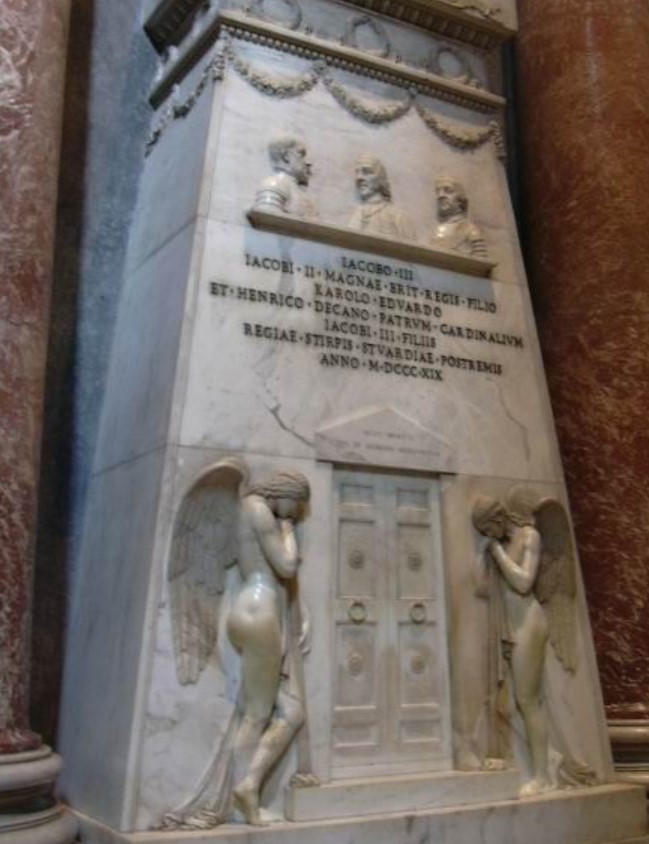
La Scultura del giorno che vi propongo oggi è il Cenotafio degli Stuart realizzato da Antonio Canova, ubicato all’interno della Basilica di San Pietro.
L’artista mise mano a quest’opera durante la fase matura della sua vita, fra il 1817 e il 1819. Gli fu commissionata dal governo Britannico per Giacomo Stuart III e i suoi figli Enrico e Carlo Edoardo che morirono in Italia.
Giacomo III Stuart era il figlio del re d’Inghilterra, esiliato durante la Glorious Revolution del 1688. Essendo cattolico, fu escluso dalla successione al trono ma venne accolto calorosamente da papa Clemente XI. Si stabilì a Roma presso il palazzo Muti-Papazzurri e lì nacquero i suoi figli.
Canova dovrà comprare autonomamente i materiali, anticipare le spese per i muratori e fare un modello in scala; il compenso finale comprensivo di tutto sarà di 9mila scudi romani, con eventuali esborsi a carico dell’artista; la commessa dovrà essere compiuta entro nove anni dalla firma contrattuale, con versamento rateale del compenso di mille scudi all’anno…”
Questo contratto relativo al cenotafio Stuart fu stipulato nel 1810 ma poi non venne più citato né tenuto in considerazione per diversi anni. Il perché non è noto ma Canova entro nove anni ultimò il suo capolavoro.
Per qualche ragione il progetto si arrestò quasi subito per poi essere ripreso nel 1817, dopo il viaggio di Canova in Inghilterra.
L’opera
Il monumento funebre ha una struttura a piramide tronca. Nella parte più alta si vedono tre ghirlande e al di sotto dei festoni decorativi Canova scolpì i busti di profilo degli Stuart con l’epigrafe concordata dall’artista assieme agli eredi della casata inglese.
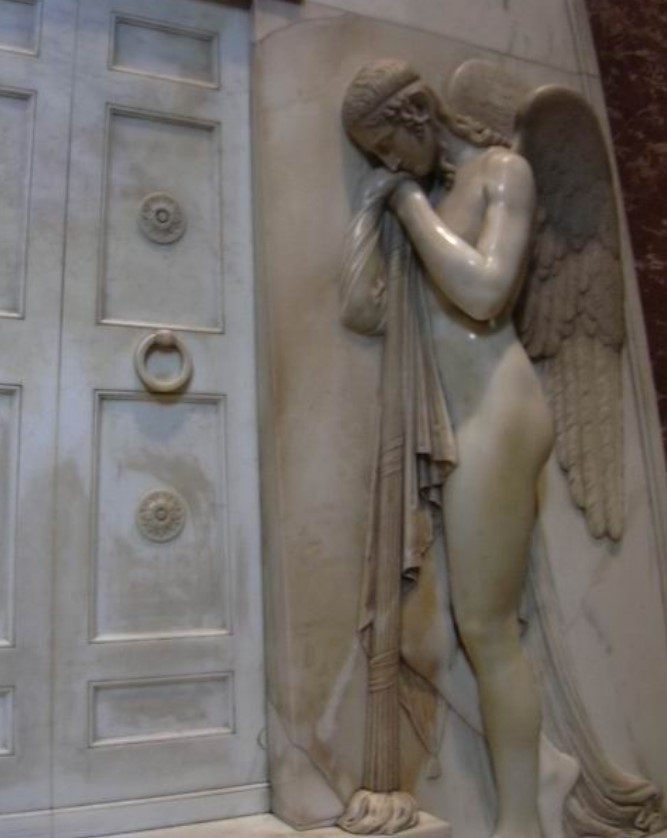
Il grande portone in marmo a due battenti simboleggia l’entrata al mondo ultraterreno, sorvegliato da due angeli alati con un corpo da adolescenti, privi di vesti. Il motivo fu tratto dall’artista, sebbene rielaborandolo in chiave più cristiana, dalle urne cinerarie etrusche.

Il Cenotafio Stuart si trova nella navata destra della Basilica di San Pietro in uno spazio abbastanza sacrificato fra due colonne che però Canova seppe sfruttare a suo vantaggio.
A proposito, come vi ho detto, quest’opera è un cenotafio, ovvero un sepolcro commemorativo che non contiene i resti delle persone a cui è dedicato. Giacomo Stuart III e i suoi figli Enrico e Carlo Edoardo furono sepolti nelle Grotte Vaticane.
La censura del Cenotafio Stuart
Il cenotafio Stuart fu inaugurato la terza settimana di maggio del 1819 e venne particolarmente apprezzato per la purezza delle forme, soprattutto dagli inglesi che avevano l’occasione di vederlo con i propri occhi.
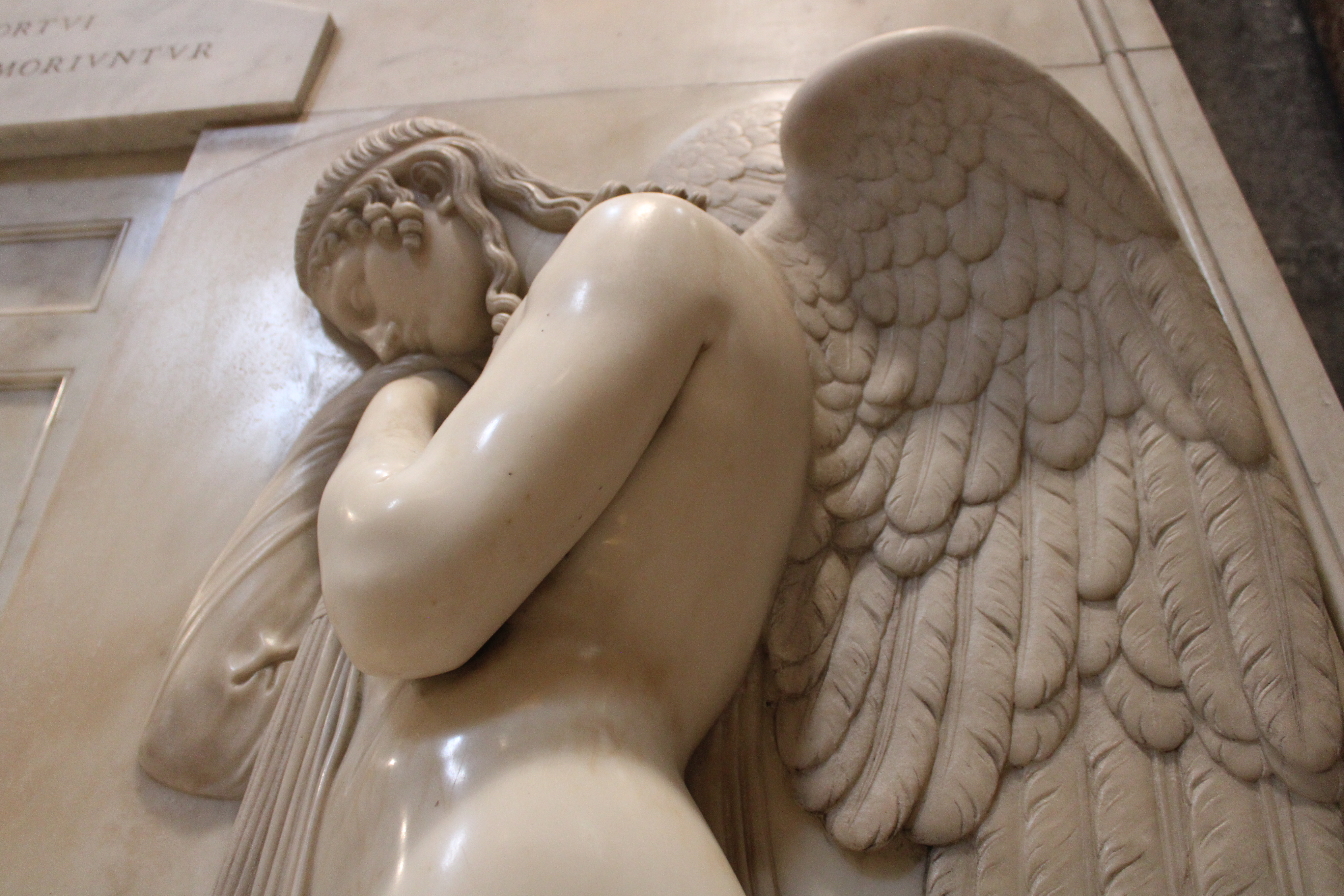
Tuttavia non mancarono le critiche mosse dalle alte sfere vaticane che si lamentavano della nudità dei due angeli.
Il 30 novembre del 1819, il maggiordomo privato di papa Pio VII, scrisse un’esortazione privata a Canova affinché ponesse rimedio a quelle nudità che turbavano lui, il pontefice e altri alti prelati.
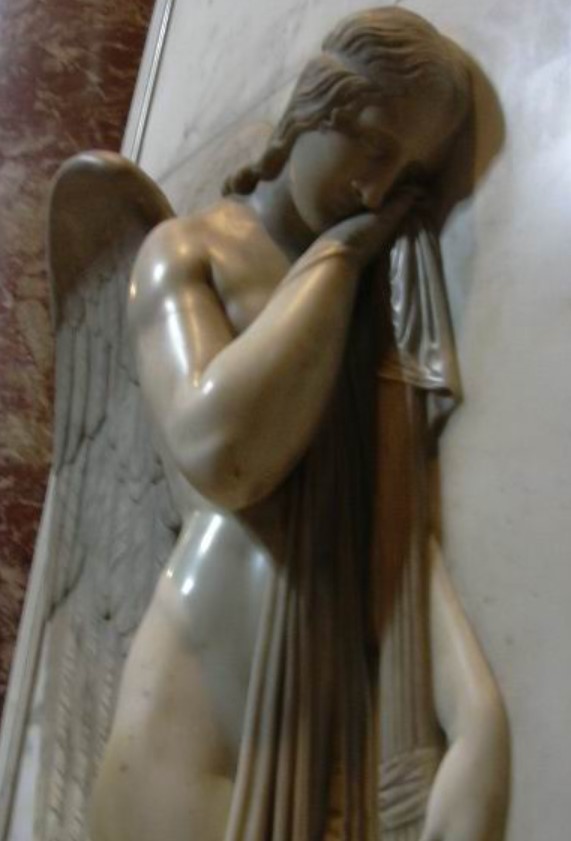
Canova non diede seguito a quella lettera senza cedere alle pressioni, a ragione ritenute sciocche e del tutto infondate.
Dopo la morte dell’artista, Leone XII impose la censura sulle due figure, facendo ricoprire i loro fianchi con dei panneggi in gesso.
Quegli osceni panneggi rimasero fino al pontificato di Leone XIII, iniziato il 20 febbraio 1878.
Il bozzetto della Gypsoteca Canova
Della fase progettuale del cenotafio Stuart rimane il bozzetto conservato presso il Museo Gypsoteca Canova di Possagno nel quale si vedono i due angeli a rilievo e non a tutto tondo e la collocazione fra le due colonne di San Pietro.

Per il momento il vostro Michelangelo Buonarroti vi saluta dandovi appuntamento ai prossimi post e sui social.
Sculpture of the day: Canova’s Stuart Cenotaph and bigoted censorship
The Sculpture of the day that I propose to you today is the Cenotaph of the Stuarts created by Antonio Canova, located inside the Basilica of San Pietro.
The artist set his hand to this work during the mature phase of his life, between 1817 and 1819. It was commissioned by the British government for James Stuart III and his sons Henry and Charles Edward who died in Italy.
James III Stuart was the son of the King of England, exiled during the Glorious Revolution of 1688. Being a Catholic, he was excluded from succession to the throne but was warmly welcomed by Pope Clement XI. He settled in Rome at the Muti-Papazzurri palace and his children were born there.
Canova will have to independently buy the materials, anticipate the costs for the masons and make a scale model; the final fee including everything will be 9,000 Roman scudi, with any disbursements to be paid by the artist; the order must be completed within nine years from the signing of the contract, with payment by installments of the fee of one thousand scudi per year…”
This contract relating to the Stuart cenotaph was made in 1810 but then was not mentioned or considered again for several years. The reason is not known but Canova completed his masterpiece within nine years.
For some reason the project stopped almost immediately only to be resumed in 1817, after Canova’s trip to England.
The work
The funeral monument has a truncated pyramid structure. In the highest part you can see three garlands and below the decorative festoons Canova sculpted the profile busts of the Stuarts with the epigraph agreed by the artist together with the heirs of the English house.
The large double-leaf marble door symbolizes the entrance to the otherworldly world, guarded by two winged angels with the bodies of teenagers, without clothes. The motif was taken by the artist, albeit reworking it in a more Christian key, from Etruscan cinerary urns.
The Stuart Cenotaph is located in the right aisle of St. Peter’s Basilica in a rather sacrificed space between two columns which Canova however knew how to exploit to his advantage.
By the way, as I told you, this work is a cenotaph, or rather a commemorative sepulcher which does not contain the remains of the people to whom it is dedicated. James Stuart III and his sons Henry and Charles Edward were buried in the Vatican Grottoes.
The censorship of the Stuart Cenotaph
The Stuart cenotaph was inaugurated on the third week of May 1819 and was particularly appreciated for its purity of form, especially by the British who had the opportunity to see it with their own eyes.
However, there was no shortage of criticism from the Vatican’s upper echelons who complained of the nudity of the two angels.
On November 30, 1819, the private butler of Pope Pius VII wrote a private exhortation to Canova asking him to remedy the nudity that disturbed him, the pontiff and other high prelates.
Canova did not follow up on that letter without giving in to pressure, rightly considered silly and completely unfounded.
After the artist’s death, Leo XII imposed censorship on the two figures, having their sides covered with plaster drapery.
Those obscene drapery remained until the pontificate of Leo XIII, which began on February 20, 1878.
The sketch of the Canova Gypsoteca
Of the design phase of the Stuart cenotaph remains the sketch preserved in the Canova Gypsoteca Museum in Possagno in which the two angels are seen in relief and not in the round and the location between the two columns of St. Peter’s.
For the moment, your Michelangelo Buonarroti greets you by making an appointment for the next posts and on social media.

Sostienici – Support Us
Se questo blog ti piace e ti appassiona, puoi aiutarci a farlo crescere sempre più sostenendoci in modo concreto condividendo i post, seguendo le pagine social e con un contributo che ci aiuta ad andare avanti con il nostro lavoro di divulgazione. . ENGLISH: If you like and are passionate about this blog, you can help us make it grow more and more by supporting us in a concrete way by sharing posts, following social pages and with a contribution that helps us to move forward with our dissemination work.
8,00 €
-
Chi è davvero Banksy? Reuters svela l’identità segreta del re della street art
🇮🇹Reuters svela l’identità di Banksy: secondo l’inchiesta, il celebre artista di graffiti sarebbe Robin Gunningham, il volto nascosto dietro il mito della street art.. 🇬🇧Reuters reveals Banksy’s identity: according to the investigation, the famous graffiti artist is Robin Gunningham, the hidden face behind the myth of street art..
-
14 marzo 1665: nasce Giuseppe Maria Crespi, lo Spagnoletto che rese moderna la pittura del quotidiano
🇮🇹Il 14 marzo 1665 nasce a Bologna Giuseppe Maria Crespi, detto lo Spagnoletto: il pittore che portò nella pittura barocca scene di vita quotidiana e una sorprendente modernità… 🇬🇧Giuseppe Maria Crespi, known as lo Spagnoletto, was born in Bologna on March 14, 1665: the painter who brought scenes of everyday life and a surprising modernity…
-
Egon Schiele, genio e scandalo: al cinema il docufilm evento sulla Vienna ribelle del Novecento
TABÙ. Egon Schiele arriva al cinema il 20, 21 e 22 aprile con La Grande Arte al Cinema: un docufilm evento sulla vita e l’arte del genio ribelle della Vienna del Novecento…
Condividi:


Questo sono io





sostienici

Sostienici – Support Us
Se questo blog ti piace e ti appassiona, puoi aiutarci a farlo crescere sempre più sostenendoci in modo concreto condividendo i post, seguendo le pagine social e con un contributo che ci aiuta ad andare avanti con il nostro lavoro di divulgazione. . ENGLISH: If you like and are passionate about this blog, you can help us make it grow more and more by supporting us in a concrete way by sharing posts, following social pages and with a contribution that helps us to move forward with our dissemination work.
€10,00


1 commento »