
Le zucche nell’arte: i dipinti più belli in cui diventano protagoniste, aspettando Halloween
Il 31 ottobre è il giorno in cui le zucche diventano le regine indiscusse di Halloween. Le troviamo illuminate dall’interno, intagliate con facce mostruose, sistemate davanti alle porte e utilizzate per decorare case e giardini. Ma vi siete mai chiesti quante volte questo ortaggio, con la sua forma particolare e il suo colore inconfondibile, sia entrato anche nella storia dell’arte?
Le zucche nei dipinti hanno una storia molto più lunga di quella legata alla festa di Halloween. Da secoli compaiono nelle nature morte, nelle scene di mercato e nelle rappresentazioni della vita quotidiana. A volte sono semplici elementi di una composizione, altre diventano le vere protagoniste della tela, grazie alle loro forme generose, alle sfumature arancioni e verdi e alla consistenza della buccia.
Pittori italiani e stranieri le hanno osservate e rappresentate con grande attenzione, trasformando un prodotto della terra in un soggetto pittorico capace di raccontare stagioni, abbondanza, alimentazione e tradizioni.
In occasione di Halloween, facciamo un viaggio nella storia dell’arte alla scoperta di alcune opere nelle quali la zucca conquista il centro della scena, dimostrando che anche un ortaggio apparentemente comune può diventare protagonista di un grande dipinto.
Bartolomeo Bimbi, la zucca gigante del giardino granducale (1711)
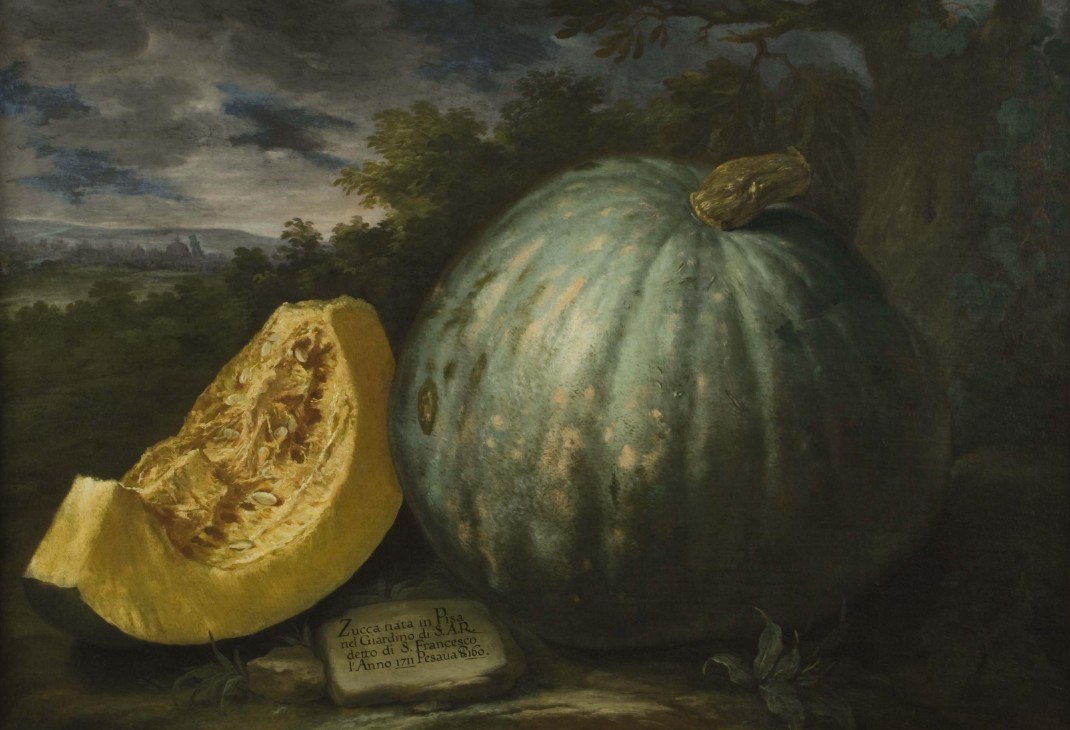
Cominciamo da un dipinto toscano davvero curioso, nel quale la zucca è la protagonista assoluta.
Bartolomeo Bimbi, pittore nato a Settignano nel 1648 e molto apprezzato alla corte dei Medici, si dedicò alla rappresentazione di frutti, fiori, animali e rarità naturali. Le sue opere avevano anche una funzione documentaria, perché permettevano di conservare la memoria delle produzioni più straordinarie dei giardini granducali.
Nel 1711 dipinse una grande zucca cresciuta nel giardino granducale di San Francesco a Pisa. L’ortaggio viene rappresentato in primo piano, con un paesaggio sullo sfondo, quasi fosse un esemplare eccezionale degno di un ritratto ufficiale.
Un’iscrizione racconta la provenienza della zucca e il suo peso: circa 18 libbre toscane, equivalenti a oltre 6 chilogrammi. Il dipinto è conservato nelle collezioni del Museo di Storia Naturale dell’Università di Firenze.
Jan Anton van der Baren, Natura morta con zucche (1657)
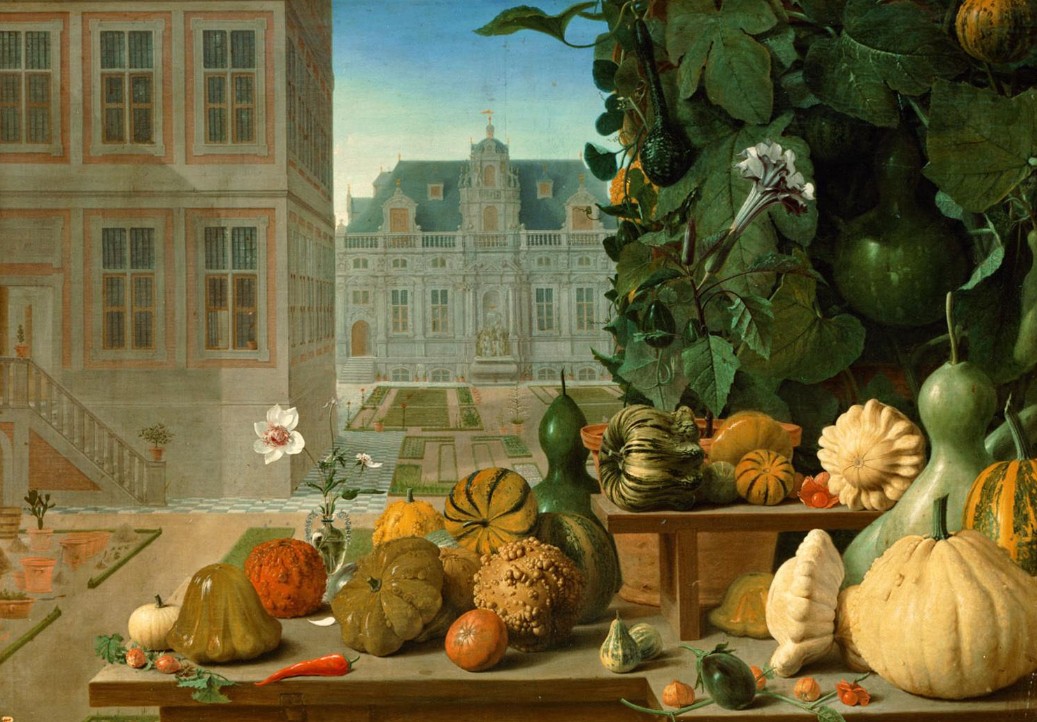
Tra le opere più interessanti dedicate a questo ortaggio troviamo anche la Natura morta con zucche del pittore fiammingo Jan Anton van der Baren, datata 1657.
La tela, conservata al Kunsthistorisches Museum, presenta una composizione nella quale le zucche assumono un ruolo centrale. Le loro forme e dimensioni si contrappongono agli altri elementi della scena, creando un insieme ricco di dettagli.
È un esempio significativo di come la natura morta seicentesca potesse trasformare prodotti della terra in soggetti di grande interesse visivo. La precisione nella rappresentazione degli oggetti e l’attenzione alle loro caratteristiche naturali sono aspetti fondamentali di questa tradizione pittorica.
Marco Antonio Rizzi, Natura morta con zucche
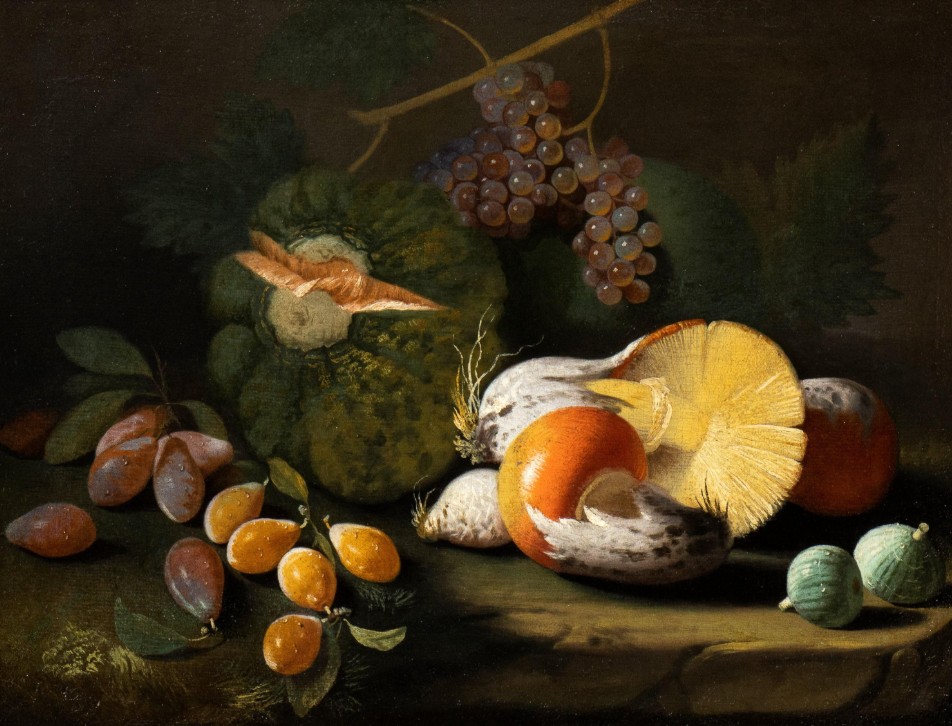
Anche la pittura italiana del Seicento e del tardo Seicento ci ha lasciato interessanti testimonianze della presenza delle zucche nelle composizioni di natura morta.
È il caso di Marco Antonio Rizzi, pittore vissuto tra il 1648 e il 1723, al quale viene attribuita una grande tela intitolata Natura morta con zucche.
L’opera, realizzata a olio su tela, misura 202 × 147 centimetri ed è conservata presso l’Accademia di Belle Arti di Brera a Milano.
La composizione appartiene a quella tradizione pittorica che attribuiva agli elementi naturali un ruolo importante, attraverso la rappresentazione di frutti e ortaggi con attenzione alle loro forme e caratteristiche.
La storia attributiva del dipinto è interessante: in passato era stato accostato ad altri pittori, tra cui Simone del Tintore, prima di essere attribuito a Rizzi in occasione degli studi sulla natura morta italiana.
Felice Boselli, Natura morta con zucche, melagrane, fichi e fiori (circa 1700)
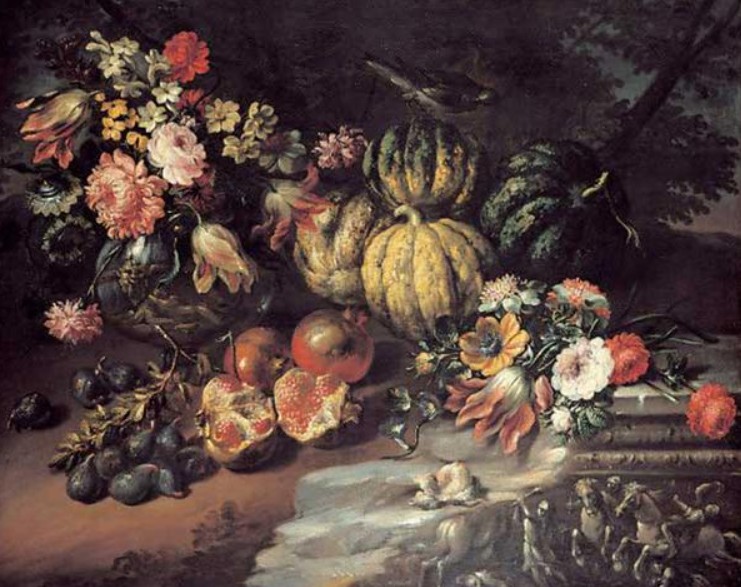
Un’altra opera da conoscere è quella di Felice Boselli, pittore nato a Piacenza nel 1650 e morto a Parma nel 1732.
Nella sua Natura morta con zucche, melagrane, fichi e fiori, databile intorno al 1700, l’artista riunisce diversi prodotti della natura in una composizione ricca di colori e forme.
La zucca dialoga con gli altri frutti, mentre melagrane e fichi contribuiscono a creare un insieme nel quale l’abbondanza della natura diventa il vero soggetto del dipinto.
L’opera, realizzata a olio su tela, è conservata al Museo Glauco Lombardi.
Henri Matisse, La Grande zucca (circa 1916)
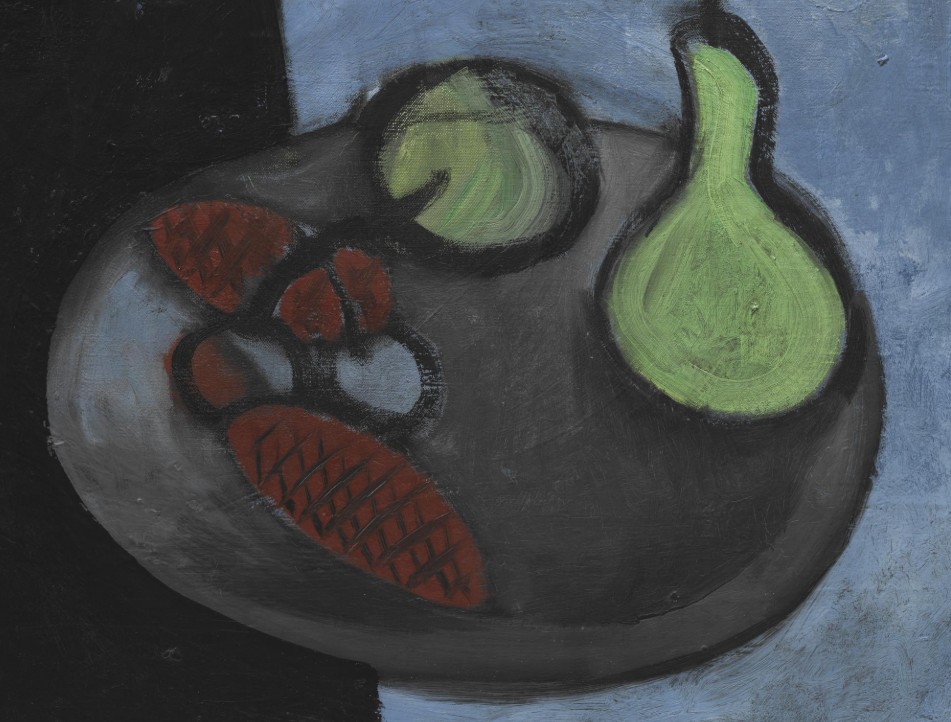
Facciamo un salto in avanti nel tempo per incontrare Henri Matisse, uno dei grandi protagonisti dell’arte del Novecento.
Intorno al 1916 dipinse The Green Pumpkin, ovvero La zucca verde, un’opera nella quale il soggetto viene interpretato attraverso una sensibilità molto diversa da quella dei pittori delle nature morte tradizionali.
Qui la zucca non è importante soltanto per la sua somiglianza con il modello reale. Diventa soprattutto una forma, un elemento di equilibrio all’interno della composizione, un’occasione per studiare i rapporti tra colori, luce e superfici.
Matisse era interessato alla costruzione dell’immagine e alla forza espressiva del colore. La zucca intera entra così in un gioco di forme e contorni che restituisce una visione personale e moderna della natura.
L’opera fa parte delle collezioni del RISD Museum.
Walt Kuhn, Pumpkins (1941)
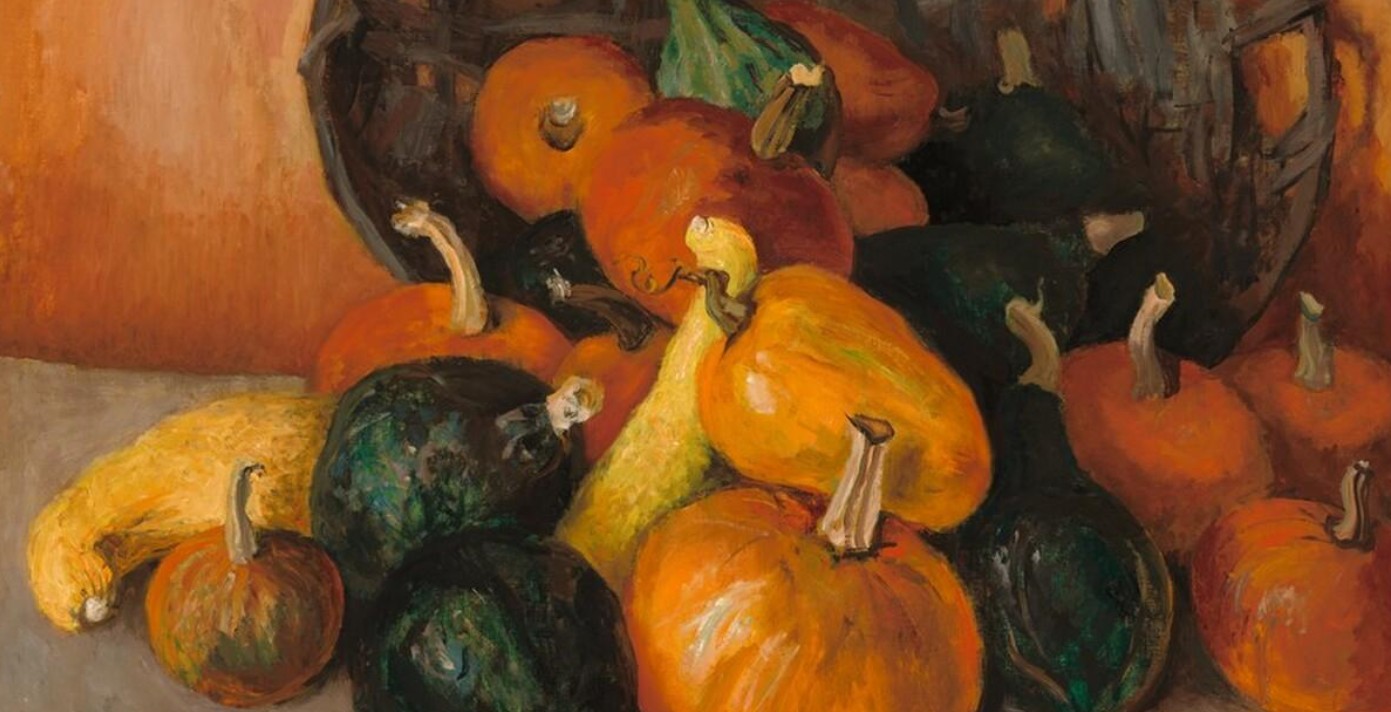
Nel 1941 il pittore americano Walt Kuhn realizzò Pumpkins, una grande natura morta dedicata a diverse varietà di zucche e squash.
Il dipinto nacque durante un soggiorno dell’artista nella sua casa di campagna sul lago Buel, nel Massachusetts, nei primi giorni dell’autunno.
Le zucche sono disposte davanti a un cesto e sembrano quasi sul punto di scivolare verso chi osserva. L’artista costruisce una composizione dinamica, nella quale gli ortaggi si distinguono per le loro forme arrotondate, i colori arancioni, verdi e gialli e le diverse texture della buccia.
Un dettaglio interessante riguarda il rapporto personale che Kuhn instaurò con questo soggetto: nelle lettere alla moglie raccontò che i due dipinti dedicati alle zucche gli avevano restituito parte della sua energia creativa.
L’opera è conservata alla National Gallery of Art ed è considerata una delle nature morte più importanti dell’ultima fase della sua carriera.
Loïs Mailou Jones, Cauliflower and Pumpkin (1938)
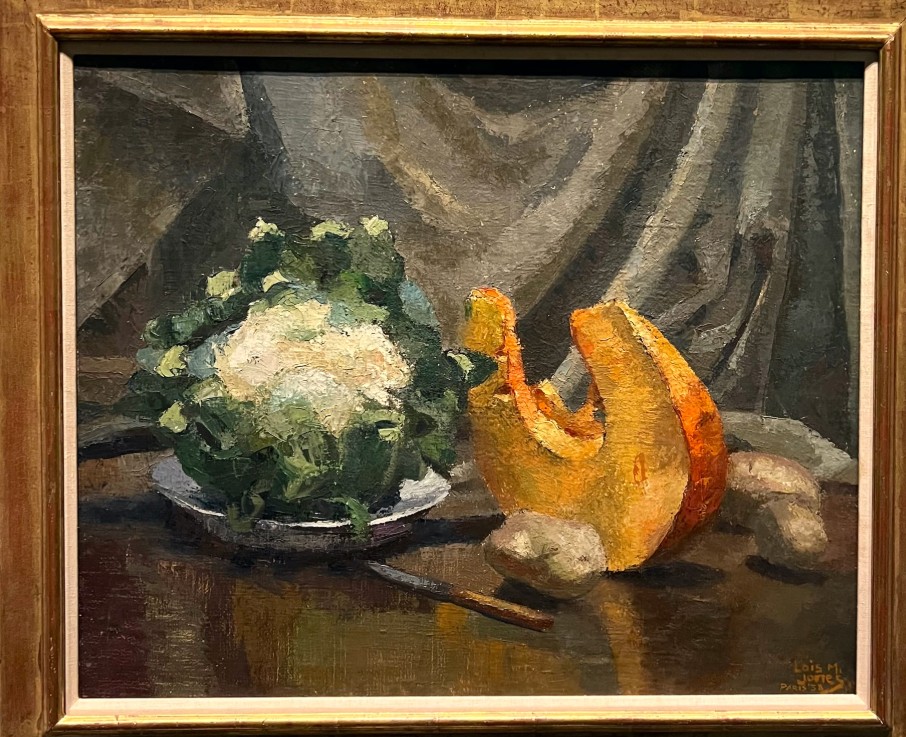
Anche Loïs Mailou Jones, artista americana nata nel 1905, ha dedicato una composizione alla zucca.
La sua opera Cauliflower and Pumpkin, realizzata nel 1938, mette insieme un cavolfiore, una zucca, patate, un coltello e un tessuto.
Si tratta di una natura morta apparentemente semplice, nella quale gli oggetti quotidiani diventano un’occasione per sperimentare con il colore e la costruzione dei volumi.
Jones aveva studiato a Parigi e aveva approfondito la pittura di Paul Cézanne. Questa esperienza si riconosce nella composizione, nella quale le forme vengono costruite attraverso piani cromatici e pennellate decise.
La superficie della zucca, liscia e arrotondata, si distingue dagli altri elementi della scena.
Il dipinto è datato 1938 ed è conservato al Metropolitan Museum of Art.
Rufino Tamayo, Still Life with Pumpkin and Sugar Canes (1931)
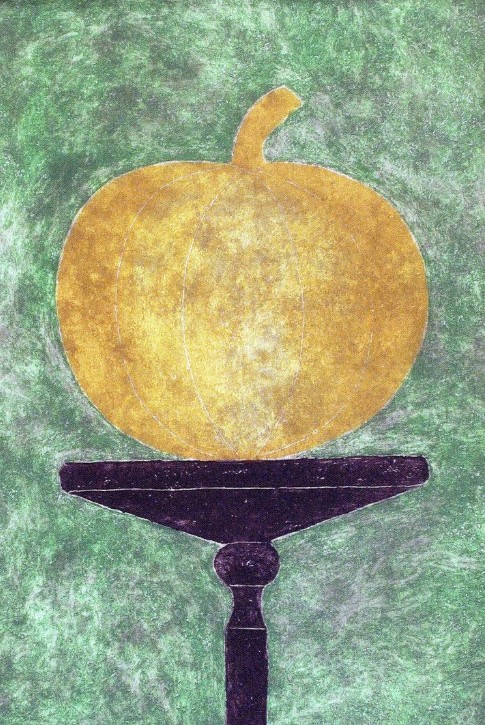
Chiudiamo questo viaggio con Rufino Tamayo, pittore messicano nato nel 1899 e morto nel 1991.
Nel 1931 realizzò Still Life with Pumpkin and Sugar Canes, una natura morta nella quale la zucca viene accostata a canne da zucchero e ad altri elementi.
Il dipinto si distingue per una tavolozza intensa e per una composizione nella quale gli oggetti sembrano emergere dal fondo scuro. La zucca assume una presenza cromatica molto forte, contribuendo a costruire l’equilibrio visivo dell’intera scena.
Tamayo, che seppe unire suggestioni della cultura messicana e linguaggi moderni, dimostra ancora una volta quanto un soggetto quotidiano possa offrire possibilità espressive molto diverse.
L’opera è conservata al Los Angeles County Museum of Art.
Le zucche simbolo dell’autunno
Molto prima che Halloween diventasse una festa popolare, la zucca era già un soggetto apprezzato dai pittori.
Nelle nature morte del Seicento e del Settecento rappresentava soprattutto l’abbondanza della terra, la ricchezza dei raccolti e la varietà del mondo naturale. Per gli artisti era anche un soggetto particolarmente interessante dal punto di vista pittorico: la buccia irregolare, le forme talvolta bizzarre, le variazioni cromatiche e i contrasti tra arancione, verde e giallo offrivano numerose possibilità.
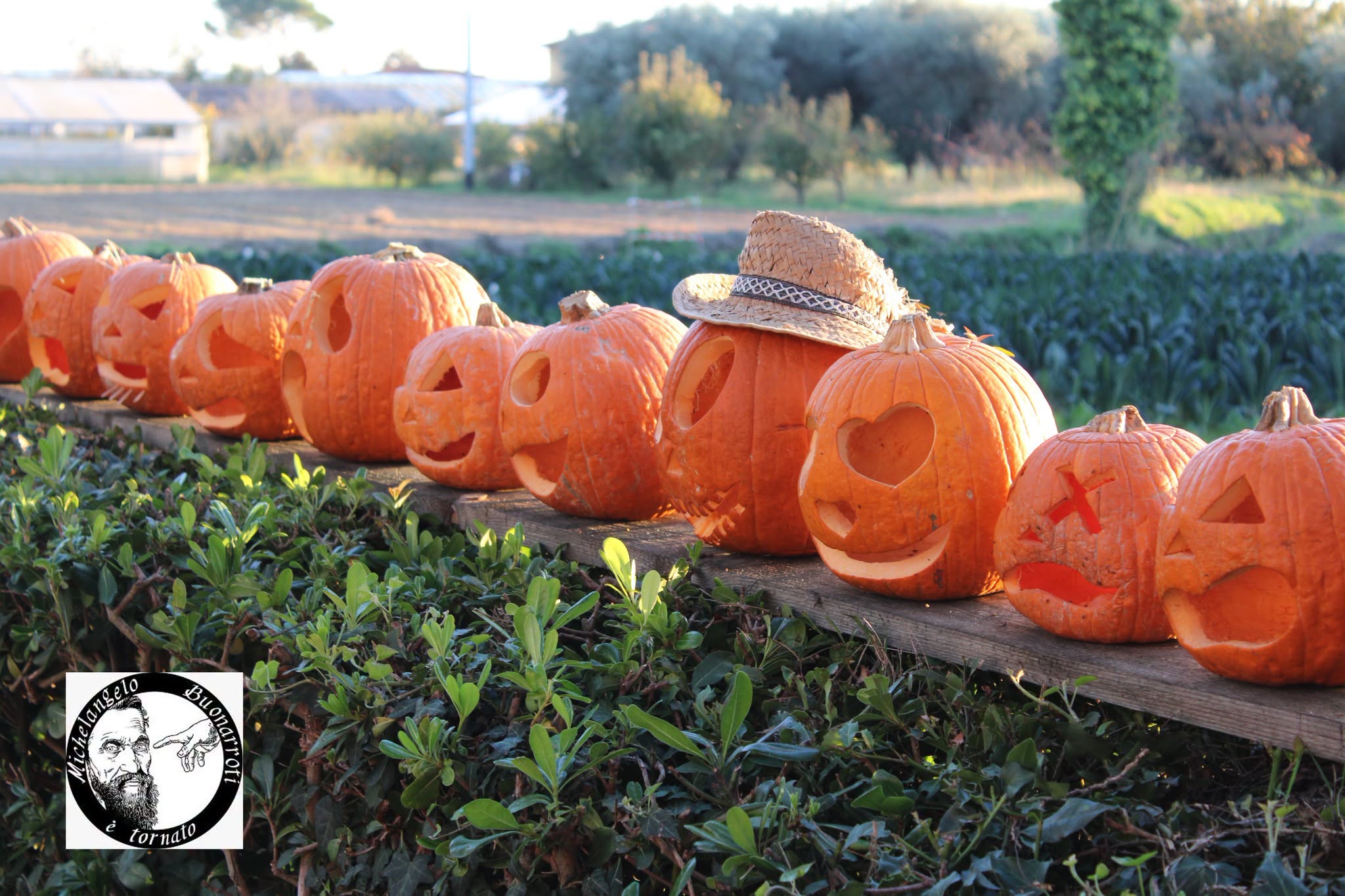
Con il passare dei secoli, la zucca ha continuato a comparire nelle composizioni artistiche, assumendo significati e interpretazioni differenti.
Oggi la associamo immediatamente ad Halloween, alle lanterne illuminate e alle decorazioni del 31 ottobre.
Per il momento il sempre vostro Michelangelo Buonarroti vi saluta dandovi appuntamento ai prossimi post e sui social.

Pumpkins in Art: The Most Beautiful Paintings Where They Take Center Stage, in Anticipation of Halloween
October 31st is the day when pumpkins become the undisputed queens of Halloween. We see them illuminated from within, carved into monstrous faces, placed in front of doorways, and used to decorate homes and gardens. But have you ever wondered how often this vegetable—with its distinctive shape and unmistakable color—has appeared throughout the history of art?
Pumpkins in paintings have a history that stretches far beyond their association with Halloween. For centuries, they have appeared in still lifes, market scenes, and depictions of everyday life. Sometimes they serve as simple elements within a composition; at other times, they become the true protagonists of the canvas, thanks to their generous forms, shades of orange and green, and the texture of their rinds.
Both Italian and international painters have observed and depicted them with great care, transforming a product of the earth into a subject capable of telling stories about the seasons, abundance, sustenance, and tradition.
In the spirit of Halloween, let us take a journey through art history to discover works in which the pumpkin takes center stage—proving that even an ostensibly ordinary vegetable can become the star of a great painting.
Bartolomeo Bimbi, The Giant Pumpkin from the Grand Ducal Garden (1711)
Let us begin with a truly curious Tuscan painting, in which a pumpkin takes center stage.
Bartolomeo Bimbi—a painter born in Settignano in 1648 and highly regarded at the Medici court—dedicated his work to depicting fruits, flowers, animals, and natural curiosities. His paintings also served a documentary purpose, preserving a record of the most extraordinary produce grown in the Grand Ducal gardens.
In 1711, he painted a large pumpkin that had grown in the Grand Ducal garden of San Francesco in Pisa. The vegetable is depicted in the foreground, set against a landscape background—as if it were an exceptional specimen worthy of an official portrait.
An inscription notes the pumpkin’s origin and its weight: approximately 18 Tuscan pounds, equivalent to over 6 kilograms. The painting is held in the collections of the Natural History Museum of the University of Florence.
Jan Anton van der Baren, Still Life with Pumpkins (1657)
Among the most compelling works dedicated to this vegetable is the Still Life with Pumpkins by the Flemish painter Jan Anton van der Baren, dated 1657.
The canvas, housed at the Kunsthistorisches Museum, features a composition in which pumpkins take center stage. Their varied shapes and sizes contrast with the other elements in the scene, resulting in a work rich in detail.
It serves as a significant example of how 17th-century still-life painting could transform produce from the earth into subjects of great visual interest. The precision in depicting these objects, combined with a keen attention to their natural characteristics, is a hallmark of this artistic tradition.
Marco Antonio Rizzi, Still Life with Pumpkins
Italian painting from the 17th and late 17th centuries also offers noteworthy examples of pumpkins appearing in still-life compositions.
One such instance is a large canvas titled Still Life with Pumpkins, attributed to the painter Marco Antonio Rizzi (1648–1723).
Executed in oil on canvas, the work measures 202 × 147 centimeters and is held at the Accademia di Belle Arti di Brera in Milan.
The composition belongs to a pictorial tradition that accorded great importance to natural elements, depicting fruits and vegetables with a careful focus on their specific forms and features.
The attribution history of this painting is particularly interesting: in the past, it was associated with other artists—including Simone del Tintore—before being attributed to Rizzi during the course of scholarly research into Italian still-life painting. Felice Boselli, Still Life with Pumpkins, Pomegranates, Figs, and Flowers (c. 1700)
Another work worth noting is by Felice Boselli, a painter born in Piacenza in 1650 who died in Parma in 1732.
In his Still Life with Pumpkins, Pomegranates, Figs, and Flowers—which can be dated to around 1700—the artist brings together various natural products in a composition rich in color and form.
The pumpkin engages with the other fruits, while the pomegranates and figs help create a whole in which the abundance of nature becomes the true subject of the painting.
The work, executed in oil on canvas, is housed at the Museo Glauco Lombardi.
Henri Matisse, The Large Pumpkin (c. 1916)
Let us leap forward in time to encounter Henri Matisse, one of the great figures of 20th-century art.
Around 1916, he painted The Green Pumpkin—a work in which the subject is interpreted through a sensibility quite distinct from that of traditional still-life painters.
Here, the pumpkin is significant not merely for its resemblance to the actual object; it functions primarily as a form—an element of balance within the composition—and as an opportunity to explore the relationships between color, light, and surface.
Matisse was deeply interested in the construction of an image and the expressive power of color. The pumpkin thus becomes part of an interplay of shapes and contours, offering a personal, modern vision of nature.
This work is part of the collection at the RISD Museum.
Walt Kuhn, Pumpkins (1941)
In 1941, the American painter Walt Kuhn created Pumpkins, a large-scale still life featuring various types of pumpkins and squash.
The painting was conceived during the artist’s stay at his country home by Lake Buel, in Massachusetts, in the early days of autumn.
Arranged in front of a basket, the pumpkins appear almost as if they might slide toward the viewer. Kuhn constructs a dynamic composition in which the vegetables stand out through their rounded forms, their hues of orange, green, and yellow, and the varied textures of their rinds.
An intriguing detail concerns the personal connection Kuhn forged with this subject: in letters to his wife, he recounted that the two paintings he created of pumpkins helped restore some of his creative energy.
The work is held by the National Gallery of Art and is considered one of the most significant still-life paintings from the final phase of his career.
Loïs Mailou Jones, Cauliflower and Pumpkin (1938)
Loïs Mailou Jones, an American artist born in 1905, also dedicated a composition to the pumpkin.
Her work Cauliflower and Pumpkin, created in 1938, brings together a cauliflower, a pumpkin, potatoes, a knife, and a piece of fabric.
It is an ostensibly simple still life, in which everyday objects become an opportunity to experiment with color and the construction of volume.
Jones had studied in Paris, where she delved into the painting of Paul Cézanne. This influence is evident in the composition, in which forms are built through planes of color and bold brushstrokes.
The surface of the pumpkin—smooth and rounded—stands out from the other elements in the scene.
The painting is dated 1938 and is held in the collection of the Metropolitan Museum of Art.
Rufino Tamayo, Still Life with Pumpkin and Sugar Canes (1931)
We conclude this journey with Rufino Tamayo, a Mexican painter who lived from 1899 to 1991.
In 1931, he created Still Life with Pumpkin and Sugar Canes, a still life in which a pumpkin is placed alongside sugarcane stalks and other elements.
The painting is notable for its intense palette and a composition in which the objects seem to emerge from a dark background. The pumpkin asserts a powerful chromatic presence, helping to establish the visual balance of the entire scene.
Tamayo—who skillfully blended influences from Mexican culture with modern artistic languages—demonstrates once again how an everyday subject can offer a wide range of expressive possibilities. The work is housed at the Los Angeles County Museum of Art.
Pumpkins: A Symbol of Autumn
Long before Halloween became a popular holiday, the pumpkin was already a subject favored by painters.
In the still lifes of the 17th and 18th centuries, it primarily represented the bounty of the earth, the richness of the harvest, and the diversity of the natural world. For artists, it was also a particularly compelling subject from a painterly perspective: its irregular skin, sometimes bizarre shapes, color variations, and the contrasts between orange, green, and yellow offered a wealth of possibilities.
Over the centuries, the pumpkin has continued to appear in artistic compositions, taking on various meanings and interpretations.
Today, we immediately associate it with Halloween, illuminated jack-o’-lanterns, and decorations for October 31st.
For now, yours truly, Michelangelo Buonarroti, bids you farewell—until the next posts and over on social media.

Sostienici – Support Us
Se questo blog ti piace e ti appassiona, puoi aiutarci a farlo crescere sempre più sostenendoci in modo concreto condividendo i post, seguendo le pagine social e con un contributo che ci aiuta ad andare avanti con il nostro lavoro di divulgazione. . ENGLISH: If you like and are passionate about this blog, you can help us make it grow more and more by supporting us in a concrete way by sharing posts, following social pages and with a contribution that helps us to move forward with our dissemination work.
10,00 €

Condividi:


Questo sono io





sostienici

Sostienici - Support Us
Se questo blog ti piace e ti appassiona, puoi aiutarci a farlo crescere sempre più sostenendoci in modo concreto condividendo i post, seguendo le pagine social e con un contributo che ci aiuta ad andare avanti con il nostro lavoro di divulgazione. . ENGLISH: If you like and are passionate about this blog, you can help us make it grow more and more by supporting us in a concrete way by sharing posts, following social pages and with a contribution that helps us to move forward with our dissemination work.
€10,00


